QUESTION IMAGE
Question
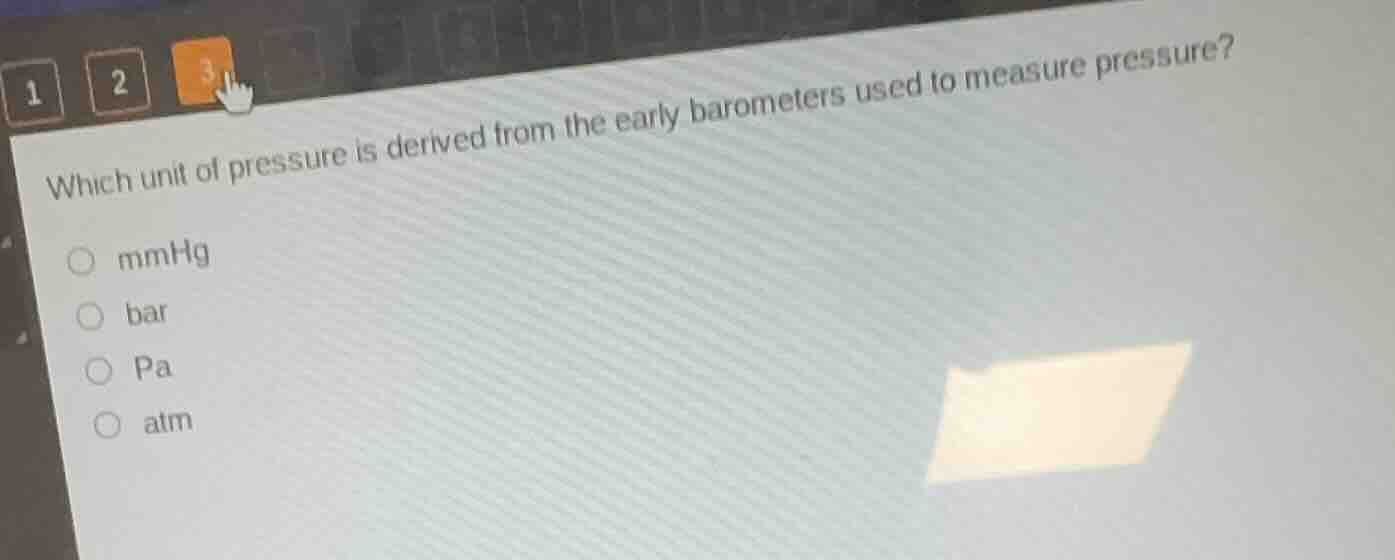
which unit of pressure is derived from the early barometers used to measure pressure?
- mmhg
- bar
- pa
- atm
Analyze the origin of early barometers
Early barometers, invented by Evangelista Torricelli, used a column of liquid mercury (\(\text{Hg}\)) in a glass tube to measure atmospheric pressure.
Relate the measurement to pressure units
The height of the mercury column, measured in millimeters (\(\text{mm}\)), directly corresponds to the pressure exerted by the atmosphere, giving rise to the unit millimeters of mercury (\(\text{mmHg}\)).
Evaluate the given options
- \(\text{mmHg}\): Directly derived from the height of mercury in early barometers.
- \(\text{bar}\): Metric unit defined as \(10^5\text{ Pa}\), not directly derived from early physical barometers.
- \(\text{Pa}\): SI unit (Pascal) defined as one newton per square meter.
- \(\text{atm}\): Standard atmosphere, defined based on average atmospheric pressure at sea level.

Snap & solve any problem in the app
Get step-by-step solutions on Sovi AI
Photo-based solutions with guided steps
Explore more problems and detailed explanations
- (A) mmHg (Correct answer)
- (B) bar
- (C) Pa
- (D) atm