QUESTION IMAGE
Question
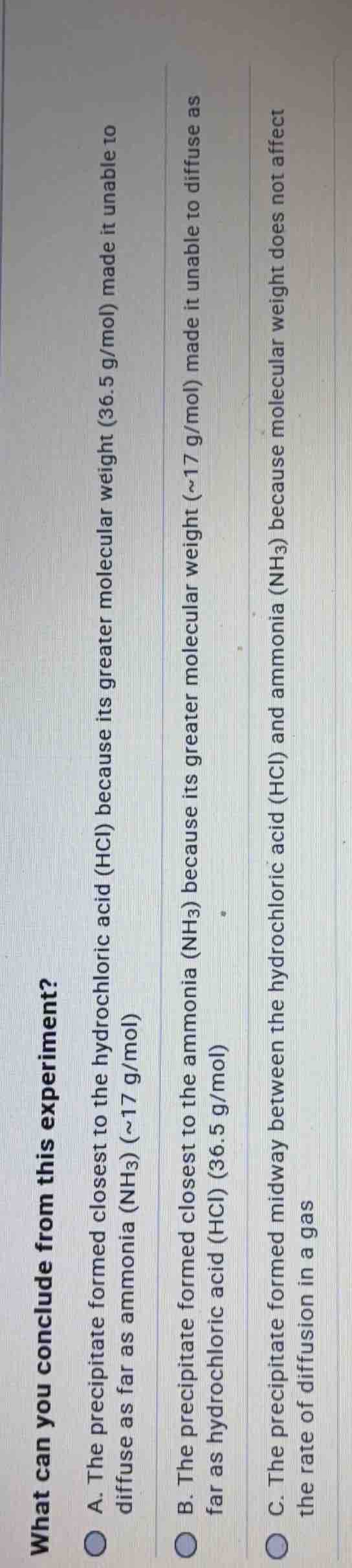
what can you conclude from this experiment?
a. the precipitate formed closest to the hydrochloric acid (hcl) because its greater molecular weight (36.5 g/mol) made it unable to diffuse as far as ammonia (\text{nh}_3) (\sim 17 g/mol)
b. the precipitate formed closest to the ammonia (\text{nh}_3) because its greater molecular weight (\sim 17 g/mol) made it unable to diffuse as far as hydrochloric acid (hcl) (36.5 g/mol)
c. the precipitate formed midway between the hydrochloric acid (hcl) and ammonia (\text{nh}_3) because molecular weight does not affect the rate of diffusion in a gas
Analyze the experimental setup
Using the Gas Diffusion Experiment knowledge point
The question asks for a conclusion from a classic laboratory experiment involving the diffusion of hydrochloric acid (\(\text{HCl}\)) gas and ammonia (\(\text{NH}_3\)) gas inside a glass tube. When these two gases meet, they react to form a white solid precipitate of ammonium chloride (\(\text{NH}_4\text{Cl}\)):
Apply Graham's Law of Effusion
Using the Grahams Law of Effusion knowledge point
According to Graham's Law, the rate of diffusion of a gas is inversely proportional to the square root of its molar mass:
- Molar mass of \(\text{NH}_3 \approx 17\text{ g/mol}\) (lighter, so it diffuses faster and farther).
- Molar mass of \(\text{HCl} \approx 36.5\text{ g/mol}\) (heavier, so it diffuses slower and a shorter distance).
Because \(\text{HCl}\) is heavier and diffuses more slowly, the meeting point (where the white precipitate forms) will be closer to the source of the \(\text{HCl}\) gas.
Evaluate the given options
Using the Gas Diffusion Experiment knowledge point
- Option A states: "The precipitate formed closest to the hydrochloric acid (\(\text{HCl}\)) because its greater molecular weight (\(36.5\text{ g/mol}\)) made it unable to diffuse as far as ammonia (\(\text{NH}_3\)) (\(\sim 17\text{ g/mol}\))". This matches our physical principles.
- Option B incorrectly states that the precipitate forms closest to the ammonia due to its greater molecular weight, which is factually incorrect since ammonia is lighter.
- Option C incorrectly states that the precipitate forms midway because molecular weight does not affect the rate of diffusion.

Snap & solve any problem in the app
Get step-by-step solutions on Sovi AI
Photo-based solutions with guided steps
Explore more problems and detailed explanations
- (A) The precipitate formed closest to the hydrochloric acid (HCl) because its greater molecular weight (36.5 g/mol) made it unable to diffuse as far as ammonia (\(\text{NH}_3\)) (\(\sim 17\) g/mol) (Correct answer)
- (B) The precipitate formed closest to the ammonia (\(\text{NH}_3\)) because its greater molecular weight (\(\sim 17\) g/mol) made it unable to diffuse as far as hydrochloric acid (HCl) (36.5 g/mol)
- (C) The precipitate formed midway between the hydrochloric acid (HCl) and ammonia (\(\text{NH}_3\)) because molecular weight does not affect the rate of diffusion in a gas