Sovi.AI - AI Math Tutor

Scan to solve math questions

QUESTION IMAGE

which unit of pressure is derived from the early barometers used to mea…

Question

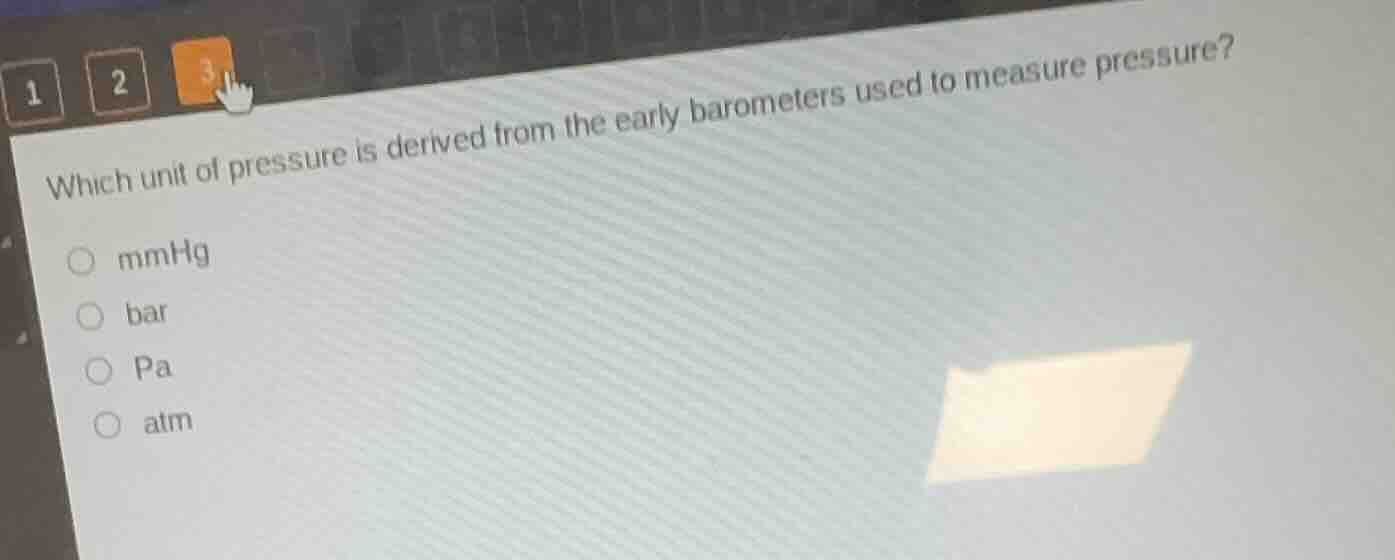
which unit of pressure is derived from the early barometers used to measure pressure?

  • mmhg
  • bar
  • pa
  • atm

Explanation:

Response

<pre_analysis>
{
"quality": "clear",
"question_count": 1,
"skills_matched": [
"direct_cot",
"multiple_choice_formatter",
"explain_then_answer",
"quick"
],
"needs_drawing": false,
"concepts_used": [
"Pressure Units"
],
"new_concepts": [
"History of Barometers",
"Mercury Barometer"
],
"current_concepts": [
"Pressure Units",
"History of Barometers",
"Mercury Barometer"
]
}
</pre_analysis>

<reasoning>

Analyze the origin of early barometers

Early barometers, invented by Evangelista Torricelli, used a column of liquid mercury (\(\text{Hg}\)) in a glass tube to measure atmospheric pressure.

Relate the measurement to pressure units

The height of the mercury column, measured in millimeters (\(\text{mm}\)), directly corresponds to the pressure exerted by the atmosphere, giving rise to the unit millimeters of mercury (\(\text{mmHg}\)).

Evaluate the given options

  • \(\text{mmHg}\): Directly derived from the height of mercury in early barometers.
  • \(\text{bar}\): Metric unit defined as \(10^5\text{ Pa}\), not directly derived from early physical barometers.
  • \(\text{Pa}\): SI unit (Pascal) defined as one newton per square meter.
  • \(\text{atm}\): Standard atmosphere, defined based on average atmospheric pressure at sea level.

</reasoning>

<answer>
<mcq-correct>(A) mmHg</mcq-correct>
<mcq-option>(B) bar</mcq-option>
<mcq-option>(C) Pa</mcq-option>
<mcq-option>(D) atm</mcq-option>
</answer>

<post_analysis>
{
"subject": "Natural Science",
"question_type": "Multiple Choice",
"knowledge_point": [
"Natural Science",
"Physics",
"Pressure Units"
]
}
</post_analysis>

Answer:

<pre_analysis>
{
"quality": "clear",
"question_count": 1,
"skills_matched": [
"direct_cot",
"multiple_choice_formatter",
"explain_then_answer",
"quick"
],
"needs_drawing": false,
"concepts_used": [
"Pressure Units"
],
"new_concepts": [
"History of Barometers",
"Mercury Barometer"
],
"current_concepts": [
"Pressure Units",
"History of Barometers",
"Mercury Barometer"
]
}
</pre_analysis>

<reasoning>

Analyze the origin of early barometers

Early barometers, invented by Evangelista Torricelli, used a column of liquid mercury (\(\text{Hg}\)) in a glass tube to measure atmospheric pressure.

Relate the measurement to pressure units

The height of the mercury column, measured in millimeters (\(\text{mm}\)), directly corresponds to the pressure exerted by the atmosphere, giving rise to the unit millimeters of mercury (\(\text{mmHg}\)).

Evaluate the given options

  • \(\text{mmHg}\): Directly derived from the height of mercury in early barometers.
  • \(\text{bar}\): Metric unit defined as \(10^5\text{ Pa}\), not directly derived from early physical barometers.
  • \(\text{Pa}\): SI unit (Pascal) defined as one newton per square meter.
  • \(\text{atm}\): Standard atmosphere, defined based on average atmospheric pressure at sea level.

</reasoning>

<answer>
<mcq-correct>(A) mmHg</mcq-correct>
<mcq-option>(B) bar</mcq-option>
<mcq-option>(C) Pa</mcq-option>
<mcq-option>(D) atm</mcq-option>
</answer>

<post_analysis>
{
"subject": "Natural Science",
"question_type": "Multiple Choice",
"knowledge_point": [
"Natural Science",
"Physics",
"Pressure Units"
]
}
</post_analysis>