Sovi.AI - AI Math Tutor

Scan to solve math questions

QUESTION IMAGE

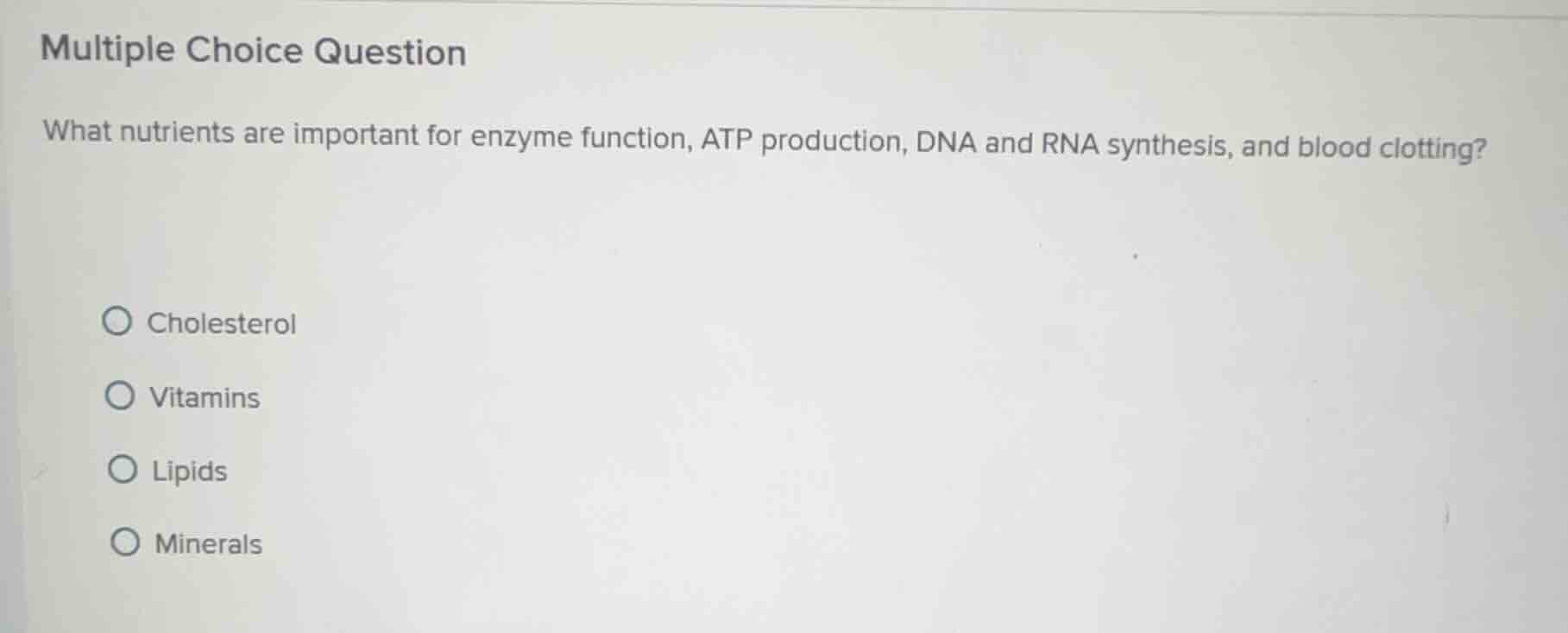
multiple choice question what nutrients are important for enzyme functi…

Question

multiple choice question

what nutrients are important for enzyme function, atp production, dna and rna synthesis, and blood clotting?

cholesterol
vitamins
lipids
minerals

Explanation:

Response

<pre_analysis>
{
"quality": "clear",
"question_count": 1,
"skills_matched": [
"direct_cot",
"multiple_choice_formatter",
"explain_then_answer",
"quick"
],
"needs_drawing": false,
"concepts_used": [
"Dietary Minerals"
],
"new_concepts": [],
"current_concepts": [
"Dietary Minerals",
"Essential Nutrients"
]
}
</pre_analysis>

<reasoning>

Analyze the physiological roles of the listed options

  • Cholesterol: Primarily used for cell membrane structure and steroid hormone synthesis.
  • Vitamins: Act mainly as organic coenzymes, but do not directly serve as structural components like phosphate in ATP/nucleic acids.
  • Lipids: Serve as energy storage, structural components of cell membranes, and signaling molecules.
  • Minerals: Inorganic elements including calcium (essential for blood clotting), phosphorus (essential for ATP, DNA, and RNA backbones), and magnesium/zinc (essential cofactors for enzyme function).

Match functions to the correct nutrient class

  • Enzyme function: Requires mineral cofactors (e.g., \(Mg^{2+}\), \(Zn^{2+}\)).
  • ATP production: Requires phosphorus (phosphate groups).
  • DNA and RNA synthesis: Requires phosphorus for the sugar-phosphate backbone.
  • Blood clotting: Requires calcium (\(Ca^{2+}\)).
  • Therefore, minerals are the essential nutrients for all these specified functions.

</reasoning>

<answer>
<mcq-option>Cholesterol</mcq-option>
<mcq-option>Vitamins</mcq-option>
<mcq-option>Lipids</mcq-option>
<mcq-correct>Minerals</mcq-correct>
</answer>

<post_analysis>
{
"subject": "Natural Science",
"question_type": "Multiple Choice",
"knowledge_point": [
"Natural Science",
"Biology",
"Dietary Minerals"
]
}
</post_analysis>

Answer:

<pre_analysis>
{
"quality": "clear",
"question_count": 1,
"skills_matched": [
"direct_cot",
"multiple_choice_formatter",
"explain_then_answer",
"quick"
],
"needs_drawing": false,
"concepts_used": [
"Dietary Minerals"
],
"new_concepts": [],
"current_concepts": [
"Dietary Minerals",
"Essential Nutrients"
]
}
</pre_analysis>

<reasoning>

Analyze the physiological roles of the listed options

  • Cholesterol: Primarily used for cell membrane structure and steroid hormone synthesis.
  • Vitamins: Act mainly as organic coenzymes, but do not directly serve as structural components like phosphate in ATP/nucleic acids.
  • Lipids: Serve as energy storage, structural components of cell membranes, and signaling molecules.
  • Minerals: Inorganic elements including calcium (essential for blood clotting), phosphorus (essential for ATP, DNA, and RNA backbones), and magnesium/zinc (essential cofactors for enzyme function).

Match functions to the correct nutrient class

  • Enzyme function: Requires mineral cofactors (e.g., \(Mg^{2+}\), \(Zn^{2+}\)).
  • ATP production: Requires phosphorus (phosphate groups).
  • DNA and RNA synthesis: Requires phosphorus for the sugar-phosphate backbone.
  • Blood clotting: Requires calcium (\(Ca^{2+}\)).
  • Therefore, minerals are the essential nutrients for all these specified functions.

</reasoning>

<answer>
<mcq-option>Cholesterol</mcq-option>
<mcq-option>Vitamins</mcq-option>
<mcq-option>Lipids</mcq-option>
<mcq-correct>Minerals</mcq-correct>
</answer>

<post_analysis>
{
"subject": "Natural Science",
"question_type": "Multiple Choice",
"knowledge_point": [
"Natural Science",
"Biology",
"Dietary Minerals"
]
}
</post_analysis>