QUESTION IMAGE
Question
multiple choice question
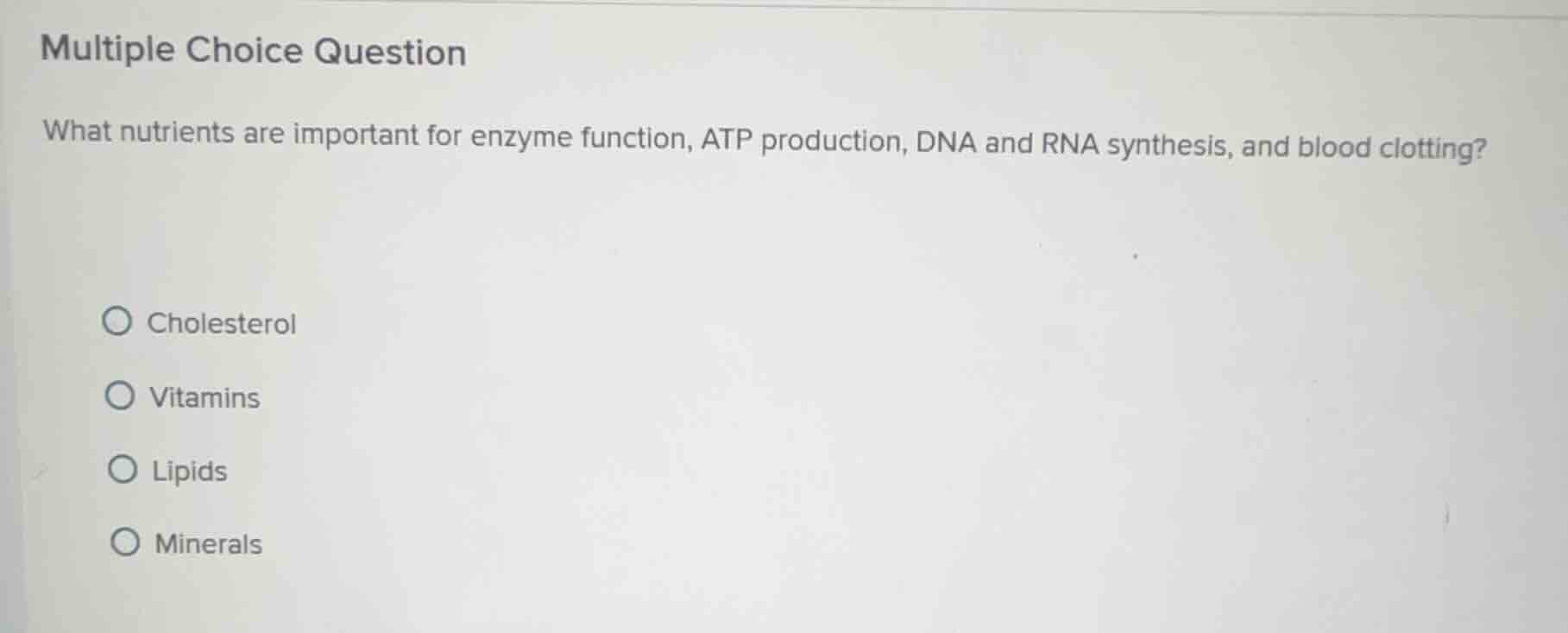
what nutrients are important for enzyme function, atp production, dna and rna synthesis, and blood clotting?
cholesterol
vitamins
lipids
minerals
<pre_analysis>
{
"quality": "clear",
"question_count": 1,
"skills_matched": [
"direct_cot",
"multiple_choice_formatter",
"explain_then_answer",
"quick"
],
"needs_drawing": false,
"concepts_used": [
"Dietary Minerals"
],
"new_concepts": [],
"current_concepts": [
"Dietary Minerals",
"Essential Nutrients"
]
}
</pre_analysis>
<reasoning>
Analyze the physiological roles of the listed options
- Cholesterol: Primarily used for cell membrane structure and steroid hormone synthesis.
- Vitamins: Act mainly as organic coenzymes, but do not directly serve as structural components like phosphate in ATP/nucleic acids.
- Lipids: Serve as energy storage, structural components of cell membranes, and signaling molecules.
- Minerals: Inorganic elements including calcium (essential for blood clotting), phosphorus (essential for ATP, DNA, and RNA backbones), and magnesium/zinc (essential cofactors for enzyme function).
Match functions to the correct nutrient class
- Enzyme function: Requires mineral cofactors (e.g., \(Mg^{2+}\), \(Zn^{2+}\)).
- ATP production: Requires phosphorus (phosphate groups).
- DNA and RNA synthesis: Requires phosphorus for the sugar-phosphate backbone.
- Blood clotting: Requires calcium (\(Ca^{2+}\)).
- Therefore, minerals are the essential nutrients for all these specified functions.
</reasoning>
<answer>
<mcq-option>Cholesterol</mcq-option>
<mcq-option>Vitamins</mcq-option>
<mcq-option>Lipids</mcq-option>
<mcq-correct>Minerals</mcq-correct>
</answer>
<post_analysis>
{
"subject": "Natural Science",
"question_type": "Multiple Choice",
"knowledge_point": [
"Natural Science",
"Biology",
"Dietary Minerals"
]
}
</post_analysis>
Snap & solve any problem in the app
Get step-by-step solutions on Sovi AI
Photo-based solutions with guided steps
Explore more problems and detailed explanations
<pre_analysis>
{
"quality": "clear",
"question_count": 1,
"skills_matched": [
"direct_cot",
"multiple_choice_formatter",
"explain_then_answer",
"quick"
],
"needs_drawing": false,
"concepts_used": [
"Dietary Minerals"
],
"new_concepts": [],
"current_concepts": [
"Dietary Minerals",
"Essential Nutrients"
]
}
</pre_analysis>
<reasoning>
Analyze the physiological roles of the listed options
- Cholesterol: Primarily used for cell membrane structure and steroid hormone synthesis.
- Vitamins: Act mainly as organic coenzymes, but do not directly serve as structural components like phosphate in ATP/nucleic acids.
- Lipids: Serve as energy storage, structural components of cell membranes, and signaling molecules.
- Minerals: Inorganic elements including calcium (essential for blood clotting), phosphorus (essential for ATP, DNA, and RNA backbones), and magnesium/zinc (essential cofactors for enzyme function).
Match functions to the correct nutrient class
- Enzyme function: Requires mineral cofactors (e.g., \(Mg^{2+}\), \(Zn^{2+}\)).
- ATP production: Requires phosphorus (phosphate groups).
- DNA and RNA synthesis: Requires phosphorus for the sugar-phosphate backbone.
- Blood clotting: Requires calcium (\(Ca^{2+}\)).
- Therefore, minerals are the essential nutrients for all these specified functions.
</reasoning>
<answer>
<mcq-option>Cholesterol</mcq-option>
<mcq-option>Vitamins</mcq-option>
<mcq-option>Lipids</mcq-option>
<mcq-correct>Minerals</mcq-correct>
</answer>
<post_analysis>
{
"subject": "Natural Science",
"question_type": "Multiple Choice",
"knowledge_point": [
"Natural Science",
"Biology",
"Dietary Minerals"
]
}
</post_analysis>