Sovi.AI - AI Math Tutor

Scan to solve math questions

QUESTION IMAGE

vernon is using the diagram shown below to develop a model of photosynt…

Question

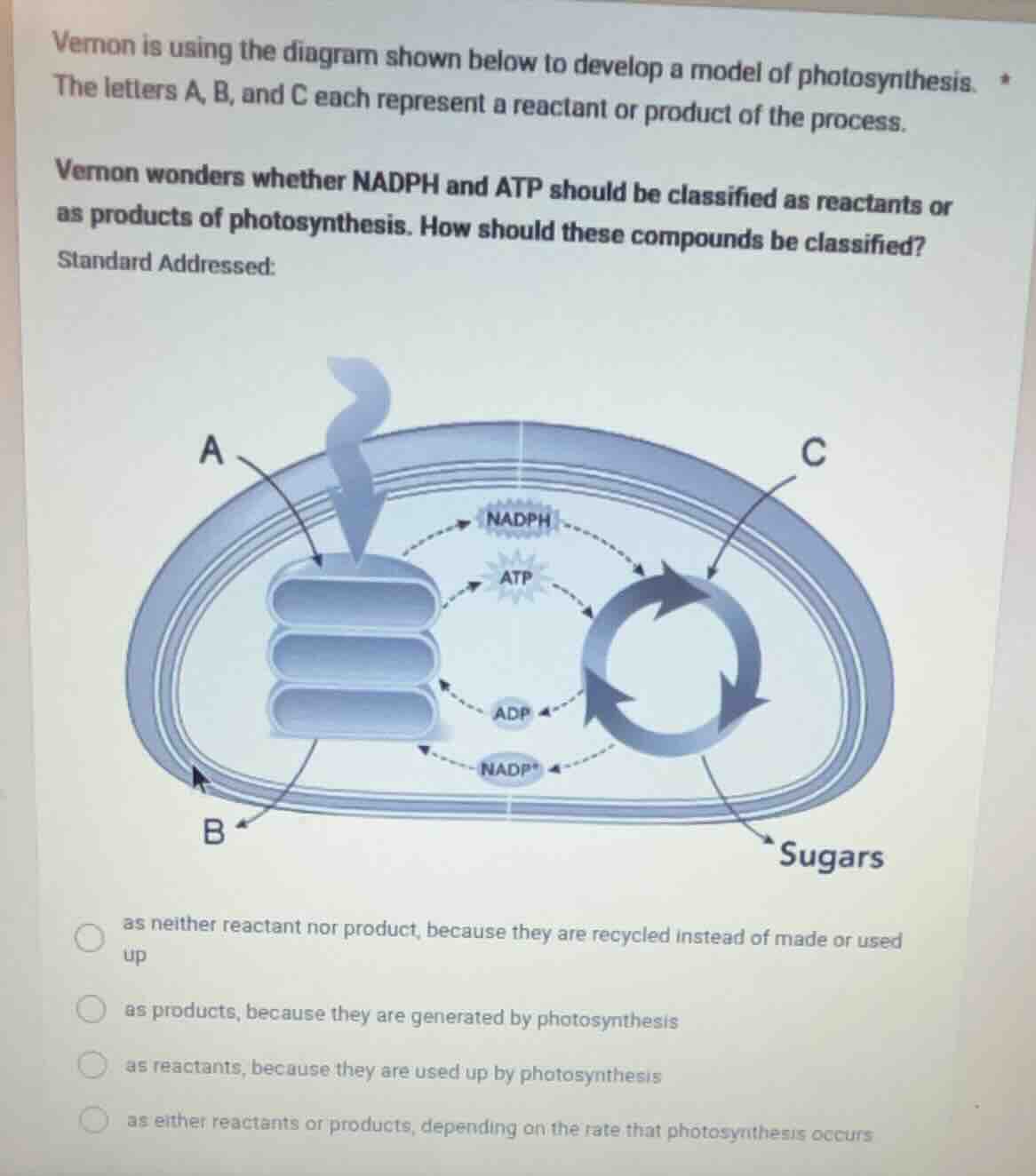
vernon is using the diagram shown below to develop a model of photosynthesis.
the letters a, b, and c each represent a reactant or product of the process.

vernon wonders whether nadph and atp should be classified as reactants or as products of photosynthesis. how should these compounds be classified?
standard addressed:

as neither reactant nor product, because they are recycled instead of made or used up
as products, because they are generated by photosynthesis
as reactants, because they are used up by photosynthesis
as either reactants or products, depending on the rate that photosynthesis occurs

Explanation:

Response

<pre_analysis>
{
"quality": "clear",
"question_count": 1,
"skills_matched": [
"direct_cot",
"multiple_choice_formatter",
"explain_then_answer",
"tutor"
],
"needs_drawing": false,
"concepts_used": [
"Photosynthesis Reactions"
],
"new_concepts": [
"Intermediate Energy Carriers"
],
"current_concepts": [
"Photosynthesis Reactions",
"Intermediate Energy Carriers"
]
}
</pre_analysis>

<reasoning>

Analyze the role of NADPH and ATP

Using the Photosynthesis Reactions knowledge point, we examine the diagram of the chloroplast. The light-dependent reactions occur in the thylakoids (A), producing \( \text{NADPH} \) and \( \text{ATP} \). These molecules then carry chemical energy to the Calvin cycle (C) in the stroma, where they are consumed to produce sugars.

Determine reactant or product status

During the Calvin cycle, \( \text{NADPH} \) and \( \text{ATP} \) are converted back into \( \text{NADP}^+ \) and \( \text{ADP} \). These depleted carriers return to the thylakoids to be re-energized. Because these molecules are continuously cycled and regenerated within the chloroplast rather than being net inputs (reactants like water and carbon dioxide) or net outputs (products like oxygen and sugars) of the overall process, they are classified as intermediates.

Match with the correct option

Since they are recycled internally, they are neither reactants nor products of the overall photosynthesis equation. This matches the first option: "as neither reactant nor product, because they are recycled instead of made or used up".
</reasoning>

<answer>
<mcq-correct>as neither reactant nor product, because they are recycled instead of made or used up</mcq-correct>
<mcq-option>as products, because they are generated by photosynthesis</mcq-option>
<mcq-option>as reactants, because they are used up by photosynthesis</mcq-option>
<mcq-option>as either reactants or products, depending on the rate that photosynthesis occurs</mcq-option>
</answer>

<post_analysis>
{
"subject": "Natural Science",
"question_type": "Multiple Choice",
"knowledge_point": [
"Natural Science",
"Biology",
"Photosynthesis Reactions"
]
}
</post_analysis>

Answer:

<pre_analysis>
{
"quality": "clear",
"question_count": 1,
"skills_matched": [
"direct_cot",
"multiple_choice_formatter",
"explain_then_answer",
"tutor"
],
"needs_drawing": false,
"concepts_used": [
"Photosynthesis Reactions"
],
"new_concepts": [
"Intermediate Energy Carriers"
],
"current_concepts": [
"Photosynthesis Reactions",
"Intermediate Energy Carriers"
]
}
</pre_analysis>

<reasoning>

Analyze the role of NADPH and ATP

Using the Photosynthesis Reactions knowledge point, we examine the diagram of the chloroplast. The light-dependent reactions occur in the thylakoids (A), producing \( \text{NADPH} \) and \( \text{ATP} \). These molecules then carry chemical energy to the Calvin cycle (C) in the stroma, where they are consumed to produce sugars.

Determine reactant or product status

During the Calvin cycle, \( \text{NADPH} \) and \( \text{ATP} \) are converted back into \( \text{NADP}^+ \) and \( \text{ADP} \). These depleted carriers return to the thylakoids to be re-energized. Because these molecules are continuously cycled and regenerated within the chloroplast rather than being net inputs (reactants like water and carbon dioxide) or net outputs (products like oxygen and sugars) of the overall process, they are classified as intermediates.

Match with the correct option

Since they are recycled internally, they are neither reactants nor products of the overall photosynthesis equation. This matches the first option: "as neither reactant nor product, because they are recycled instead of made or used up".
</reasoning>

<answer>
<mcq-correct>as neither reactant nor product, because they are recycled instead of made or used up</mcq-correct>
<mcq-option>as products, because they are generated by photosynthesis</mcq-option>
<mcq-option>as reactants, because they are used up by photosynthesis</mcq-option>
<mcq-option>as either reactants or products, depending on the rate that photosynthesis occurs</mcq-option>
</answer>

<post_analysis>
{
"subject": "Natural Science",
"question_type": "Multiple Choice",
"knowledge_point": [
"Natural Science",
"Biology",
"Photosynthesis Reactions"
]
}
</post_analysis>