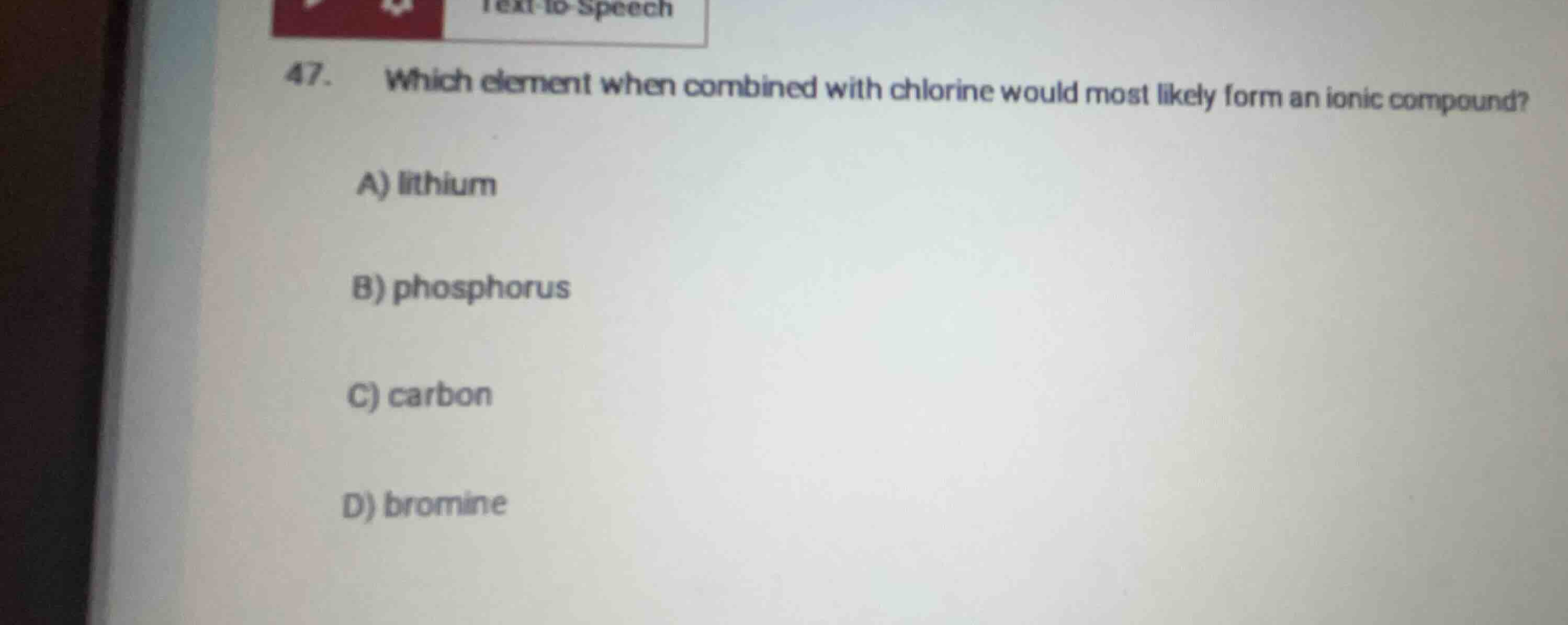
QUESTION IMAGE
Question
- which element when combined with chlorine would most likely form an ionic compound?
a) lithium
b) phosphorus
c) carbon
d) bromine
<pre_analysis>
{
"quality": "clear",
"question_count": 1,
"skills_matched": [
"direct_cot",
"multiple_choice_formatter",
"explain_then_answer",
"quick"
],
"needs_drawing": false,
"concepts_used": [
"Ionic Bonding",
"Metals and Nonmetals"
],
"new_concepts": [],
"current_concepts": [
"Ionic Bonding",
"Metals and Nonmetals"
]
}
</pre_analysis>
<reasoning>
Identify the nature of ionic bonding
An ionic compound typically forms between a metal (which loses electrons to form a cation) and a nonmetal (which gains electrons to form an anion). Chlorine is a nonmetal.
Classify the given options
- Lithium: Metal (Group 1 alkali metal)
- Phosphorus: Nonmetal (Group 15)
- Carbon: Nonmetal (Group 14)
- Bromine: Nonmetal (Group 17 halogen)
Determine the correct combination
Combining the metal lithium with the nonmetal chlorine results in the ionic compound lithium chloride (\(\text{LiCl}\)). The other options combine nonmetals with chlorine, forming covalent bonds.
</reasoning>
<answer>
<mcq-correct>(A) lithium</mcq-correct>
<mcq-option>(B) phosphorus</mcq-option>
<mcq-option>(C) carbon</mcq-option>
<mcq-option>(D) bromine</mcq-option>
</answer>
<post_analysis>
{
"subject": "Natural Science",
"question_type": "Multiple Choice",
"knowledge_point": [
"Natural Science",
"Chemistry",
"Ionic Bonding"
]
}
</post_analysis>
Snap & solve any problem in the app
Get step-by-step solutions on Sovi AI
Photo-based solutions with guided steps
Explore more problems and detailed explanations
<pre_analysis>
{
"quality": "clear",
"question_count": 1,
"skills_matched": [
"direct_cot",
"multiple_choice_formatter",
"explain_then_answer",
"quick"
],
"needs_drawing": false,
"concepts_used": [
"Ionic Bonding",
"Metals and Nonmetals"
],
"new_concepts": [],
"current_concepts": [
"Ionic Bonding",
"Metals and Nonmetals"
]
}
</pre_analysis>
<reasoning>
Identify the nature of ionic bonding
An ionic compound typically forms between a metal (which loses electrons to form a cation) and a nonmetal (which gains electrons to form an anion). Chlorine is a nonmetal.
Classify the given options
- Lithium: Metal (Group 1 alkali metal)
- Phosphorus: Nonmetal (Group 15)
- Carbon: Nonmetal (Group 14)
- Bromine: Nonmetal (Group 17 halogen)
Determine the correct combination
Combining the metal lithium with the nonmetal chlorine results in the ionic compound lithium chloride (\(\text{LiCl}\)). The other options combine nonmetals with chlorine, forming covalent bonds.
</reasoning>
<answer>
<mcq-correct>(A) lithium</mcq-correct>
<mcq-option>(B) phosphorus</mcq-option>
<mcq-option>(C) carbon</mcq-option>
<mcq-option>(D) bromine</mcq-option>
</answer>
<post_analysis>
{
"subject": "Natural Science",
"question_type": "Multiple Choice",
"knowledge_point": [
"Natural Science",
"Chemistry",
"Ionic Bonding"
]
}
</post_analysis>