Sovi.AI - AI Math Tutor

Scan to solve math questions

QUESTION IMAGE

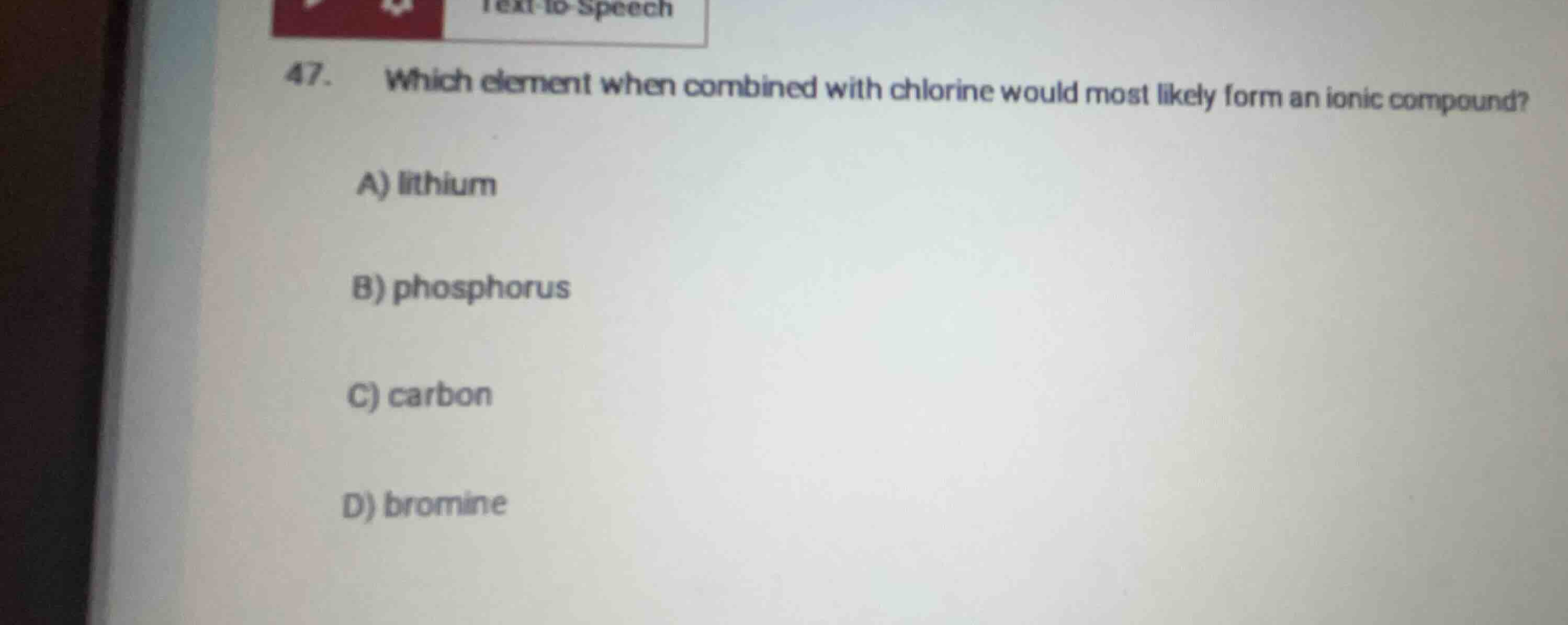
47. which element when combined with chlorine would most likely form an…

Question

  1. which element when combined with chlorine would most likely form an ionic compound?

a) lithium
b) phosphorus
c) carbon
d) bromine

Explanation:

Response

<pre_analysis>
{
"quality": "clear",
"question_count": 1,
"skills_matched": [
"direct_cot",
"multiple_choice_formatter",
"explain_then_answer",
"quick"
],
"needs_drawing": false,
"concepts_used": [
"Ionic Bonding",
"Metals and Nonmetals"
],
"new_concepts": [],
"current_concepts": [
"Ionic Bonding",
"Metals and Nonmetals"
]
}
</pre_analysis>

<reasoning>

Identify the nature of ionic bonding

An ionic compound typically forms between a metal (which loses electrons to form a cation) and a nonmetal (which gains electrons to form an anion). Chlorine is a nonmetal.

Classify the given options

  • Lithium: Metal (Group 1 alkali metal)
  • Phosphorus: Nonmetal (Group 15)
  • Carbon: Nonmetal (Group 14)
  • Bromine: Nonmetal (Group 17 halogen)

Determine the correct combination

Combining the metal lithium with the nonmetal chlorine results in the ionic compound lithium chloride (\(\text{LiCl}\)). The other options combine nonmetals with chlorine, forming covalent bonds.
</reasoning>

<answer>
<mcq-correct>(A) lithium</mcq-correct>
<mcq-option>(B) phosphorus</mcq-option>
<mcq-option>(C) carbon</mcq-option>
<mcq-option>(D) bromine</mcq-option>
</answer>

<post_analysis>
{
"subject": "Natural Science",
"question_type": "Multiple Choice",
"knowledge_point": [
"Natural Science",
"Chemistry",
"Ionic Bonding"
]
}
</post_analysis>

Answer:

<pre_analysis>
{
"quality": "clear",
"question_count": 1,
"skills_matched": [
"direct_cot",
"multiple_choice_formatter",
"explain_then_answer",
"quick"
],
"needs_drawing": false,
"concepts_used": [
"Ionic Bonding",
"Metals and Nonmetals"
],
"new_concepts": [],
"current_concepts": [
"Ionic Bonding",
"Metals and Nonmetals"
]
}
</pre_analysis>

<reasoning>

Identify the nature of ionic bonding

An ionic compound typically forms between a metal (which loses electrons to form a cation) and a nonmetal (which gains electrons to form an anion). Chlorine is a nonmetal.

Classify the given options

  • Lithium: Metal (Group 1 alkali metal)
  • Phosphorus: Nonmetal (Group 15)
  • Carbon: Nonmetal (Group 14)
  • Bromine: Nonmetal (Group 17 halogen)

Determine the correct combination

Combining the metal lithium with the nonmetal chlorine results in the ionic compound lithium chloride (\(\text{LiCl}\)). The other options combine nonmetals with chlorine, forming covalent bonds.
</reasoning>

<answer>
<mcq-correct>(A) lithium</mcq-correct>
<mcq-option>(B) phosphorus</mcq-option>
<mcq-option>(C) carbon</mcq-option>
<mcq-option>(D) bromine</mcq-option>
</answer>

<post_analysis>
{
"subject": "Natural Science",
"question_type": "Multiple Choice",
"knowledge_point": [
"Natural Science",
"Chemistry",
"Ionic Bonding"
]
}
</post_analysis>