Sovi.AI - AI Math Tutor

Scan to solve math questions

QUESTION IMAGE

which of the following statements describe the conditions of the \curre…

Question

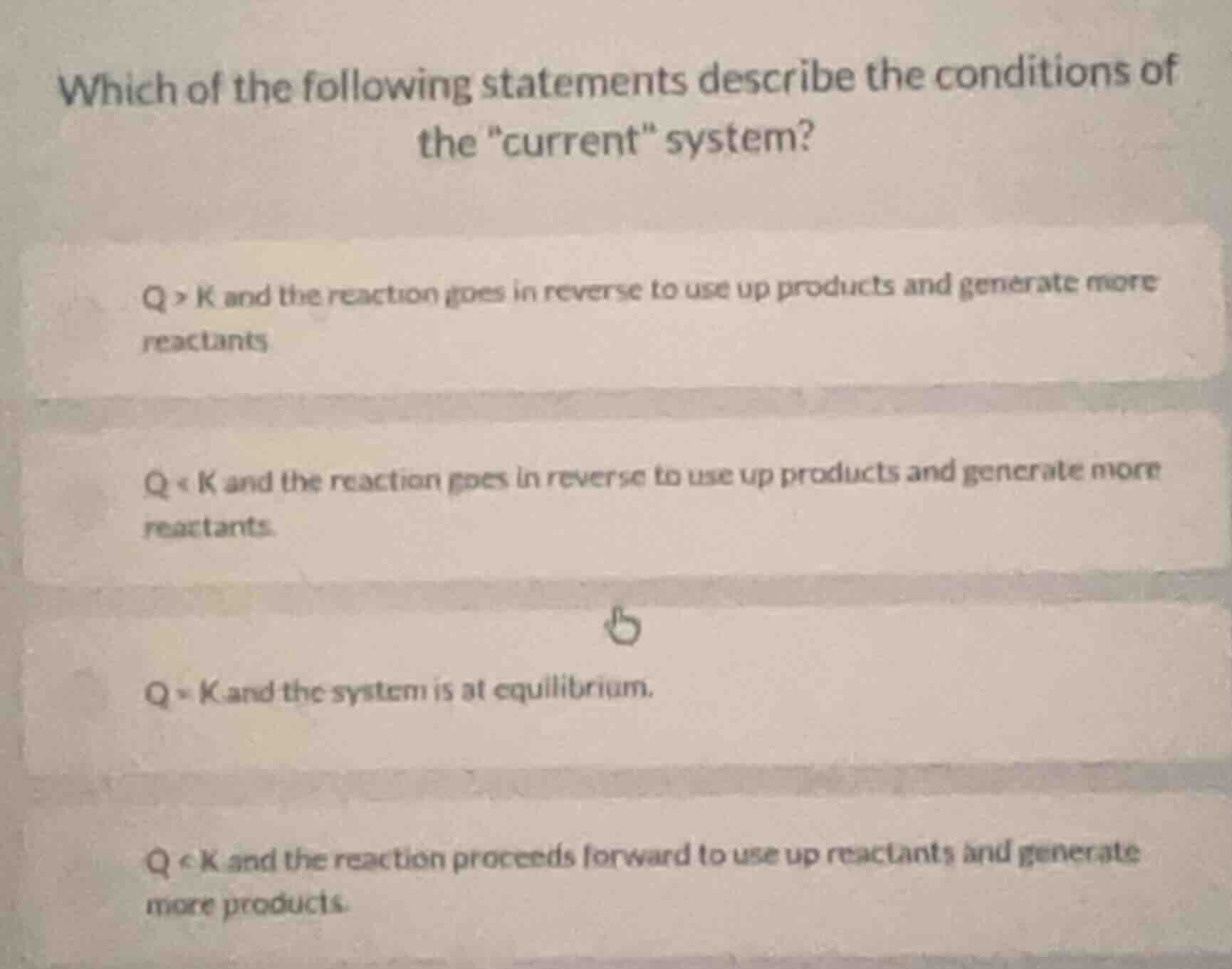
which of the following statements describe the conditions of the \current\ system?

\\(q > k\\) and the reaction goes in reverse to use up products and generate more reactants.

\\(q < k\\) and the reaction goes in reverse to use up products and generate more reactants.

\\(q = k\\) and the system is at equilibrium.

\\(q < k\\) and the reaction proceeds forward to use up reactants and generate more products.

Explanation:

Response

<pre_analysis>
{
"quality": "clear",
"question_count": 1,
"skills_matched": [
"direct_cot",
"multiple_choice_formatter",
"explain_then_answer",
"tutor",
"mastery_adaptive_brevity"
],
"needs_drawing": false,
"concepts_used": [
"Reaction Quotient",
"Chemical Equilibrium"
],
"new_concepts": [],
"current_concepts": [
"Reaction Quotient",
"Chemical Equilibrium"
]
}
</pre_analysis>

<reasoning>

Compare Q and K

Using the Reaction Quotient and Chemical Equilibrium knowledge points

  • When \(Q > K\), the concentration of products is higher than at equilibrium. To reach equilibrium, the system shifts in reverse (left) to consume products and produce more reactants.
  • When \(Q < K\), the concentration of reactants is higher than at equilibrium. The system shifts forward (right) to consume reactants and produce more products.
  • When \(Q = K\), the system is at equilibrium.

Identify the correct statement

Using the Reaction Quotient and Chemical Equilibrium knowledge points

  • The option stating "\(Q > K\) and the reaction goes in reverse to use up products and generate more reactants" is scientifically correct.
  • The option stating "\(Q < K\) and the reaction goes in reverse..." is incorrect because a system with \(Q < K\) shifts forward.
  • The option stating "\(Q = K\) and the system is at equilibrium" is a correct general statement, but the selected option in the image (indicated by the radio button marker) is the first option: "\(Q > K\) and the reaction goes in reverse to use up products and generate more reactants".

</reasoning>

<answer>
<mcq-correct>(A) Q &gt; K and the reaction goes in reverse to use up products and generate more reactants</mcq-correct>
<mcq-option>(B) Q &lt; K and the reaction goes in reverse to use up products and generate more reactants</mcq-option>
<mcq-option>(C) Q = K and the system is at equilibrium.</mcq-option>
<mcq-option>(D) Q &lt; K and the reaction proceeds forward to use up reactants and generate more products</mcq-option>
</answer>

<post_analysis>
{
"subject": "Natural Science",
"question_type": "Multiple Choice",
"knowledge_point": [
"Natural Science",
"Chemistry",
"Reaction Quotient"
]
}
</post_analysis>

Answer:

<pre_analysis>
{
"quality": "clear",
"question_count": 1,
"skills_matched": [
"direct_cot",
"multiple_choice_formatter",
"explain_then_answer",
"tutor",
"mastery_adaptive_brevity"
],
"needs_drawing": false,
"concepts_used": [
"Reaction Quotient",
"Chemical Equilibrium"
],
"new_concepts": [],
"current_concepts": [
"Reaction Quotient",
"Chemical Equilibrium"
]
}
</pre_analysis>

<reasoning>

Compare Q and K

Using the Reaction Quotient and Chemical Equilibrium knowledge points

  • When \(Q > K\), the concentration of products is higher than at equilibrium. To reach equilibrium, the system shifts in reverse (left) to consume products and produce more reactants.
  • When \(Q < K\), the concentration of reactants is higher than at equilibrium. The system shifts forward (right) to consume reactants and produce more products.
  • When \(Q = K\), the system is at equilibrium.

Identify the correct statement

Using the Reaction Quotient and Chemical Equilibrium knowledge points

  • The option stating "\(Q > K\) and the reaction goes in reverse to use up products and generate more reactants" is scientifically correct.
  • The option stating "\(Q < K\) and the reaction goes in reverse..." is incorrect because a system with \(Q < K\) shifts forward.
  • The option stating "\(Q = K\) and the system is at equilibrium" is a correct general statement, but the selected option in the image (indicated by the radio button marker) is the first option: "\(Q > K\) and the reaction goes in reverse to use up products and generate more reactants".

</reasoning>

<answer>
<mcq-correct>(A) Q &gt; K and the reaction goes in reverse to use up products and generate more reactants</mcq-correct>
<mcq-option>(B) Q &lt; K and the reaction goes in reverse to use up products and generate more reactants</mcq-option>
<mcq-option>(C) Q = K and the system is at equilibrium.</mcq-option>
<mcq-option>(D) Q &lt; K and the reaction proceeds forward to use up reactants and generate more products</mcq-option>
</answer>

<post_analysis>
{
"subject": "Natural Science",
"question_type": "Multiple Choice",
"knowledge_point": [
"Natural Science",
"Chemistry",
"Reaction Quotient"
]
}
</post_analysis>