QUESTION IMAGE
Question
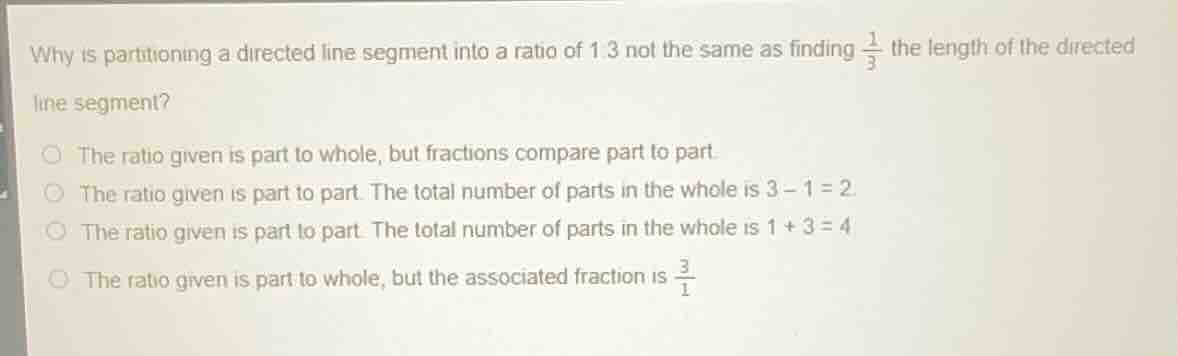
why is partitioning a directed line segment into a ratio of 1:3 not the same as finding \\(\frac{1}{3}\\) the length of the directed line segment?
- the ratio given is part to whole, but fractions compare part to part.
- the ratio given is part to part. the total number of parts in the whole is 3 - 1 = 2.
- the ratio given is part to part. the total number of parts in the whole is 1 + 3 = 4.
- the ratio given is part to whole, but the associated fraction is \\(\frac{3}{1}\\).
Analyze the partition ratio definition
$$
\text{Ratio } a:b = 1:3 \implies \text{Part}_1 = 1, \text{Part}_2 = 3
$$
Determine the total parts of the whole segment
$$
\text{Total Parts} = a + b = 1 + 3 = 4
$$
Compare with the fraction of the whole length
$$
\text{Fraction of whole} = \frac{a}{a+b} = \frac{1}{4}
eq \frac{1}{3}
$$

Snap & solve any problem in the app
Get step-by-step solutions on Sovi AI
Photo-based solutions with guided steps
Explore more problems and detailed explanations
- The ratio given is part to whole, but fractions compare part to part.
- The ratio given is part to part. The total number of parts in the whole is \(3 - 1 = 2\).
- The ratio given is part to part. The total number of parts in the whole is \(1 + 3 = 4\) (Correct answer)
- The ratio given is part to whole, but the associated fraction is \(\frac{3}{1}\).