Sovi.AI - AI Math Tutor

Scan to solve math questions

QUESTION IMAGE

why is partitioning a directed line segment into a ratio of 1:3 not the…

Question

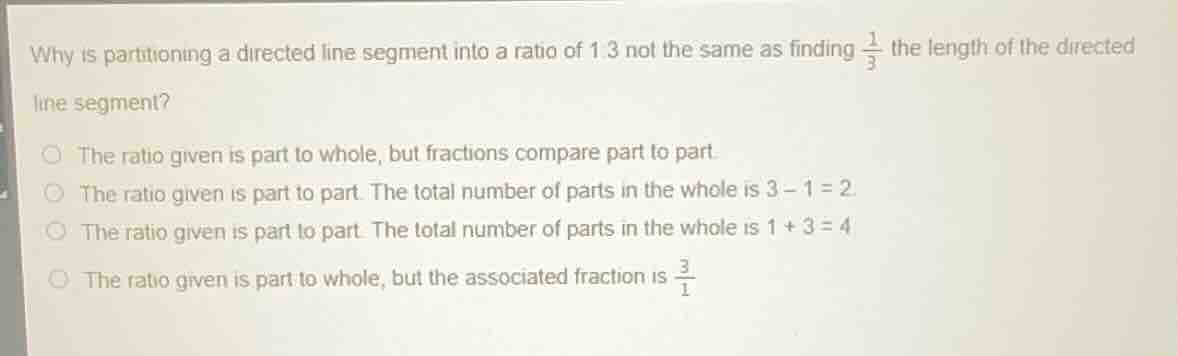
why is partitioning a directed line segment into a ratio of 1:3 not the same as finding \\(\frac{1}{3}\\) the length of the directed line segment?

  • the ratio given is part to whole, but fractions compare part to part.
  • the ratio given is part to part. the total number of parts in the whole is 3 - 1 = 2.
  • the ratio given is part to part. the total number of parts in the whole is 1 + 3 = 4.
  • the ratio given is part to whole, but the associated fraction is \\(\frac{3}{1}\\).

Explanation:

Response

<pre_analysis>
{
"quality": "clear",
"question_count": 1,
"skills_matched": [
"step_cot",
"multiple_choice_formatter",
"explain_then_answer",
"quick"
],
"needs_drawing": false,
"concepts_used": [
"Directed Line Segments",
"Section Formula",
"Midpoint Partition Ratio"
],
"new_concepts": [],
"current_concepts": [
"Directed Line Segments",
"Section Formula",
"Midpoint Partition Ratio"
]
}
</pre_analysis>

<reasoning>

Analyze the partition ratio definition

\[
\text{Ratio } a:b = 1:3 \implies \text{Part}_1 = 1, \text{Part}_2 = 3
\]

Determine the total parts of the whole segment

\[
\text{Total Parts} = a + b = 1 + 3 = 4
\]

Compare with the fraction of the whole length

\[
\text{Fraction of whole} = \frac{a}{a+b} = \frac{1}{4}
eq \frac{1}{3}
\]
</reasoning>

<answer>
<mcq-option>The ratio given is part to whole, but fractions compare part to part.</mcq-option>
<mcq-option>The ratio given is part to part. The total number of parts in the whole is \(3 - 1 = 2\).</mcq-option>
<mcq-correct>The ratio given is part to part. The total number of parts in the whole is \(1 + 3 = 4\)</mcq-correct>
<mcq-option>The ratio given is part to whole, but the associated fraction is \(\frac{3}{1}\).</mcq-option>
</answer>

<post_analysis>
{
"subject": "Mathematics",
"question_type": "Multiple Choice",
"knowledge_point": [
"Mathematics",
"Geometry",
"Directed Line Segments"
]
}
</post_analysis>

Answer:

<pre_analysis>
{
"quality": "clear",
"question_count": 1,
"skills_matched": [
"step_cot",
"multiple_choice_formatter",
"explain_then_answer",
"quick"
],
"needs_drawing": false,
"concepts_used": [
"Directed Line Segments",
"Section Formula",
"Midpoint Partition Ratio"
],
"new_concepts": [],
"current_concepts": [
"Directed Line Segments",
"Section Formula",
"Midpoint Partition Ratio"
]
}
</pre_analysis>

<reasoning>

Analyze the partition ratio definition

\[
\text{Ratio } a:b = 1:3 \implies \text{Part}_1 = 1, \text{Part}_2 = 3
\]

Determine the total parts of the whole segment

\[
\text{Total Parts} = a + b = 1 + 3 = 4
\]

Compare with the fraction of the whole length

\[
\text{Fraction of whole} = \frac{a}{a+b} = \frac{1}{4}
eq \frac{1}{3}
\]
</reasoning>

<answer>
<mcq-option>The ratio given is part to whole, but fractions compare part to part.</mcq-option>
<mcq-option>The ratio given is part to part. The total number of parts in the whole is \(3 - 1 = 2\).</mcq-option>
<mcq-correct>The ratio given is part to part. The total number of parts in the whole is \(1 + 3 = 4\)</mcq-correct>
<mcq-option>The ratio given is part to whole, but the associated fraction is \(\frac{3}{1}\).</mcq-option>
</answer>

<post_analysis>
{
"subject": "Mathematics",
"question_type": "Multiple Choice",
"knowledge_point": [
"Mathematics",
"Geometry",
"Directed Line Segments"
]
}
</post_analysis>