QUESTION IMAGE
Question
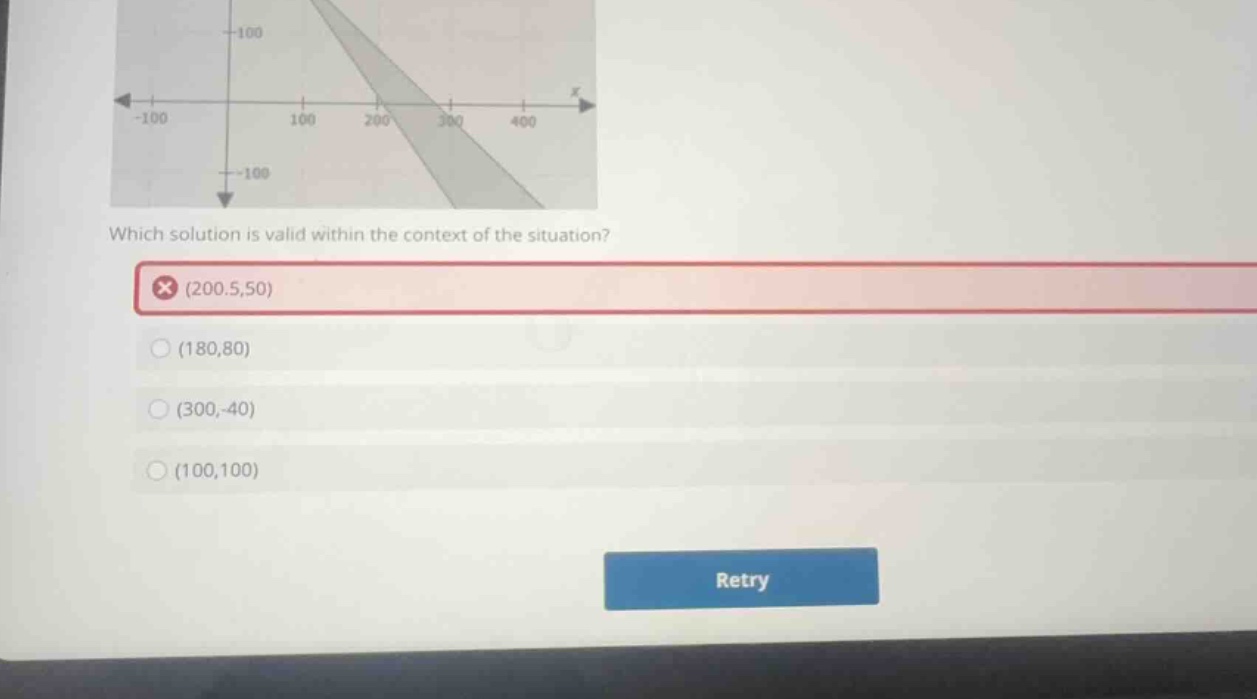
which solution is valid within the context of the situation?
(200.5, 50)
(180, 80)
(300, -40)
(100, 100)
<pre_analysis>
{
"quality": "clear",
"question_count": 1,
"skills_matched": [
"step_cot",
"multiple_choice_formatter",
"explain_then_answer",
"tutor"
],
"needs_drawing": false,
"concepts_used": [
"Systems of Linear Inequalities",
"Graphical Solutions",
"Feasible Region Interpretation",
"Real-world Constraints"
],
"new_concepts": [],
"current_concepts": [
"Systems of Linear Inequalities",
"Graphical Solutions",
"Feasible Region Interpretation",
"Real-world Constraints"
]
}
</pre_analysis>
<reasoning>
Identify the feasible region
We analyze the shaded region representing the Systems of Linear Inequalities.
The overlapping shaded region (feasible region) is the darker band.
It lies entirely in the first quadrant where \(x \ge 0\) and \(y \ge 0\).
This represents standard Real-world Constraints where quantities must be non-negative.
Determine boundary lines
We estimate the boundary lines from the Graphical Solutions.
The first boundary line passes through approximately \((250, 0)\) and \((0, 250)\).
The second boundary line passes through approximately \((300, 0)\) and \((0, 300)\).
The feasible region is the band between these two lines:
\[250 \le x + y \le 300\]
with non-negativity constraints \(x \ge 0, y \ge 0\).
Test the given options
We evaluate each option using Feasible Region Interpretation:
- For \((200.5, 50)\): \(x + y = 200.5 + 50 = 250.5\). This lies within the band, but real-world contexts often require integer values. Let's check other options.
- For \((180, 80)\): \(x + y = 180 + 80 = 260\). This is a pair of positive integers lying well inside the region.
- For \((300, -40)\): \(y = -40 < 0\), violating the non-negativity constraint.
- For \((100, 100)\): \(x + y = 200 < 250\), which lies outside the shaded band.
Select the valid solution
Comparing the remaining candidates, \((180, 80)\) consists of whole numbers.
It lies strictly inside the shaded region.
Thus, \((180, 80)\) is the most valid solution.
</reasoning>
<answer>
<mcq-option>(A) (200.5,50)</mcq-option>
<mcq-correct>(B) (180,80)</mcq-correct>
<mcq-option>(C) (300,-40)</mcq-option>
<mcq-option>(D) (100,100)</mcq-option>
</answer>
<post_analysis>
{
"subject": "Mathematics",
"question_type": "Multiple Choice",
"knowledge_point": [
"Mathematics",
"Algebra",
"Systems of Linear Inequalities"
]
}
</post_analysis>
Snap & solve any problem in the app
Get step-by-step solutions on Sovi AI
Photo-based solutions with guided steps
Explore more problems and detailed explanations
<pre_analysis>
{
"quality": "clear",
"question_count": 1,
"skills_matched": [
"step_cot",
"multiple_choice_formatter",
"explain_then_answer",
"tutor"
],
"needs_drawing": false,
"concepts_used": [
"Systems of Linear Inequalities",
"Graphical Solutions",
"Feasible Region Interpretation",
"Real-world Constraints"
],
"new_concepts": [],
"current_concepts": [
"Systems of Linear Inequalities",
"Graphical Solutions",
"Feasible Region Interpretation",
"Real-world Constraints"
]
}
</pre_analysis>
<reasoning>
Identify the feasible region
We analyze the shaded region representing the Systems of Linear Inequalities.
The overlapping shaded region (feasible region) is the darker band.
It lies entirely in the first quadrant where \(x \ge 0\) and \(y \ge 0\).
This represents standard Real-world Constraints where quantities must be non-negative.
Determine boundary lines
We estimate the boundary lines from the Graphical Solutions.
The first boundary line passes through approximately \((250, 0)\) and \((0, 250)\).
The second boundary line passes through approximately \((300, 0)\) and \((0, 300)\).
The feasible region is the band between these two lines:
\[250 \le x + y \le 300\]
with non-negativity constraints \(x \ge 0, y \ge 0\).
Test the given options
We evaluate each option using Feasible Region Interpretation:
- For \((200.5, 50)\): \(x + y = 200.5 + 50 = 250.5\). This lies within the band, but real-world contexts often require integer values. Let's check other options.
- For \((180, 80)\): \(x + y = 180 + 80 = 260\). This is a pair of positive integers lying well inside the region.
- For \((300, -40)\): \(y = -40 < 0\), violating the non-negativity constraint.
- For \((100, 100)\): \(x + y = 200 < 250\), which lies outside the shaded band.
Select the valid solution
Comparing the remaining candidates, \((180, 80)\) consists of whole numbers.
It lies strictly inside the shaded region.
Thus, \((180, 80)\) is the most valid solution.
</reasoning>
<answer>
<mcq-option>(A) (200.5,50)</mcq-option>
<mcq-correct>(B) (180,80)</mcq-correct>
<mcq-option>(C) (300,-40)</mcq-option>
<mcq-option>(D) (100,100)</mcq-option>
</answer>
<post_analysis>
{
"subject": "Mathematics",
"question_type": "Multiple Choice",
"knowledge_point": [
"Mathematics",
"Algebra",
"Systems of Linear Inequalities"
]
}
</post_analysis>