QUESTION IMAGE
Question
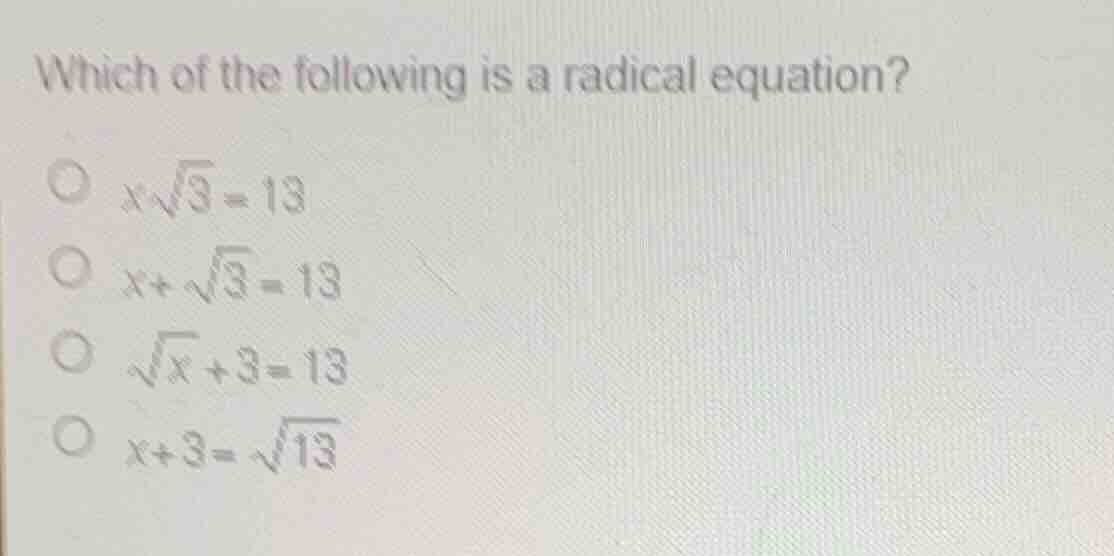
which of the following is a radical equation?
\\(x\sqrt{3} = 13\\)
\\(x + \sqrt{3} = 13\\)
\\(\sqrt{x} + 3 = 13\\)
\\(x + 3 = \sqrt{13}\\)
<pre_analysis>
{
"quality": "clear",
"question_count": 1,
"skills_matched": [
"step_cot",
"multiple_choice_formatter",
"explain_then_answer",
"tutor",
"mastery_adaptive_brevity"
],
"needs_drawing": false,
"concepts_used": [
"Solving Radical Equations"
],
"new_concepts": [
"Radical Equation Definition"
],
"current_concepts": [
"Solving Radical Equations",
"Radical Equation Definition"
]
}
</pre_analysis>
<reasoning>
Define a radical equation
Using the Solving Radical Equations knowledge point
An equation is classified as a radical equation if and only if it contains a variable inside a radical (such as a square root, cube root, etc.). If the radical contains only a constant number, the equation is linear or polynomial, not radical.
Analyze each option
- Option 1: \(x\sqrt{3} = 13\)
The variable \(x\) is outside the radical. The radical contains only the constant \(3\). This is a linear equation.
- Option 2: \(x + \sqrt{3} = 13\)
The variable \(x\) is outside the radical. The radical contains only the constant \(3\). This is a linear equation.
- Option 3: \(\sqrt{x} + 3 = 13\)
The variable \(x\) is inside the square root radical. Therefore, this is a radical equation.
- Option 4: \(x + 3 = \sqrt{13}\)
The variable \(x\) is outside the radical. The radical contains only the constant \(13\). This is a linear equation.
</reasoning>
<answer>
<mcq-option>(A) \(x\sqrt{3} = 13\)</mcq-option>
<mcq-option>(B) \(x + \sqrt{3} = 13\)</mcq-option>
<mcq-correct>(C) \(\sqrt{x} + 3 = 13\)</mcq-correct>
<mcq-option>(D) \(x + 3 = \sqrt{13}\)</mcq-option>
</answer>
<post_analysis>
{
"subject": "Mathematics",
"question_type": "Multiple Choice",
"knowledge_point": [
"Mathematics",
"Algebra",
"Radical Equation Definition"
]
}
</post_analysis>
Snap & solve any problem in the app
Get step-by-step solutions on Sovi AI
Photo-based solutions with guided steps
Explore more problems and detailed explanations
<pre_analysis>
{
"quality": "clear",
"question_count": 1,
"skills_matched": [
"step_cot",
"multiple_choice_formatter",
"explain_then_answer",
"tutor",
"mastery_adaptive_brevity"
],
"needs_drawing": false,
"concepts_used": [
"Solving Radical Equations"
],
"new_concepts": [
"Radical Equation Definition"
],
"current_concepts": [
"Solving Radical Equations",
"Radical Equation Definition"
]
}
</pre_analysis>
<reasoning>
Define a radical equation
Using the Solving Radical Equations knowledge point
An equation is classified as a radical equation if and only if it contains a variable inside a radical (such as a square root, cube root, etc.). If the radical contains only a constant number, the equation is linear or polynomial, not radical.
Analyze each option
- Option 1: \(x\sqrt{3} = 13\)
The variable \(x\) is outside the radical. The radical contains only the constant \(3\). This is a linear equation.
- Option 2: \(x + \sqrt{3} = 13\)
The variable \(x\) is outside the radical. The radical contains only the constant \(3\). This is a linear equation.
- Option 3: \(\sqrt{x} + 3 = 13\)
The variable \(x\) is inside the square root radical. Therefore, this is a radical equation.
- Option 4: \(x + 3 = \sqrt{13}\)
The variable \(x\) is outside the radical. The radical contains only the constant \(13\). This is a linear equation.
</reasoning>
<answer>
<mcq-option>(A) \(x\sqrt{3} = 13\)</mcq-option>
<mcq-option>(B) \(x + \sqrt{3} = 13\)</mcq-option>
<mcq-correct>(C) \(\sqrt{x} + 3 = 13\)</mcq-correct>
<mcq-option>(D) \(x + 3 = \sqrt{13}\)</mcq-option>
</answer>
<post_analysis>
{
"subject": "Mathematics",
"question_type": "Multiple Choice",
"knowledge_point": [
"Mathematics",
"Algebra",
"Radical Equation Definition"
]
}
</post_analysis>