QUESTION IMAGE
Question
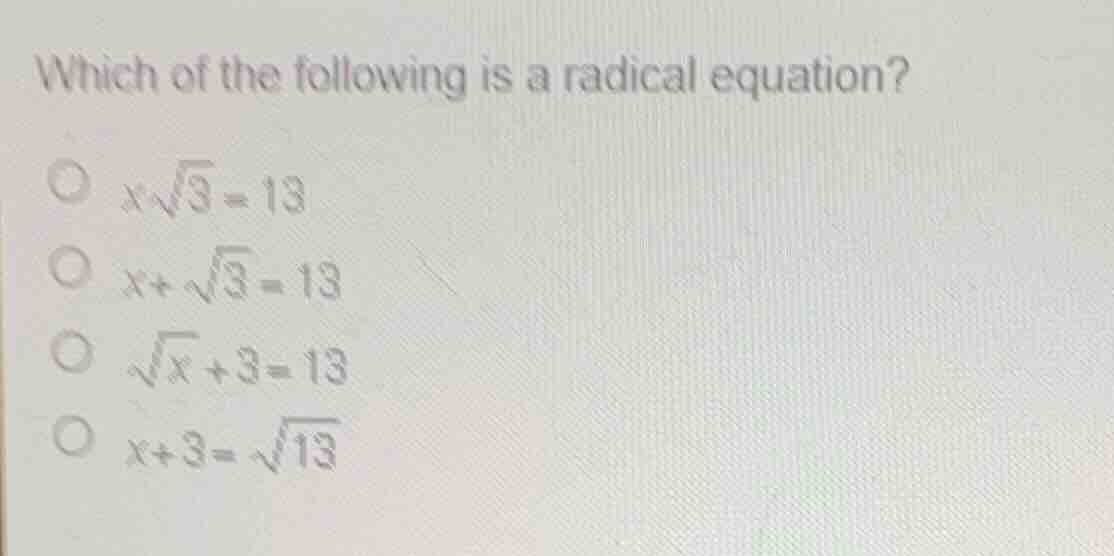
which of the following is a radical equation?
\\(x\sqrt{3} = 13\\)
\\(x + \sqrt{3} = 13\\)
\\(\sqrt{x} + 3 = 13\\)
\\(x + 3 = \sqrt{13}\\)
Define a radical equation
Using the Solving Radical Equations knowledge point
An equation is classified as a radical equation if and only if it contains a variable inside a radical (such as a square root, cube root, etc.). If the radical contains only a constant number, the equation is linear or polynomial, not radical.
Analyze each option
- Option 1: \(x\sqrt{3} = 13\)
The variable \(x\) is outside the radical. The radical contains only the constant \(3\). This is a linear equation.
- Option 2: \(x + \sqrt{3} = 13\)
The variable \(x\) is outside the radical. The radical contains only the constant \(3\). This is a linear equation.
- Option 3: \(\sqrt{x} + 3 = 13\)
The variable \(x\) is inside the square root radical. Therefore, this is a radical equation.
- Option 4: \(x + 3 = \sqrt{13}\)
The variable \(x\) is outside the radical. The radical contains only the constant \(13\). This is a linear equation.

Snap & solve any problem in the app
Get step-by-step solutions on Sovi AI
Photo-based solutions with guided steps
Explore more problems and detailed explanations
- (A) \(x\sqrt{3} = 13\)
- (B) \(x + \sqrt{3} = 13\)
- (C) \(\sqrt{x} + 3 = 13\) (Correct answer)
- (D) \(x + 3 = \sqrt{13}\)