QUESTION IMAGE
Question
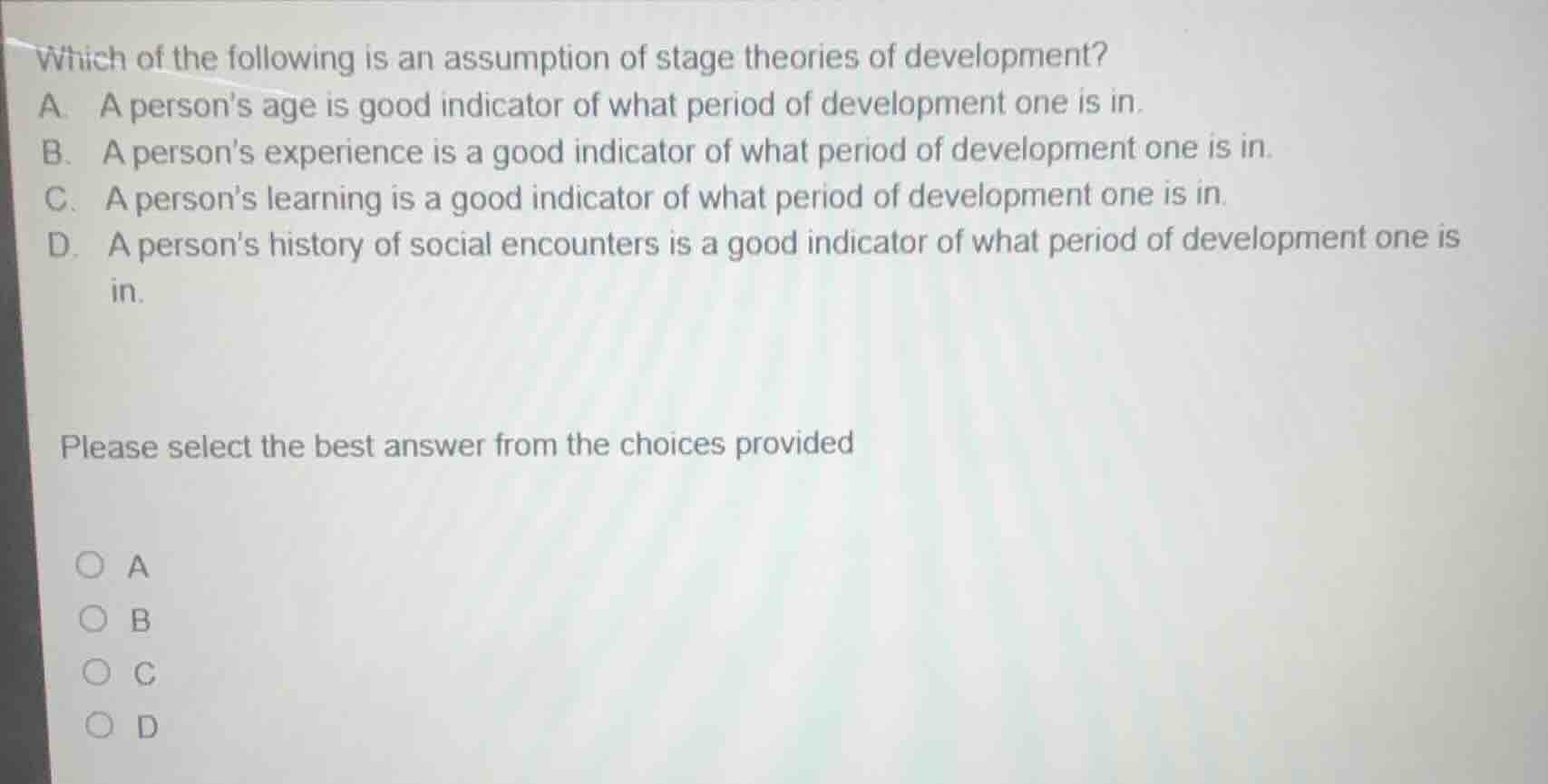
which of the following is an assumption of stage theories of development?
a. a persons age is good indicator of what period of development one is in.
b. a persons experience is a good indicator of what period of development one is in.
c. a persons learning is a good indicator of what period of development one is in.
d. a persons history of social encounters is a good indicator of what period of development one is in.
please select the best answer from the choices provided
a
b
c
d
<pre_analysis>
{
"quality": "clear",
"question_count": 1,
"skills_matched": [
"direct_cot",
"multiple_choice_formatter",
"explain_then_answer",
"quick"
],
"needs_drawing": false,
"concepts_used": [
"Stage Theories"
],
"new_concepts": [],
"current_concepts": [
"Stage Theories",
"Developmental Psychology"
]
}
</pre_analysis>
<reasoning>
Analyze the core assumption of stage theories
Stage theories of development (such as those proposed by Piaget, Erikson, or Kohlberg) assume that development occurs in a series of distinct, sequential, and age-linked stages. Consequently, a person's chronological age is considered a reliable indicator of their current developmental period.
Evaluate the given options
- Option A directly aligns with the fundamental premise that developmental stages are closely tied to chronological age.
- Options B, C, and D focus on experience, learning, and social history, which are more aligned with continuous or behavioral theories of development rather than strict stage theories.
</reasoning>
<answer>
<mcq-correct>(A) A person's age is good indicator of what period of development one is in.</mcq-correct>
<mcq-option>(B) A person's experience is a good indicator of what period of development one is in.</mcq-option>
<mcq-option>(C) A person's learning is a good indicator of what period of development one is in.</mcq-option>
<mcq-option>(D) A person's history of social encounters is a good indicator of what period of development one is in.</mcq-option>
</answer>
<post_analysis>
{
"subject": "Social Science",
"question_type": "Multiple Choice",
"knowledge_point": [
"Social Science",
"Psychology",
"Developmental Psychology"
]
}
</post_analysis>
Snap & solve any problem in the app
Get step-by-step solutions on Sovi AI
Photo-based solutions with guided steps
Explore more problems and detailed explanations
<pre_analysis>
{
"quality": "clear",
"question_count": 1,
"skills_matched": [
"direct_cot",
"multiple_choice_formatter",
"explain_then_answer",
"quick"
],
"needs_drawing": false,
"concepts_used": [
"Stage Theories"
],
"new_concepts": [],
"current_concepts": [
"Stage Theories",
"Developmental Psychology"
]
}
</pre_analysis>
<reasoning>
Analyze the core assumption of stage theories
Stage theories of development (such as those proposed by Piaget, Erikson, or Kohlberg) assume that development occurs in a series of distinct, sequential, and age-linked stages. Consequently, a person's chronological age is considered a reliable indicator of their current developmental period.
Evaluate the given options
- Option A directly aligns with the fundamental premise that developmental stages are closely tied to chronological age.
- Options B, C, and D focus on experience, learning, and social history, which are more aligned with continuous or behavioral theories of development rather than strict stage theories.
</reasoning>
<answer>
<mcq-correct>(A) A person's age is good indicator of what period of development one is in.</mcq-correct>
<mcq-option>(B) A person's experience is a good indicator of what period of development one is in.</mcq-option>
<mcq-option>(C) A person's learning is a good indicator of what period of development one is in.</mcq-option>
<mcq-option>(D) A person's history of social encounters is a good indicator of what period of development one is in.</mcq-option>
</answer>
<post_analysis>
{
"subject": "Social Science",
"question_type": "Multiple Choice",
"knowledge_point": [
"Social Science",
"Psychology",
"Developmental Psychology"
]
}
</post_analysis>