Sovi.AI - AI Math Tutor

Scan to solve math questions

QUESTION IMAGE

which of the following is an assumption of stage theories of developmen…

Question

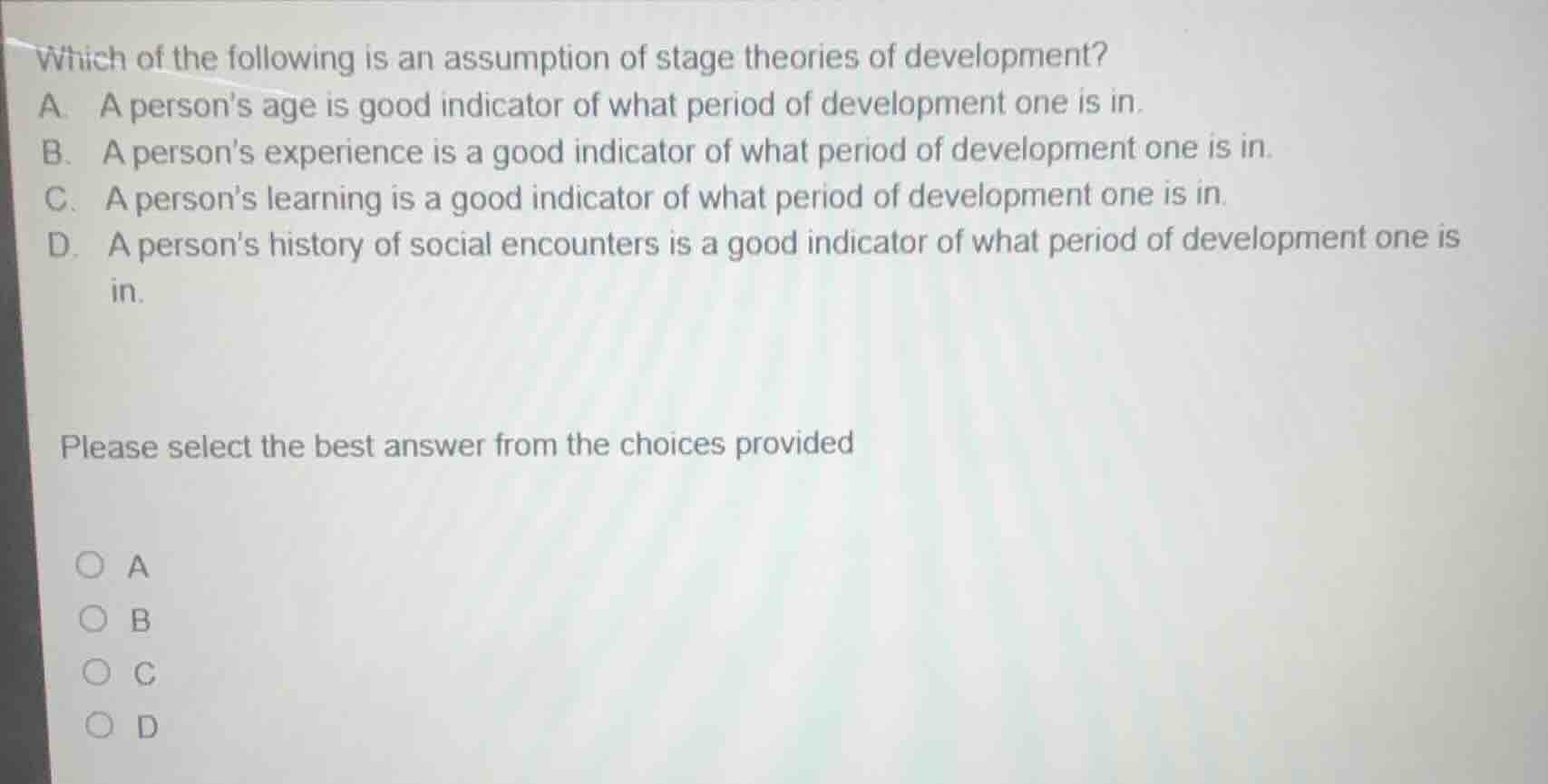
which of the following is an assumption of stage theories of development?
a. a persons age is good indicator of what period of development one is in.
b. a persons experience is a good indicator of what period of development one is in.
c. a persons learning is a good indicator of what period of development one is in.
d. a persons history of social encounters is a good indicator of what period of development one is in.

please select the best answer from the choices provided

a
b
c
d

Explanation:

Response

<pre_analysis>
{
"quality": "clear",
"question_count": 1,
"skills_matched": [
"direct_cot",
"multiple_choice_formatter",
"explain_then_answer",
"quick"
],
"needs_drawing": false,
"concepts_used": [
"Stage Theories"
],
"new_concepts": [],
"current_concepts": [
"Stage Theories",
"Developmental Psychology"
]
}
</pre_analysis>

<reasoning>

Analyze the core assumption of stage theories

Stage theories of development (such as those proposed by Piaget, Erikson, or Kohlberg) assume that development occurs in a series of distinct, sequential, and age-linked stages. Consequently, a person's chronological age is considered a reliable indicator of their current developmental period.

Evaluate the given options

  • Option A directly aligns with the fundamental premise that developmental stages are closely tied to chronological age.
  • Options B, C, and D focus on experience, learning, and social history, which are more aligned with continuous or behavioral theories of development rather than strict stage theories.

</reasoning>

<answer>
<mcq-correct>(A) A person's age is good indicator of what period of development one is in.</mcq-correct>
<mcq-option>(B) A person's experience is a good indicator of what period of development one is in.</mcq-option>
<mcq-option>(C) A person's learning is a good indicator of what period of development one is in.</mcq-option>
<mcq-option>(D) A person's history of social encounters is a good indicator of what period of development one is in.</mcq-option>
</answer>

<post_analysis>
{
"subject": "Social Science",
"question_type": "Multiple Choice",
"knowledge_point": [
"Social Science",
"Psychology",
"Developmental Psychology"
]
}
</post_analysis>

Answer:

<pre_analysis>
{
"quality": "clear",
"question_count": 1,
"skills_matched": [
"direct_cot",
"multiple_choice_formatter",
"explain_then_answer",
"quick"
],
"needs_drawing": false,
"concepts_used": [
"Stage Theories"
],
"new_concepts": [],
"current_concepts": [
"Stage Theories",
"Developmental Psychology"
]
}
</pre_analysis>

<reasoning>

Analyze the core assumption of stage theories

Stage theories of development (such as those proposed by Piaget, Erikson, or Kohlberg) assume that development occurs in a series of distinct, sequential, and age-linked stages. Consequently, a person's chronological age is considered a reliable indicator of their current developmental period.

Evaluate the given options

  • Option A directly aligns with the fundamental premise that developmental stages are closely tied to chronological age.
  • Options B, C, and D focus on experience, learning, and social history, which are more aligned with continuous or behavioral theories of development rather than strict stage theories.

</reasoning>

<answer>
<mcq-correct>(A) A person's age is good indicator of what period of development one is in.</mcq-correct>
<mcq-option>(B) A person's experience is a good indicator of what period of development one is in.</mcq-option>
<mcq-option>(C) A person's learning is a good indicator of what period of development one is in.</mcq-option>
<mcq-option>(D) A person's history of social encounters is a good indicator of what period of development one is in.</mcq-option>
</answer>

<post_analysis>
{
"subject": "Social Science",
"question_type": "Multiple Choice",
"knowledge_point": [
"Social Science",
"Psychology",
"Developmental Psychology"
]
}
</post_analysis>