QUESTION IMAGE
Question
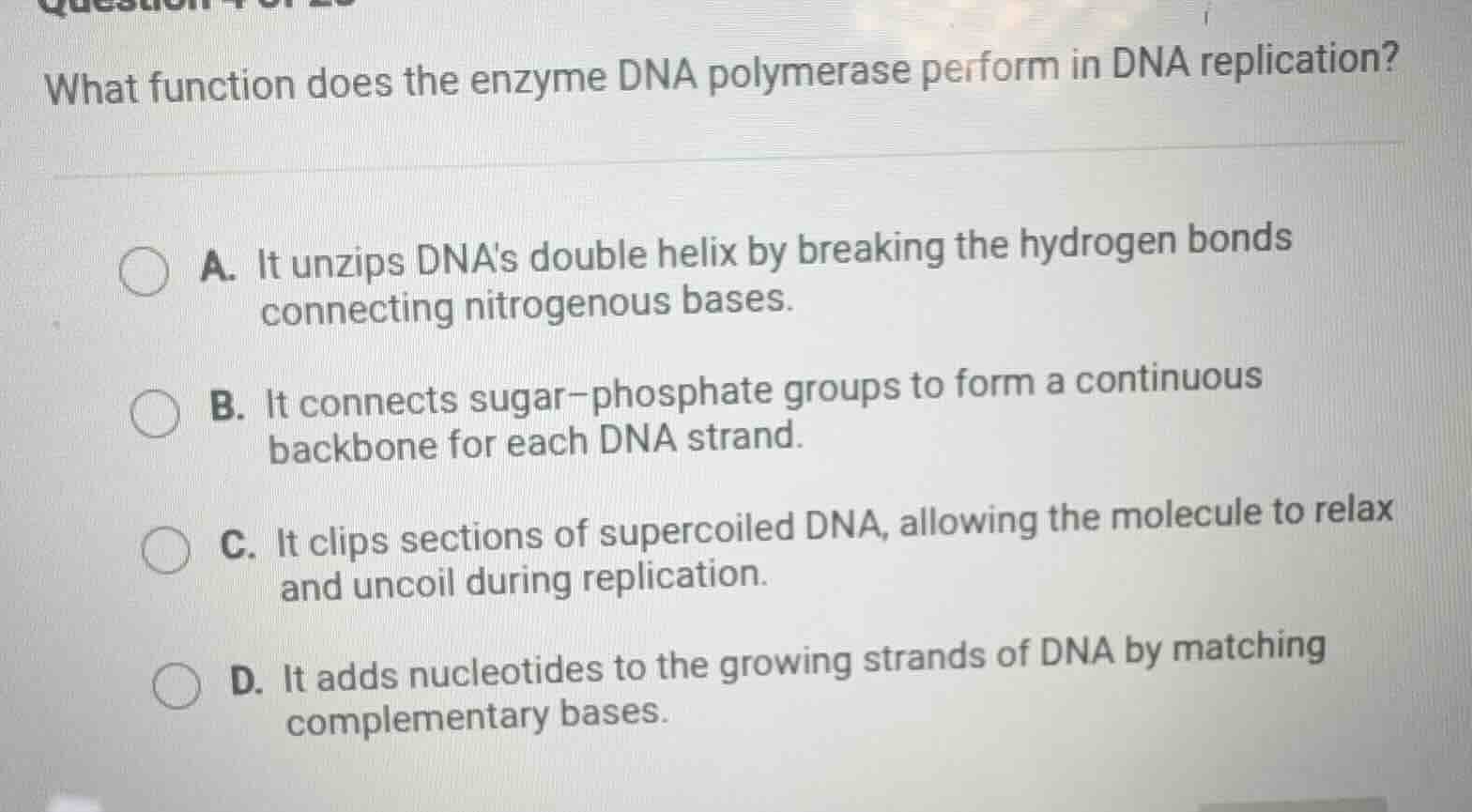
what function does the enzyme dna polymerase perform in dna replication?
a. it unzips dnas double helix by breaking the hydrogen bonds connecting nitrogen bases.
b. it connects sugar-phosphate groups to form a continuous backbone for each dna strand.
c. it clips sections of supercoiled dna, allowing the molecule to relax and uncoil during replication.
d. it adds nucleotides to the growing strands of dna by matching complementary bases.
<pre_analysis>
{
"quality": "clear",
"question_count": 1,
"skills_matched": [
"direct_cot",
"multiple_choice_formatter",
"explain_then_answer",
"quick"
],
"needs_drawing": false,
"concepts_used": [],
"new_concepts": [
"DNA Polymerase Function"
],
"current_concepts": [
"DNA Replication Stages",
"DNA Polymerase Function"
]
}
</pre_analysis>
<reasoning>
Analyze the role of DNA polymerase
DNA polymerase is the primary enzyme responsible for synthesizing new DNA strands. It does this by adding free nucleotides to the 3' end of a growing DNA strand, matching them to the template strand using complementary base pairing rules (A with T, and C with G).
Evaluate the given options
- Option A describes the function of DNA helicase, which unzips the double helix by breaking hydrogen bonds.
- Option B describes the function of DNA ligase, which seals nicks in the sugar-phosphate backbone by joining Okazaki fragments.
- Option C describes the function of topoisomerase (or gyrase), which relieves supercoiling strain ahead of the replication fork.
- Option D correctly describes the function of DNA polymerase, which adds nucleotides to the growing DNA strands by matching complementary bases.
</reasoning>
<answer>
<mcq-option>(A) It unzips DNA's double helix by breaking the hydrogen bonds connecting nitrogen bases.</mcq-option>
<mcq-option>(B) It connects sugar-phosphate groups to form a continuous backbone for each DNA strand.</mcq-option>
<mcq-option>(C) It clips sections of supercoiled DNA, allowing the molecule to relax and uncoil during replication.</mcq-option>
<mcq-correct>(D) It adds nucleotides to the growing strands of DNA by matching complementary bases.</mcq-correct>
</answer>
<post_analysis>
{
"subject": "Natural Science",
"question_type": "Multiple Choice",
"knowledge_point": [
"Natural Science",
"Biology",
"DNA Replication"
]
}
</post_analysis>
Snap & solve any problem in the app
Get step-by-step solutions on Sovi AI
Photo-based solutions with guided steps
Explore more problems and detailed explanations
<pre_analysis>
{
"quality": "clear",
"question_count": 1,
"skills_matched": [
"direct_cot",
"multiple_choice_formatter",
"explain_then_answer",
"quick"
],
"needs_drawing": false,
"concepts_used": [],
"new_concepts": [
"DNA Polymerase Function"
],
"current_concepts": [
"DNA Replication Stages",
"DNA Polymerase Function"
]
}
</pre_analysis>
<reasoning>
Analyze the role of DNA polymerase
DNA polymerase is the primary enzyme responsible for synthesizing new DNA strands. It does this by adding free nucleotides to the 3' end of a growing DNA strand, matching them to the template strand using complementary base pairing rules (A with T, and C with G).
Evaluate the given options
- Option A describes the function of DNA helicase, which unzips the double helix by breaking hydrogen bonds.
- Option B describes the function of DNA ligase, which seals nicks in the sugar-phosphate backbone by joining Okazaki fragments.
- Option C describes the function of topoisomerase (or gyrase), which relieves supercoiling strain ahead of the replication fork.
- Option D correctly describes the function of DNA polymerase, which adds nucleotides to the growing DNA strands by matching complementary bases.
</reasoning>
<answer>
<mcq-option>(A) It unzips DNA's double helix by breaking the hydrogen bonds connecting nitrogen bases.</mcq-option>
<mcq-option>(B) It connects sugar-phosphate groups to form a continuous backbone for each DNA strand.</mcq-option>
<mcq-option>(C) It clips sections of supercoiled DNA, allowing the molecule to relax and uncoil during replication.</mcq-option>
<mcq-correct>(D) It adds nucleotides to the growing strands of DNA by matching complementary bases.</mcq-correct>
</answer>
<post_analysis>
{
"subject": "Natural Science",
"question_type": "Multiple Choice",
"knowledge_point": [
"Natural Science",
"Biology",
"DNA Replication"
]
}
</post_analysis>