QUESTION IMAGE
Question
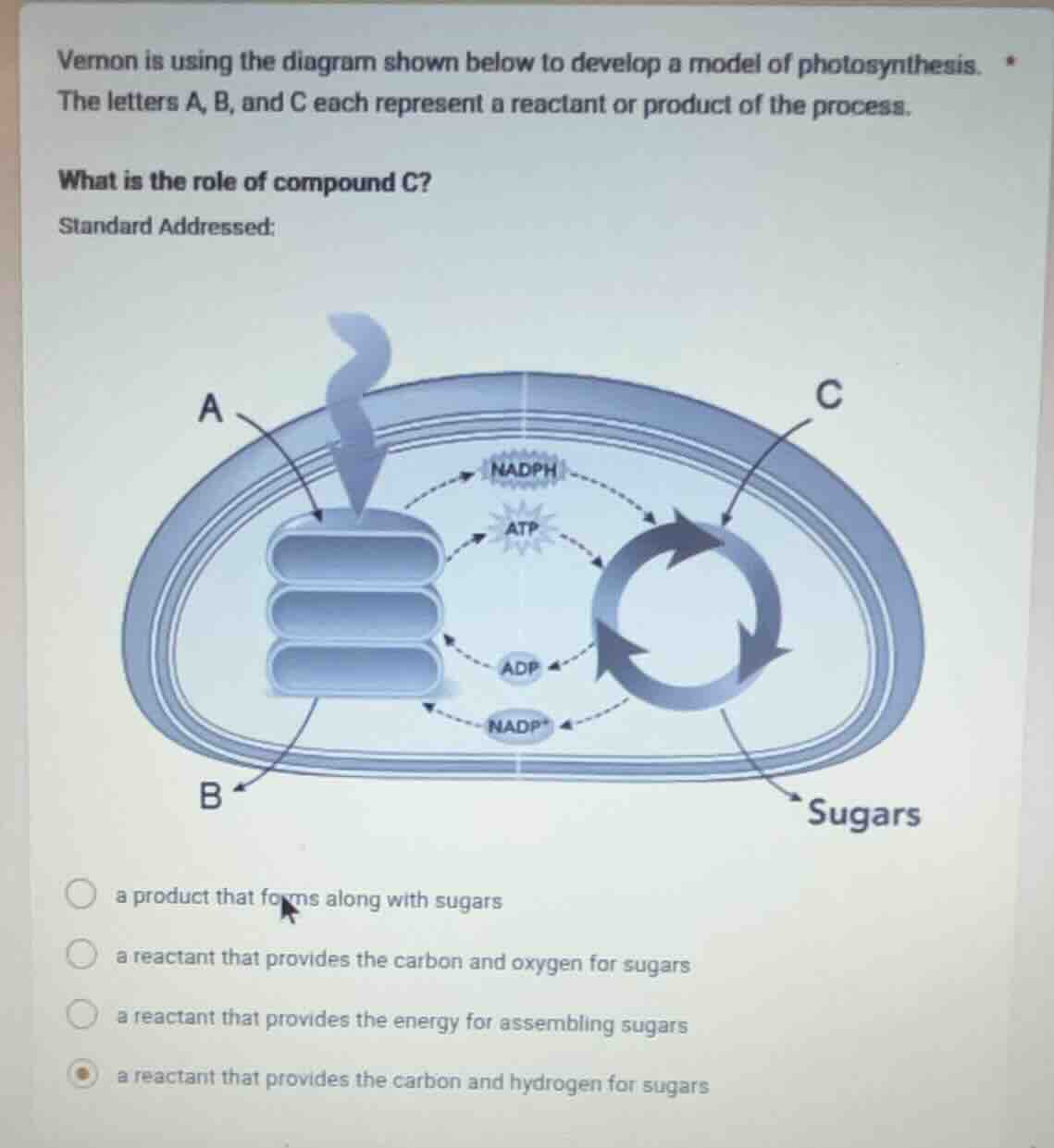
vernon is using the diagram shown below to develop a model of photosynthesis. the letters a, b, and c each represent a reactant or product of the process.
what is the role of compound c?
standard addressed:
a product that forms along with sugars
a reactant that provides the carbon and oxygen for sugars
a reactant that provides the energy for assembling sugars
a reactant that provides the carbon and hydrogen for sugars
<pre_analysis>
{
"quality": "clear",
"question_count": 1,
"skills_matched": [
"direct_cot",
"multiple_choice_formatter",
"explain_then_answer",
"tutor"
],
"needs_drawing": false,
"concepts_used": [
"Photosynthesis Reactions",
"Calvin Cycle Reactants"
],
"new_concepts": [
"Calvin Cycle Carbon Fixation"
],
"current_concepts": [
"Photosynthesis Reactions",
"Calvin Cycle Reactants",
"Calvin Cycle Carbon Fixation"
]
}
</pre_analysis>
<reasoning>
Identify the components of the photosynthesis model
The diagram illustrates the two main stages of photosynthesis occurring inside a chloroplast: the light-dependent reactions (on the left, taking place in the thylakoids) and the light-independent reactions or Calvin cycle (on the right, taking place in the stroma).
In Photosynthesis Reactions:
- A represents water (\(\text{H}_2\text{O}\)), which enters the light-dependent reactions.
- B represents oxygen (\(\text{O}_2\)), which is released as a byproduct of photolysis.
- C represents carbon dioxide (\(\text{CO}_2\)), which enters the Calvin cycle.
Analyze the role of compound C
Compound C is carbon dioxide (\(\text{CO}_2\)). In the Calvin cycle, carbon dioxide is a key reactant.
Using the Calvin Cycle Reactants knowledge point, we know that \(\text{CO}_2\) enters the cycle to undergo carbon fixation. The carbon and oxygen atoms from \(\text{CO}_2\) are used to build the backbone of the synthesized organic molecules (Sugars, such as G3P/glucose).
Evaluate the given multiple-choice options
- Option 1: "a product that forms along with sugars" — Incorrect, because compound C is an input (reactant) entering the cycle, not a product leaving it.
- Option 2: "a reactant that provides the carbon and oxygen for sugars" — Correct, because \(\text{CO}_2\) provides both the carbon and oxygen atoms that make up the carbohydrate molecules (\(\text{C}_6\text{H}_{12}\text{O}_6\)).
- Option 3: "a reactant that provides the energy for assembling sugars" — Incorrect, because the energy is provided by ATP and NADPH, which are generated in the light-dependent reactions.
- Option 4: "a reactant that provides the carbon and hydrogen for sugars" — Incorrect, because \(\text{CO}_2\) does not contain hydrogen; hydrogen is provided by NADPH.
</reasoning>
<answer>
<mcq-option>a product that forms along with sugars</mcq-option>
<mcq-correct>a reactant that provides the carbon and oxygen for sugars</mcq-correct>
<mcq-option>a reactant that provides the energy for assembling sugars</mcq-option>
<mcq-option>a reactant that provides the carbon and hydrogen for sugars</mcq-option>
</answer>
<post_analysis>
{
"subject": "Natural Science",
"question_type": "Multiple Choice",
"knowledge_point": [
"Natural Science",
"Biology",
"Photosynthesis"
]
}
</post_analysis>
Snap & solve any problem in the app
Get step-by-step solutions on Sovi AI
Photo-based solutions with guided steps
Explore more problems and detailed explanations
<pre_analysis>
{
"quality": "clear",
"question_count": 1,
"skills_matched": [
"direct_cot",
"multiple_choice_formatter",
"explain_then_answer",
"tutor"
],
"needs_drawing": false,
"concepts_used": [
"Photosynthesis Reactions",
"Calvin Cycle Reactants"
],
"new_concepts": [
"Calvin Cycle Carbon Fixation"
],
"current_concepts": [
"Photosynthesis Reactions",
"Calvin Cycle Reactants",
"Calvin Cycle Carbon Fixation"
]
}
</pre_analysis>
<reasoning>
Identify the components of the photosynthesis model
The diagram illustrates the two main stages of photosynthesis occurring inside a chloroplast: the light-dependent reactions (on the left, taking place in the thylakoids) and the light-independent reactions or Calvin cycle (on the right, taking place in the stroma).
In Photosynthesis Reactions:
- A represents water (\(\text{H}_2\text{O}\)), which enters the light-dependent reactions.
- B represents oxygen (\(\text{O}_2\)), which is released as a byproduct of photolysis.
- C represents carbon dioxide (\(\text{CO}_2\)), which enters the Calvin cycle.
Analyze the role of compound C
Compound C is carbon dioxide (\(\text{CO}_2\)). In the Calvin cycle, carbon dioxide is a key reactant.
Using the Calvin Cycle Reactants knowledge point, we know that \(\text{CO}_2\) enters the cycle to undergo carbon fixation. The carbon and oxygen atoms from \(\text{CO}_2\) are used to build the backbone of the synthesized organic molecules (Sugars, such as G3P/glucose).
Evaluate the given multiple-choice options
- Option 1: "a product that forms along with sugars" — Incorrect, because compound C is an input (reactant) entering the cycle, not a product leaving it.
- Option 2: "a reactant that provides the carbon and oxygen for sugars" — Correct, because \(\text{CO}_2\) provides both the carbon and oxygen atoms that make up the carbohydrate molecules (\(\text{C}_6\text{H}_{12}\text{O}_6\)).
- Option 3: "a reactant that provides the energy for assembling sugars" — Incorrect, because the energy is provided by ATP and NADPH, which are generated in the light-dependent reactions.
- Option 4: "a reactant that provides the carbon and hydrogen for sugars" — Incorrect, because \(\text{CO}_2\) does not contain hydrogen; hydrogen is provided by NADPH.
</reasoning>
<answer>
<mcq-option>a product that forms along with sugars</mcq-option>
<mcq-correct>a reactant that provides the carbon and oxygen for sugars</mcq-correct>
<mcq-option>a reactant that provides the energy for assembling sugars</mcq-option>
<mcq-option>a reactant that provides the carbon and hydrogen for sugars</mcq-option>
</answer>
<post_analysis>
{
"subject": "Natural Science",
"question_type": "Multiple Choice",
"knowledge_point": [
"Natural Science",
"Biology",
"Photosynthesis"
]
}
</post_analysis>