QUESTION IMAGE
Question
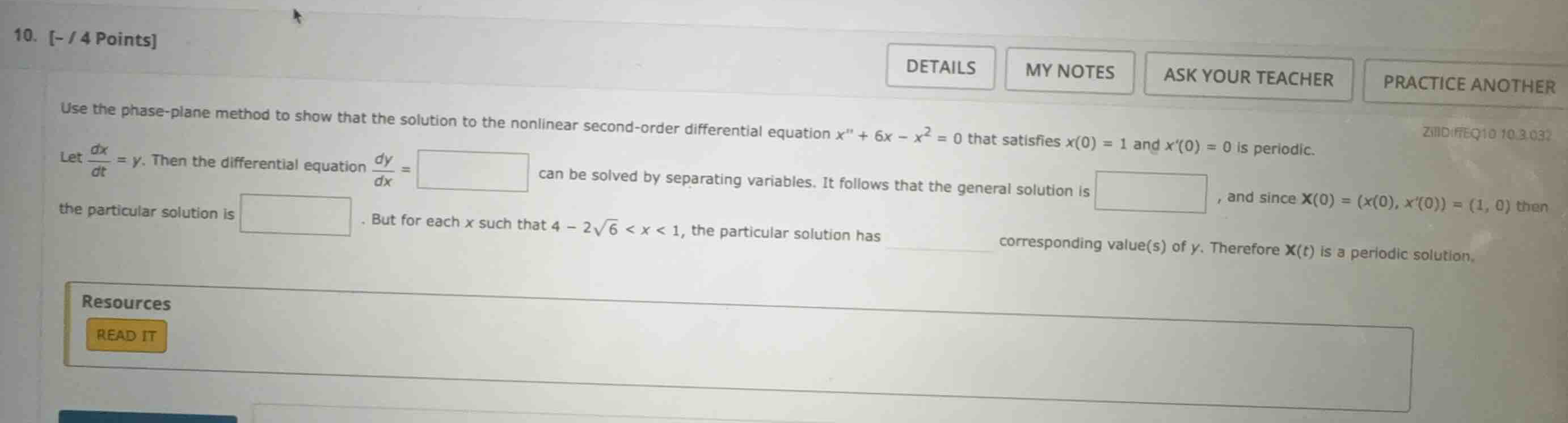
use the phase-plane method to show that the solution to the nonlinear second-order differential equation \\(x + 6x - x^2 = 0\\) that satisfies \\(x(0) = 1\\) and \\(x(0) = 0\\) is periodic.
let \\(\frac{dx}{dt} = y\\). then the differential equation \\(\frac{dy}{dx} =\\) can be solved by separating variables. it follows that the general solution is , and since \\(\mathbf{x}(0) = (x(0), x(0)) = (1, 0)\\) then the particular solution is . but for each \\(x\\) such that \\(4 - 2\sqrt{6} < x < 1\\), the particular solution has corresponding value(s) of \\(y\\). therefore \\(\mathbf{x}(t)\\) is a periodic solution.
Convert to a first-order system
Using the Nonlinear Systems of ODEs knowledge point
Formulate the phase-plane equation
Using the Phase Portrait Analysis knowledge point
Solve by separation of variables
Using the Phase Portrait Analysis knowledge point
Apply the initial conditions
Using the Phase Portrait Analysis knowledge point
Analyze the periodic behavior
Using the Phase Portrait Analysis knowledge point
For each \(x\) in the interval \(4 - 2\sqrt{6} < x < 1\), the term inside the square root is strictly positive, yielding two real, symmetric values of \(y\).

Snap & solve any problem in the app
Get step-by-step solutions on Sovi AI
Photo-based solutions with guided steps
Explore more problems and detailed explanations
Use the phase-plane method to show that the solution to the nonlinear second-order differential equation \(x'' + 6x - x^2 = 0\) that satisfies \(x(0) = 1\) and \(x'(0) = 0\) is periodic.
Let \(\frac{dx}{dt} = y\). Then the differential equation \(\frac{dy}{dx} =\) <blank>\(\frac{x^2-6x}{y}\)</blank> can be solved by separating variables. It follows that the general solution is <blank>\(y^2 - \frac{2}{3}x^3 + 6x^2 = C\)</blank>, and since \(\mathbf{X}(0) = (x(0), x'(0)) = (1, 0)\) then the particular solution is <blank>\(y^2 - \frac{2}{3}x^3 + 6x^2 = \frac{16}{3}\)</blank>. But for each \(x\) such that \(4 - 2\sqrt{6} < x < 1\), the particular solution has <blank>two real</blank> corresponding value(s) of \(y\). Therefore \(\mathbf{X}(t)\) is a periodic solution.