Sovi.AI - AI Math Tutor

Scan to solve math questions

QUESTION IMAGE

use the phase-plane method to show that the solution to the nonlinear s…

Question

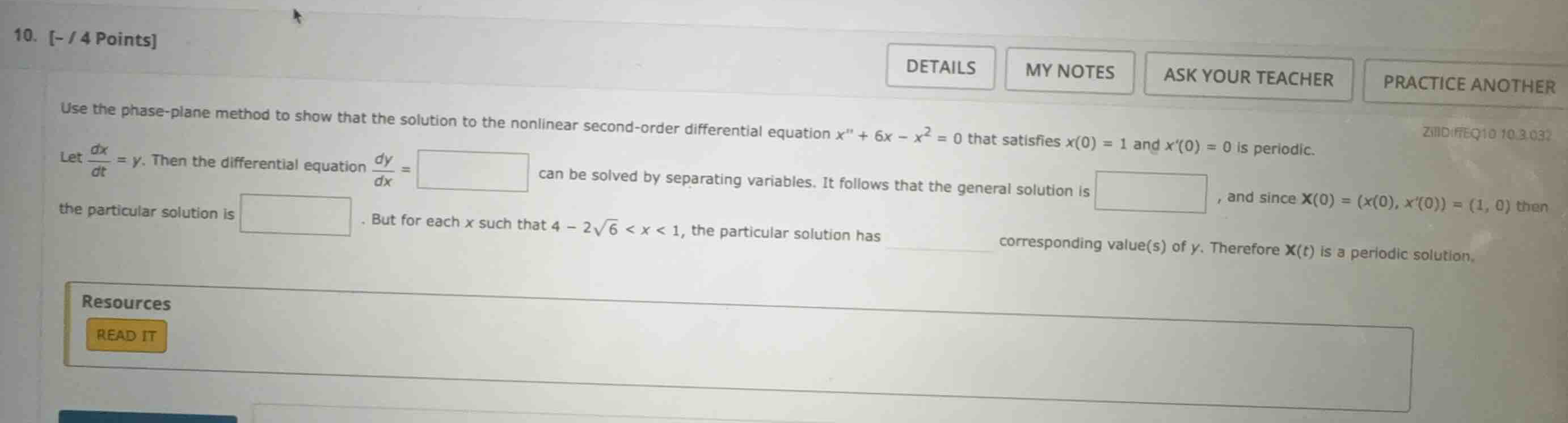
use the phase-plane method to show that the solution to the nonlinear second-order differential equation \\(x + 6x - x^2 = 0\\) that satisfies \\(x(0) = 1\\) and \\(x(0) = 0\\) is periodic.

let \\(\frac{dx}{dt} = y\\). then the differential equation \\(\frac{dy}{dx} =\\) can be solved by separating variables. it follows that the general solution is , and since \\(\mathbf{x}(0) = (x(0), x(0)) = (1, 0)\\) then the particular solution is . but for each \\(x\\) such that \\(4 - 2\sqrt{6} < x < 1\\), the particular solution has corresponding value(s) of \\(y\\). therefore \\(\mathbf{x}(t)\\) is a periodic solution.

Explanation:

Response

<pre_analysis>
{
"quality": "clear",
"question_count": 1,
"skills_matched": [
"step_cot",
"blank_filling_formatter",
"explain_then_answer",
"tutor",
"mastery_adaptive_brevity"
],
"needs_drawing": false,
"concepts_used": [
"Phase Portrait Analysis",
"Nonlinear Systems of ODEs"
],
"new_concepts": [
"Phase-Plane Method",
"Periodic Solutions of ODEs"
],
"current_concepts": [
"Phase Portrait Analysis",
"Nonlinear Systems of ODEs",
"Phase-Plane Method",
"Periodic Solutions of ODEs"
]
}
</pre_analysis>

<reasoning>

Convert to a first-order system

Using the Nonlinear Systems of ODEs knowledge point
\[

$$\begin{aligned} &\frac{dx}{dt} = y\\ &\frac{dy}{dt} = x'' = x^2 - 6x \end{aligned}$$

\]

Formulate the phase-plane equation

Using the Phase Portrait Analysis knowledge point
\[
\frac{dy}{dx} = \frac{dy/dt}{dx/dt} = \frac{x^2 - 6x}{y}
\]

Solve by separation of variables

Using the Phase Portrait Analysis knowledge point
\[

$$\begin{aligned} &y \, dy = (x^2 - 6x) \, dx\\ &\frac{1}{2}y^2 = \frac{1}{3}x^3 - 3x^2 + C\\ &y^2 - \frac{2}{3}x^3 + 6x^2 = C_1 \end{aligned}$$

\]

Apply the initial conditions

Using the Phase Portrait Analysis knowledge point
\[

$$\begin{aligned} &x(0) = 1, \quad y(0) = 0\\ &0^2 - \frac{2}{3}(1)^3 + 6(1)^2 = \frac{16}{3}\\ &y^2 - \frac{2}{3}x^3 + 6x^2 = \frac{16}{3} \end{aligned}$$

\]

Analyze the periodic behavior

Using the Phase Portrait Analysis knowledge point
\[

$$\begin{aligned} &y^2 = \frac{2}{3}x^3 - 6x^2 + \frac{16}{3}\\ &y = \pm \sqrt{\frac{2}{3}x^3 - 6x^2 + \frac{16}{3}} \end{aligned}$$

\]
For each \(x\) in the interval \(4 - 2\sqrt{6} < x < 1\), the term inside the square root is strictly positive, yielding two real, symmetric values of \(y\).
</reasoning>

<answer>
Use the phase-plane method to show that the solution to the nonlinear second-order differential equation \(x'' + 6x - x^2 = 0\) that satisfies \(x(0) = 1\) and \(x'(0) = 0\) is periodic.

Let \(\frac{dx}{dt} = y\). Then the differential equation \(\frac{dy}{dx} =\) <blank>\(\frac{x^2-6x}{y}\)</blank> can be solved by separating variables. It follows that the general solution is <blank>\(y^2 - \frac{2}{3}x^3 + 6x^2 = C\)</blank>, and since \(\mathbf{X}(0) = (x(0), x'(0)) = (1, 0)\) then the particular solution is <blank>\(y^2 - \frac{2}{3}x^3 + 6x^2 = \frac{16}{3}\)</blank>. But for each \(x\) such that \(4 - 2\sqrt{6} < x < 1\), the particular solution has <blank>two real</blank> corresponding value(s) of \(y\). Therefore \(\mathbf{X}(t)\) is a periodic solution.
</answer>

<post_analysis>
{
"subject": "Mathematics",
"question_type": "Fill-in-the-blank",
"knowledge_point": [
"Mathematics",
"Calculus",
"Nonlinear Systems of ODEs"
]
}
</post_analysis>

Answer:

<pre_analysis>
{
"quality": "clear",
"question_count": 1,
"skills_matched": [
"step_cot",
"blank_filling_formatter",
"explain_then_answer",
"tutor",
"mastery_adaptive_brevity"
],
"needs_drawing": false,
"concepts_used": [
"Phase Portrait Analysis",
"Nonlinear Systems of ODEs"
],
"new_concepts": [
"Phase-Plane Method",
"Periodic Solutions of ODEs"
],
"current_concepts": [
"Phase Portrait Analysis",
"Nonlinear Systems of ODEs",
"Phase-Plane Method",
"Periodic Solutions of ODEs"
]
}
</pre_analysis>

<reasoning>

Convert to a first-order system

Using the Nonlinear Systems of ODEs knowledge point
\[

$$\begin{aligned} &\frac{dx}{dt} = y\\ &\frac{dy}{dt} = x'' = x^2 - 6x \end{aligned}$$

\]

Formulate the phase-plane equation

Using the Phase Portrait Analysis knowledge point
\[
\frac{dy}{dx} = \frac{dy/dt}{dx/dt} = \frac{x^2 - 6x}{y}
\]

Solve by separation of variables

Using the Phase Portrait Analysis knowledge point
\[

$$\begin{aligned} &y \, dy = (x^2 - 6x) \, dx\\ &\frac{1}{2}y^2 = \frac{1}{3}x^3 - 3x^2 + C\\ &y^2 - \frac{2}{3}x^3 + 6x^2 = C_1 \end{aligned}$$

\]

Apply the initial conditions

Using the Phase Portrait Analysis knowledge point
\[

$$\begin{aligned} &x(0) = 1, \quad y(0) = 0\\ &0^2 - \frac{2}{3}(1)^3 + 6(1)^2 = \frac{16}{3}\\ &y^2 - \frac{2}{3}x^3 + 6x^2 = \frac{16}{3} \end{aligned}$$

\]

Analyze the periodic behavior

Using the Phase Portrait Analysis knowledge point
\[

$$\begin{aligned} &y^2 = \frac{2}{3}x^3 - 6x^2 + \frac{16}{3}\\ &y = \pm \sqrt{\frac{2}{3}x^3 - 6x^2 + \frac{16}{3}} \end{aligned}$$

\]
For each \(x\) in the interval \(4 - 2\sqrt{6} < x < 1\), the term inside the square root is strictly positive, yielding two real, symmetric values of \(y\).
</reasoning>

<answer>
Use the phase-plane method to show that the solution to the nonlinear second-order differential equation \(x'' + 6x - x^2 = 0\) that satisfies \(x(0) = 1\) and \(x'(0) = 0\) is periodic.

Let \(\frac{dx}{dt} = y\). Then the differential equation \(\frac{dy}{dx} =\) <blank>\(\frac{x^2-6x}{y}\)</blank> can be solved by separating variables. It follows that the general solution is <blank>\(y^2 - \frac{2}{3}x^3 + 6x^2 = C\)</blank>, and since \(\mathbf{X}(0) = (x(0), x'(0)) = (1, 0)\) then the particular solution is <blank>\(y^2 - \frac{2}{3}x^3 + 6x^2 = \frac{16}{3}\)</blank>. But for each \(x\) such that \(4 - 2\sqrt{6} < x < 1\), the particular solution has <blank>two real</blank> corresponding value(s) of \(y\). Therefore \(\mathbf{X}(t)\) is a periodic solution.
</answer>

<post_analysis>
{
"subject": "Mathematics",
"question_type": "Fill-in-the-blank",
"knowledge_point": [
"Mathematics",
"Calculus",
"Nonlinear Systems of ODEs"
]
}
</post_analysis>