QUESTION IMAGE
Question
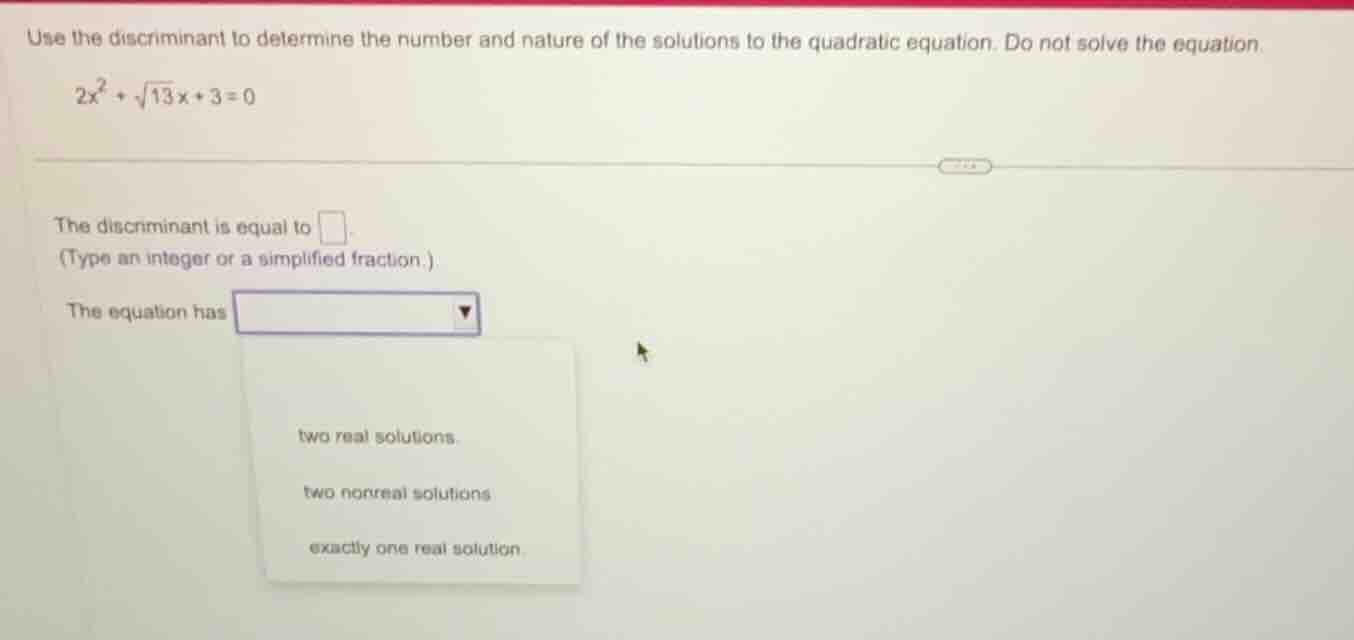
use the discriminant to determine the number and nature of the solutions to the quadratic equation. do not solve the equation.
(2x^2 + \sqrt{13}x + 3 = 0)
the discriminant is equal to .
(type an integer or a simplified fraction.)
the equation has
- two real solutions
- two nonreal solutions
- exactly one real solution
<pre_analysis>
{
"quality": "clear",
"question_count": 1,
"skills_matched": [
"step_cot",
"blank_filling_formatter",
"explain_then_answer",
"quick"
],
"needs_drawing": false,
"concepts_used": [
"Quadratic Equations"
],
"new_concepts": [
"Discriminant Analysis"
],
"current_concepts": [
"Quadratic Equations",
"Discriminant Analysis"
]
}
</pre_analysis>
<reasoning>
Identify coefficients of the quadratic equation
\[
\]
Calculate the discriminant
\[
\]
Determine the number and nature of solutions
\[
\]
</reasoning>
<answer>
Use the discriminant to determine the number and nature of the solutions to the quadratic equation. Do not solve the equation.
\(2x^2 + \sqrt{13}x + 3 = 0\)
The discriminant is equal to <blank>-11</blank>.
(Type an integer or a simplified fraction.)
The equation has <blank>two nonreal solutions</blank>.
</answer>
<post_analysis>
{
"subject": "Mathematics",
"question_type": "Fill-in-the-blank",
"knowledge_point": [
"Mathematics",
"Algebra",
"Discriminant Analysis"
]
}
</post_analysis>
Snap & solve any problem in the app
Get step-by-step solutions on Sovi AI
Photo-based solutions with guided steps
Explore more problems and detailed explanations
<pre_analysis>
{
"quality": "clear",
"question_count": 1,
"skills_matched": [
"step_cot",
"blank_filling_formatter",
"explain_then_answer",
"quick"
],
"needs_drawing": false,
"concepts_used": [
"Quadratic Equations"
],
"new_concepts": [
"Discriminant Analysis"
],
"current_concepts": [
"Quadratic Equations",
"Discriminant Analysis"
]
}
</pre_analysis>
<reasoning>
Identify coefficients of the quadratic equation
\[
\]
Calculate the discriminant
\[
\]
Determine the number and nature of solutions
\[
\]
</reasoning>
<answer>
Use the discriminant to determine the number and nature of the solutions to the quadratic equation. Do not solve the equation.
\(2x^2 + \sqrt{13}x + 3 = 0\)
The discriminant is equal to <blank>-11</blank>.
(Type an integer or a simplified fraction.)
The equation has <blank>two nonreal solutions</blank>.
</answer>
<post_analysis>
{
"subject": "Mathematics",
"question_type": "Fill-in-the-blank",
"knowledge_point": [
"Mathematics",
"Algebra",
"Discriminant Analysis"
]
}
</post_analysis>