Sovi.AI - AI Math Tutor

Scan to solve math questions

QUESTION IMAGE

use the discriminant to determine the number and nature of the solution…

Question

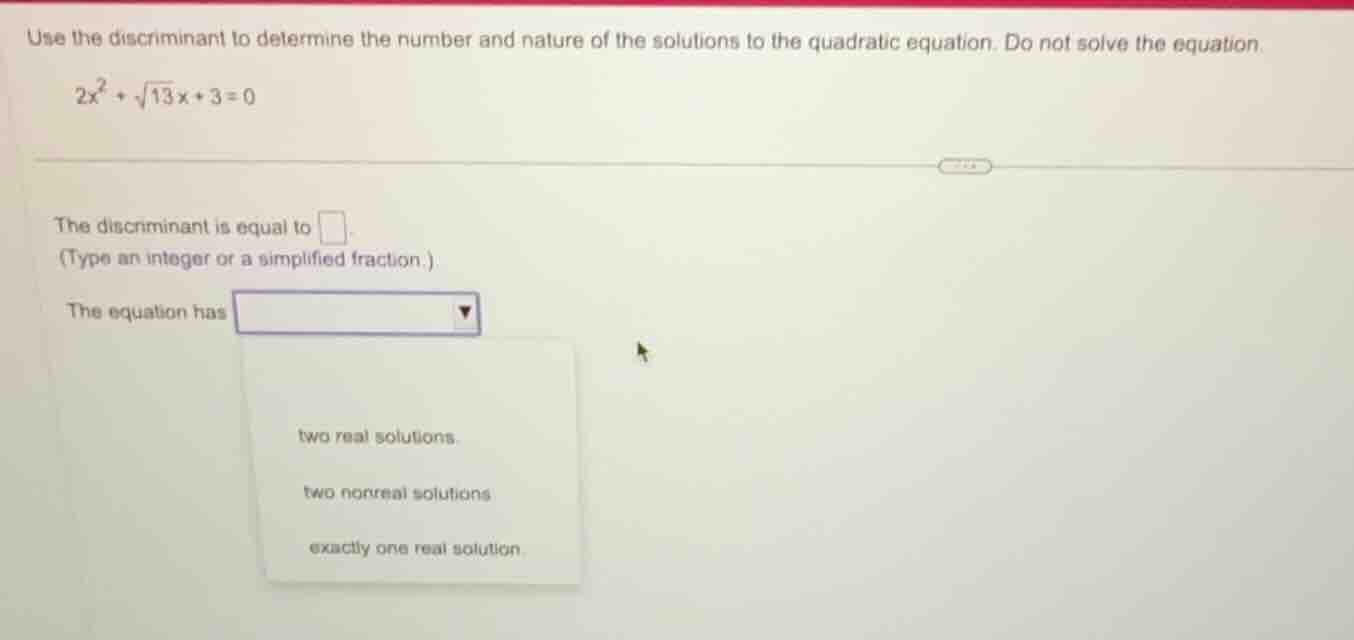
use the discriminant to determine the number and nature of the solutions to the quadratic equation. do not solve the equation.

(2x^2 + \sqrt{13}x + 3 = 0)

the discriminant is equal to .
(type an integer or a simplified fraction.)

the equation has

  • two real solutions
  • two nonreal solutions
  • exactly one real solution

Explanation:

Response

<pre_analysis>
{
"quality": "clear",
"question_count": 1,
"skills_matched": [
"step_cot",
"blank_filling_formatter",
"explain_then_answer",
"quick"
],
"needs_drawing": false,
"concepts_used": [
"Quadratic Equations"
],
"new_concepts": [
"Discriminant Analysis"
],
"current_concepts": [
"Quadratic Equations",
"Discriminant Analysis"
]
}
</pre_analysis>

<reasoning>

Identify coefficients of the quadratic equation

\[

$$\begin{aligned} &2x^2 + \sqrt{13}x + 3 = 0\\ &a = 2,\quad b = \sqrt{13},\quad c = 3 \end{aligned}$$

\]

Calculate the discriminant

\[

$$\begin{aligned} D &= b^2 - 4ac\\ D &= (\sqrt{13})^2 - 4(2)(3)\\ D &= 13 - 24\\ D &= -11 \end{aligned}$$

\]

Determine the number and nature of solutions

\[

$$\begin{aligned} &D = -11 < 0\\ &\text{Since } D < 0, \text{ the equation has two nonreal solutions.} \end{aligned}$$

\]
</reasoning>

<answer>
Use the discriminant to determine the number and nature of the solutions to the quadratic equation. Do not solve the equation.
\(2x^2 + \sqrt{13}x + 3 = 0\)

The discriminant is equal to <blank>-11</blank>.
(Type an integer or a simplified fraction.)

The equation has <blank>two nonreal solutions</blank>.
</answer>

<post_analysis>
{
"subject": "Mathematics",
"question_type": "Fill-in-the-blank",
"knowledge_point": [
"Mathematics",
"Algebra",
"Discriminant Analysis"
]
}
</post_analysis>

Answer:

<pre_analysis>
{
"quality": "clear",
"question_count": 1,
"skills_matched": [
"step_cot",
"blank_filling_formatter",
"explain_then_answer",
"quick"
],
"needs_drawing": false,
"concepts_used": [
"Quadratic Equations"
],
"new_concepts": [
"Discriminant Analysis"
],
"current_concepts": [
"Quadratic Equations",
"Discriminant Analysis"
]
}
</pre_analysis>

<reasoning>

Identify coefficients of the quadratic equation

\[

$$\begin{aligned} &2x^2 + \sqrt{13}x + 3 = 0\\ &a = 2,\quad b = \sqrt{13},\quad c = 3 \end{aligned}$$

\]

Calculate the discriminant

\[

$$\begin{aligned} D &= b^2 - 4ac\\ D &= (\sqrt{13})^2 - 4(2)(3)\\ D &= 13 - 24\\ D &= -11 \end{aligned}$$

\]

Determine the number and nature of solutions

\[

$$\begin{aligned} &D = -11 < 0\\ &\text{Since } D < 0, \text{ the equation has two nonreal solutions.} \end{aligned}$$

\]
</reasoning>

<answer>
Use the discriminant to determine the number and nature of the solutions to the quadratic equation. Do not solve the equation.
\(2x^2 + \sqrt{13}x + 3 = 0\)

The discriminant is equal to <blank>-11</blank>.
(Type an integer or a simplified fraction.)

The equation has <blank>two nonreal solutions</blank>.
</answer>

<post_analysis>
{
"subject": "Mathematics",
"question_type": "Fill-in-the-blank",
"knowledge_point": [
"Mathematics",
"Algebra",
"Discriminant Analysis"
]
}
</post_analysis>