QUESTION IMAGE
Question
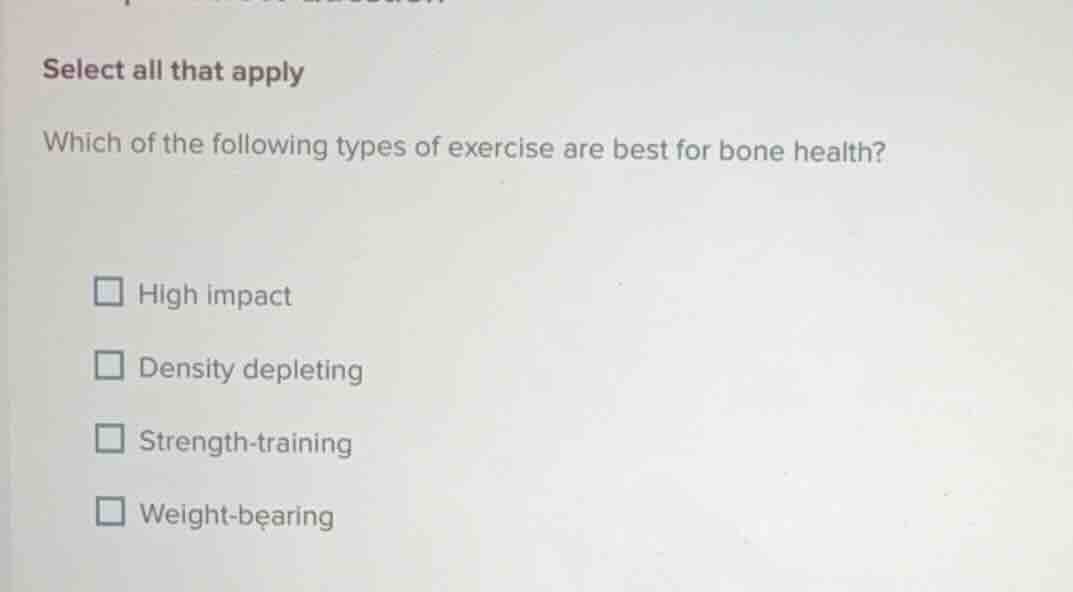
select all that apply
which of the following types of exercise are best for bone health?
high impact
density depleting
strength-training
weight-bearing
<pre_analysis>
{
"quality": "clear",
"question_count": 1,
"skills_matched": [
"direct_cot",
"multiple_choice_formatter",
"explain_then_answer",
"tutor",
"mastery_adaptive_brevity"
],
"needs_drawing": false,
"concepts_used": [
"Bone Functions",
"Bone Remodeling"
],
"new_concepts": [
"Mechanical Loading on Bone",
"Osteogenic Exercises"
],
"current_concepts": [
"Bone Functions",
"Bone Remodeling",
"Mechanical Loading on Bone",
"Osteogenic Exercises"
]
}
</pre_analysis>
<reasoning>
Analyze mechanical stress on bone remodeling
Using the Bone Remodeling and Bone Functions knowledge points
- Bone tissue adapts to mechanical stress by increasing deposition of mineral salts and collagen fibers.
- Without mechanical stress, bones undergo demineralization (loss of bone minerals) and collagen reduction.
- Therefore, exercises that place physical stress or load on the skeletal system stimulate osteoblast activity, increasing bone density.
Evaluate the exercise options
- High impact: Activities like jumping or running apply rapid, high-magnitude forces to bones, which strongly stimulates bone deposition. (Correct)
- Density depleting: This is not a standard exercise type and implies losing bone density, which is harmful to bone health. (Incorrect)
- Strength-training: Resistance exercises (e.g., lifting weights) pull on the bones via muscle contraction, promoting localized bone growth and strength. (Correct)
- Weight-bearing: Exercises where you work against gravity while staying upright (e.g., walking, hiking) force the bones to support body weight, stimulating bone maintenance. (Correct)
</reasoning>
<answer>
<mcq-correct>High impact</mcq-correct>
<mcq-option>Density depleting</mcq-option>
<mcq-correct>Strength-training</mcq-correct>
<mcq-correct>Weight-bearing</mcq-correct>
</answer>
<post_analysis>
{
"subject": "Natural Science",
"question_type": "Multiple Choice",
"knowledge_point": [
"Natural Science",
"Anatomy & Physiology",
"Skeletal System Physiology"
]
}
</post_analysis>
Snap & solve any problem in the app
Get step-by-step solutions on Sovi AI
Photo-based solutions with guided steps
Explore more problems and detailed explanations
<pre_analysis>
{
"quality": "clear",
"question_count": 1,
"skills_matched": [
"direct_cot",
"multiple_choice_formatter",
"explain_then_answer",
"tutor",
"mastery_adaptive_brevity"
],
"needs_drawing": false,
"concepts_used": [
"Bone Functions",
"Bone Remodeling"
],
"new_concepts": [
"Mechanical Loading on Bone",
"Osteogenic Exercises"
],
"current_concepts": [
"Bone Functions",
"Bone Remodeling",
"Mechanical Loading on Bone",
"Osteogenic Exercises"
]
}
</pre_analysis>
<reasoning>
Analyze mechanical stress on bone remodeling
Using the Bone Remodeling and Bone Functions knowledge points
- Bone tissue adapts to mechanical stress by increasing deposition of mineral salts and collagen fibers.
- Without mechanical stress, bones undergo demineralization (loss of bone minerals) and collagen reduction.
- Therefore, exercises that place physical stress or load on the skeletal system stimulate osteoblast activity, increasing bone density.
Evaluate the exercise options
- High impact: Activities like jumping or running apply rapid, high-magnitude forces to bones, which strongly stimulates bone deposition. (Correct)
- Density depleting: This is not a standard exercise type and implies losing bone density, which is harmful to bone health. (Incorrect)
- Strength-training: Resistance exercises (e.g., lifting weights) pull on the bones via muscle contraction, promoting localized bone growth and strength. (Correct)
- Weight-bearing: Exercises where you work against gravity while staying upright (e.g., walking, hiking) force the bones to support body weight, stimulating bone maintenance. (Correct)
</reasoning>
<answer>
<mcq-correct>High impact</mcq-correct>
<mcq-option>Density depleting</mcq-option>
<mcq-correct>Strength-training</mcq-correct>
<mcq-correct>Weight-bearing</mcq-correct>
</answer>
<post_analysis>
{
"subject": "Natural Science",
"question_type": "Multiple Choice",
"knowledge_point": [
"Natural Science",
"Anatomy & Physiology",
"Skeletal System Physiology"
]
}
</post_analysis>