Sovi.AI - AI Math Tutor

Scan to solve math questions

QUESTION IMAGE

select all that apply which of the following types of exercise are best…

Question

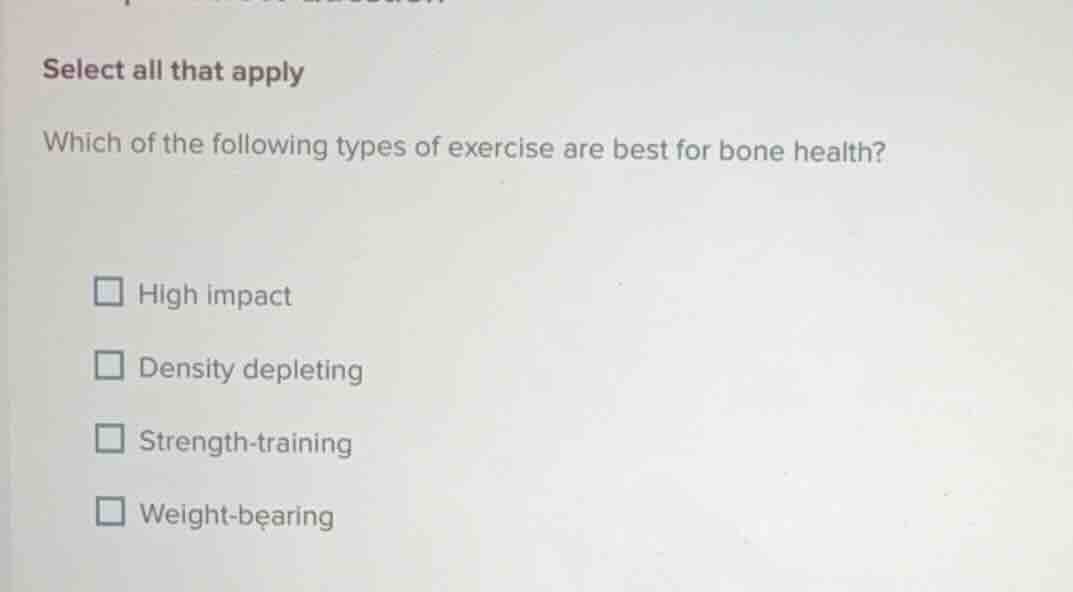
select all that apply

which of the following types of exercise are best for bone health?

high impact
density depleting
strength-training
weight-bearing

Explanation:

Response

<pre_analysis>
{
"quality": "clear",
"question_count": 1,
"skills_matched": [
"direct_cot",
"multiple_choice_formatter",
"explain_then_answer",
"tutor",
"mastery_adaptive_brevity"
],
"needs_drawing": false,
"concepts_used": [
"Bone Functions",
"Bone Remodeling"
],
"new_concepts": [
"Mechanical Loading on Bone",
"Osteogenic Exercises"
],
"current_concepts": [
"Bone Functions",
"Bone Remodeling",
"Mechanical Loading on Bone",
"Osteogenic Exercises"
]
}
</pre_analysis>

<reasoning>

Analyze mechanical stress on bone remodeling

Using the Bone Remodeling and Bone Functions knowledge points

  • Bone tissue adapts to mechanical stress by increasing deposition of mineral salts and collagen fibers.
  • Without mechanical stress, bones undergo demineralization (loss of bone minerals) and collagen reduction.
  • Therefore, exercises that place physical stress or load on the skeletal system stimulate osteoblast activity, increasing bone density.

Evaluate the exercise options

  • High impact: Activities like jumping or running apply rapid, high-magnitude forces to bones, which strongly stimulates bone deposition. (Correct)
  • Density depleting: This is not a standard exercise type and implies losing bone density, which is harmful to bone health. (Incorrect)
  • Strength-training: Resistance exercises (e.g., lifting weights) pull on the bones via muscle contraction, promoting localized bone growth and strength. (Correct)
  • Weight-bearing: Exercises where you work against gravity while staying upright (e.g., walking, hiking) force the bones to support body weight, stimulating bone maintenance. (Correct)

</reasoning>

<answer>
<mcq-correct>High impact</mcq-correct>
<mcq-option>Density depleting</mcq-option>
<mcq-correct>Strength-training</mcq-correct>
<mcq-correct>Weight-bearing</mcq-correct>
</answer>

<post_analysis>
{
"subject": "Natural Science",
"question_type": "Multiple Choice",
"knowledge_point": [
"Natural Science",
"Anatomy & Physiology",
"Skeletal System Physiology"
]
}
</post_analysis>

Answer:

<pre_analysis>
{
"quality": "clear",
"question_count": 1,
"skills_matched": [
"direct_cot",
"multiple_choice_formatter",
"explain_then_answer",
"tutor",
"mastery_adaptive_brevity"
],
"needs_drawing": false,
"concepts_used": [
"Bone Functions",
"Bone Remodeling"
],
"new_concepts": [
"Mechanical Loading on Bone",
"Osteogenic Exercises"
],
"current_concepts": [
"Bone Functions",
"Bone Remodeling",
"Mechanical Loading on Bone",
"Osteogenic Exercises"
]
}
</pre_analysis>

<reasoning>

Analyze mechanical stress on bone remodeling

Using the Bone Remodeling and Bone Functions knowledge points

  • Bone tissue adapts to mechanical stress by increasing deposition of mineral salts and collagen fibers.
  • Without mechanical stress, bones undergo demineralization (loss of bone minerals) and collagen reduction.
  • Therefore, exercises that place physical stress or load on the skeletal system stimulate osteoblast activity, increasing bone density.

Evaluate the exercise options

  • High impact: Activities like jumping or running apply rapid, high-magnitude forces to bones, which strongly stimulates bone deposition. (Correct)
  • Density depleting: This is not a standard exercise type and implies losing bone density, which is harmful to bone health. (Incorrect)
  • Strength-training: Resistance exercises (e.g., lifting weights) pull on the bones via muscle contraction, promoting localized bone growth and strength. (Correct)
  • Weight-bearing: Exercises where you work against gravity while staying upright (e.g., walking, hiking) force the bones to support body weight, stimulating bone maintenance. (Correct)

</reasoning>

<answer>
<mcq-correct>High impact</mcq-correct>
<mcq-option>Density depleting</mcq-option>
<mcq-correct>Strength-training</mcq-correct>
<mcq-correct>Weight-bearing</mcq-correct>
</answer>

<post_analysis>
{
"subject": "Natural Science",
"question_type": "Multiple Choice",
"knowledge_point": [
"Natural Science",
"Anatomy & Physiology",
"Skeletal System Physiology"
]
}
</post_analysis>