Sovi.AI - AI Math Tutor

Scan to solve math questions

QUESTION IMAGE

represent the quadratic polynomial \\(2x^2 + x - 6\\) using algebra til…

Question

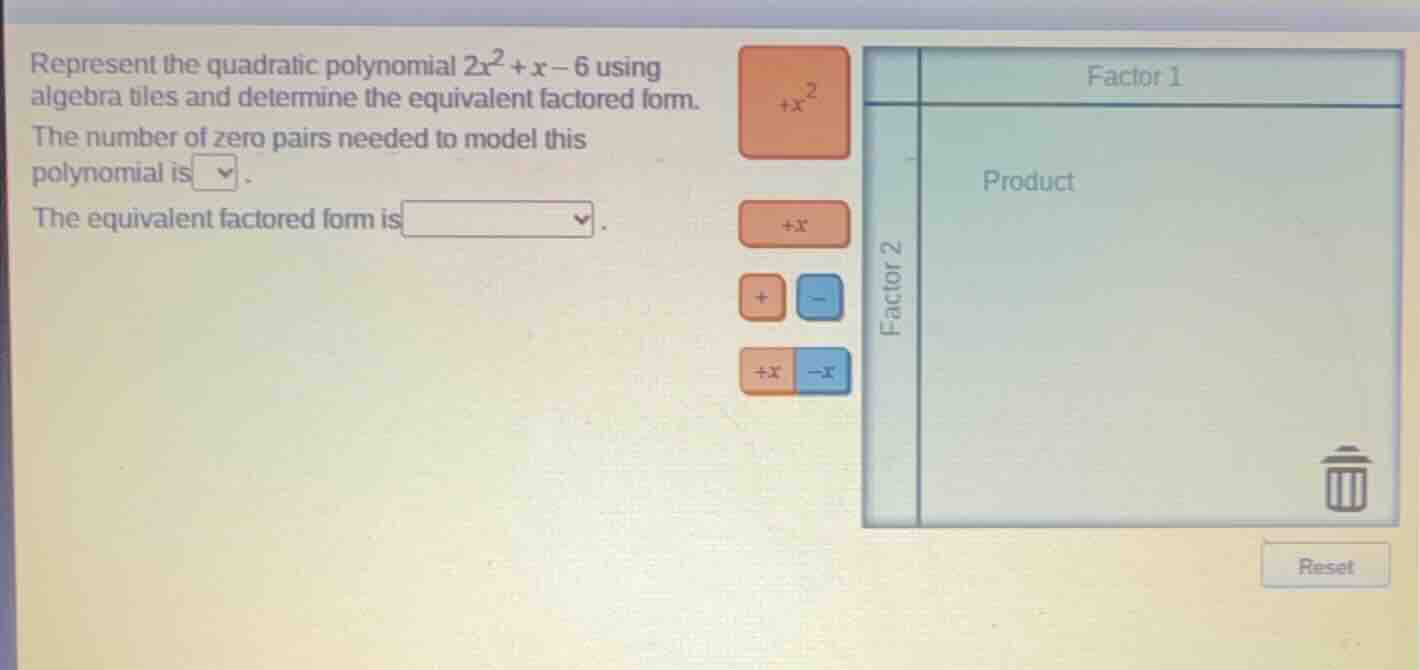
represent the quadratic polynomial \\(2x^2 + x - 6\\) using algebra tiles and determine the equivalent factored form.
the number of zero pairs needed to model this polynomial is dropdown.
the equivalent factored form is dropdown.

Explanation:

Response

<pre_analysis>
{
"quality": "clear",
"question_count": 1,
"skills_matched": [
"step_cot",
"blank_filling_formatter",
"explain_then_answer",
"tutor"
],
"needs_drawing": false,
"concepts_used": [
"Algebra Tiles",
"Factoring Trinomials"
],
"new_concepts": [],
"current_concepts": [
"Algebra Tiles",
"Factoring Trinomials"
]
}
</pre_analysis>

<reasoning>

Analyze the quadratic polynomial

We are given the quadratic polynomial \(2x^2 + x - 6\). To represent this polynomial using Algebra Tiles in a rectangular grid, we need to arrange two \(+x^2\) tiles, some \(x\) tiles (both positive and negative), and six \(-1\) tiles into a perfect rectangle.

Determine the required zero pairs

To factor \(2x^2 + x - 6\) using Factoring Trinomials, we look for two numbers that multiply to \(a \cdot c = 2 \cdot (-6) = -12\) and add up to \(b = 1\).
These two numbers are \(4\) and \(-3\) because:
\[
4 \cdot (-3) = -12
\]
\[
4 + (-3) = 1
\]
This means we need to split the middle term \(+x\) into \(4x - 3x\).
In terms of Algebra Tiles, we start with one \(+x\) tile. To get \(4\) positive \(x\) tiles and \(3\) negative \(x\) tiles, we must add zero pairs of \(x\) tiles (each pair consists of one \(+x\) and one \(-x\) tile).
Since we need \(4\) positive \(x\) tiles and we only have \(1\) positive \(x\) tile, we must add \(3\) more positive \(x\) tiles along with \(3\) negative \(-x\) tiles.
Thus, the number of zero pairs of \(x\) tiles needed is \(3\).

Find the equivalent factored form

Using the split middle term, we rewrite and factor the polynomial by grouping:
\[
2x^2 + 4x - 3x - 6
\]
Group the terms:
\[
(2x^2 + 4x) - (3x + 6)
\]
Factor out the greatest common factor from each group:
\[
2x(x + 2) - 3(x + 2)
\]
Factor out the common binomial \((x + 2)\):
\[
(2x - 3)(x + 2)
\]
This represents the dimensions of the rectangle formed by the algebra tiles, which gives the equivalent factored form.
</reasoning>

<answer>
Represent the quadratic polynomial \(2x^2 + x - 6\) using algebra tiles and determine the equivalent factored form.
The number of zero pairs needed to model this polynomial is <blank>3</blank>.
The equivalent factored form is <blank>\((2x - 3)(x + 2)\)</blank>.
</answer>

<post_analysis>
{
"subject": "Mathematics",
"question_type": "Fill-in-the-blank",
"knowledge_point": [
"Mathematics",
"Algebra",
"Factoring Polynomials"
]
}
</post_analysis>

Answer:

<pre_analysis>
{
"quality": "clear",
"question_count": 1,
"skills_matched": [
"step_cot",
"blank_filling_formatter",
"explain_then_answer",
"tutor"
],
"needs_drawing": false,
"concepts_used": [
"Algebra Tiles",
"Factoring Trinomials"
],
"new_concepts": [],
"current_concepts": [
"Algebra Tiles",
"Factoring Trinomials"
]
}
</pre_analysis>

<reasoning>

Analyze the quadratic polynomial

We are given the quadratic polynomial \(2x^2 + x - 6\). To represent this polynomial using Algebra Tiles in a rectangular grid, we need to arrange two \(+x^2\) tiles, some \(x\) tiles (both positive and negative), and six \(-1\) tiles into a perfect rectangle.

Determine the required zero pairs

To factor \(2x^2 + x - 6\) using Factoring Trinomials, we look for two numbers that multiply to \(a \cdot c = 2 \cdot (-6) = -12\) and add up to \(b = 1\).
These two numbers are \(4\) and \(-3\) because:
\[
4 \cdot (-3) = -12
\]
\[
4 + (-3) = 1
\]
This means we need to split the middle term \(+x\) into \(4x - 3x\).
In terms of Algebra Tiles, we start with one \(+x\) tile. To get \(4\) positive \(x\) tiles and \(3\) negative \(x\) tiles, we must add zero pairs of \(x\) tiles (each pair consists of one \(+x\) and one \(-x\) tile).
Since we need \(4\) positive \(x\) tiles and we only have \(1\) positive \(x\) tile, we must add \(3\) more positive \(x\) tiles along with \(3\) negative \(-x\) tiles.
Thus, the number of zero pairs of \(x\) tiles needed is \(3\).

Find the equivalent factored form

Using the split middle term, we rewrite and factor the polynomial by grouping:
\[
2x^2 + 4x - 3x - 6
\]
Group the terms:
\[
(2x^2 + 4x) - (3x + 6)
\]
Factor out the greatest common factor from each group:
\[
2x(x + 2) - 3(x + 2)
\]
Factor out the common binomial \((x + 2)\):
\[
(2x - 3)(x + 2)
\]
This represents the dimensions of the rectangle formed by the algebra tiles, which gives the equivalent factored form.
</reasoning>

<answer>
Represent the quadratic polynomial \(2x^2 + x - 6\) using algebra tiles and determine the equivalent factored form.
The number of zero pairs needed to model this polynomial is <blank>3</blank>.
The equivalent factored form is <blank>\((2x - 3)(x + 2)\)</blank>.
</answer>

<post_analysis>
{
"subject": "Mathematics",
"question_type": "Fill-in-the-blank",
"knowledge_point": [
"Mathematics",
"Algebra",
"Factoring Polynomials"
]
}
</post_analysis>