QUESTION IMAGE
Question
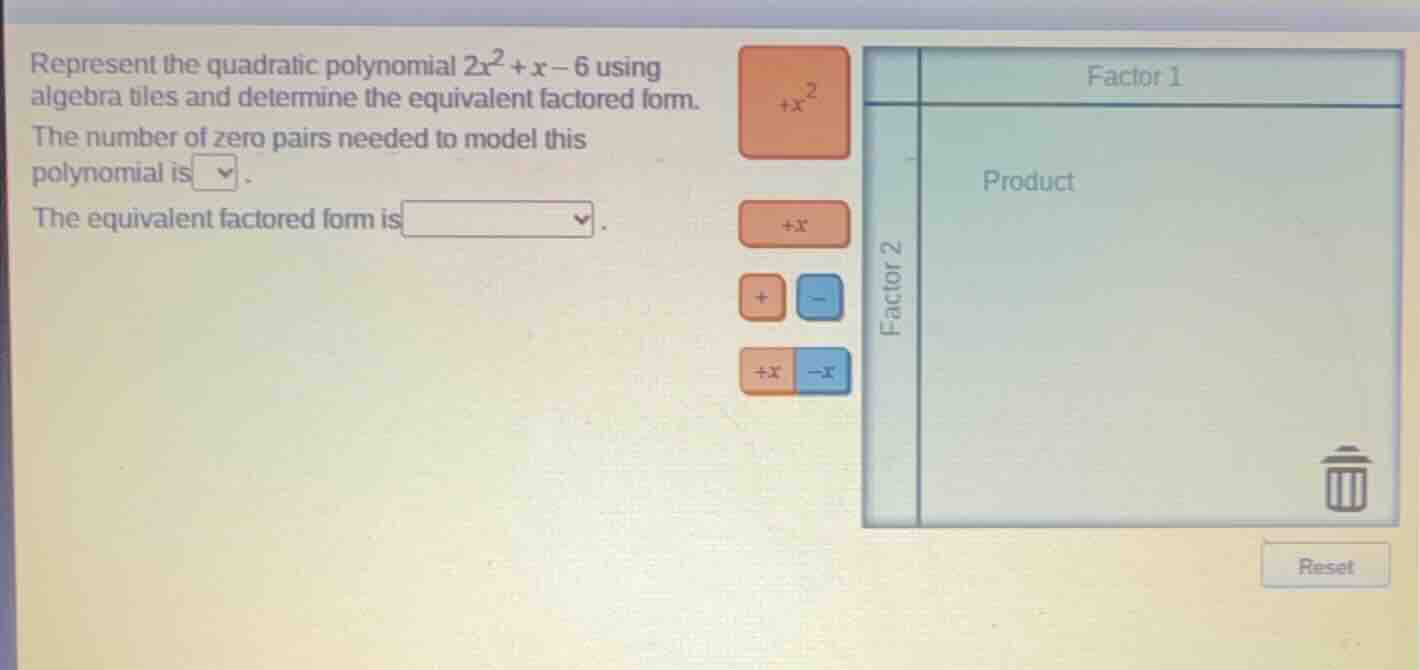
represent the quadratic polynomial \\(2x^2 + x - 6\\) using algebra tiles and determine the equivalent factored form.
the number of zero pairs needed to model this polynomial is dropdown.
the equivalent factored form is dropdown.
Analyze the quadratic polynomial
We are given the quadratic polynomial \(2x^2 + x - 6\). To represent this polynomial using Algebra Tiles in a rectangular grid, we need to arrange two \(+x^2\) tiles, some \(x\) tiles (both positive and negative), and six \(-1\) tiles into a perfect rectangle.
Determine the required zero pairs
To factor \(2x^2 + x - 6\) using Factoring Trinomials, we look for two numbers that multiply to \(a \cdot c = 2 \cdot (-6) = -12\) and add up to \(b = 1\).
These two numbers are \(4\) and \(-3\) because:
This means we need to split the middle term \(+x\) into \(4x - 3x\).
In terms of Algebra Tiles, we start with one \(+x\) tile. To get \(4\) positive \(x\) tiles and \(3\) negative \(x\) tiles, we must add zero pairs of \(x\) tiles (each pair consists of one \(+x\) and one \(-x\) tile).
Since we need \(4\) positive \(x\) tiles and we only have \(1\) positive \(x\) tile, we must add \(3\) more positive \(x\) tiles along with \(3\) negative \(-x\) tiles.
Thus, the number of zero pairs of \(x\) tiles needed is \(3\).
Find the equivalent factored form
Using the split middle term, we rewrite and factor the polynomial by grouping:
Group the terms:
Factor out the greatest common factor from each group:
Factor out the common binomial \((x + 2)\):
This represents the dimensions of the rectangle formed by the algebra tiles, which gives the equivalent factored form.

Snap & solve any problem in the app
Get step-by-step solutions on Sovi AI
Photo-based solutions with guided steps
Explore more problems and detailed explanations
Represent the quadratic polynomial \(2x^2 + x - 6\) using algebra tiles and determine the equivalent factored form.
The number of zero pairs needed to model this polynomial is <blank>3</blank>.
The equivalent factored form is <blank>\((2x - 3)(x + 2)\)</blank>.