Sovi.AI - AI Math Tutor

Scan to solve math questions

QUESTION IMAGE

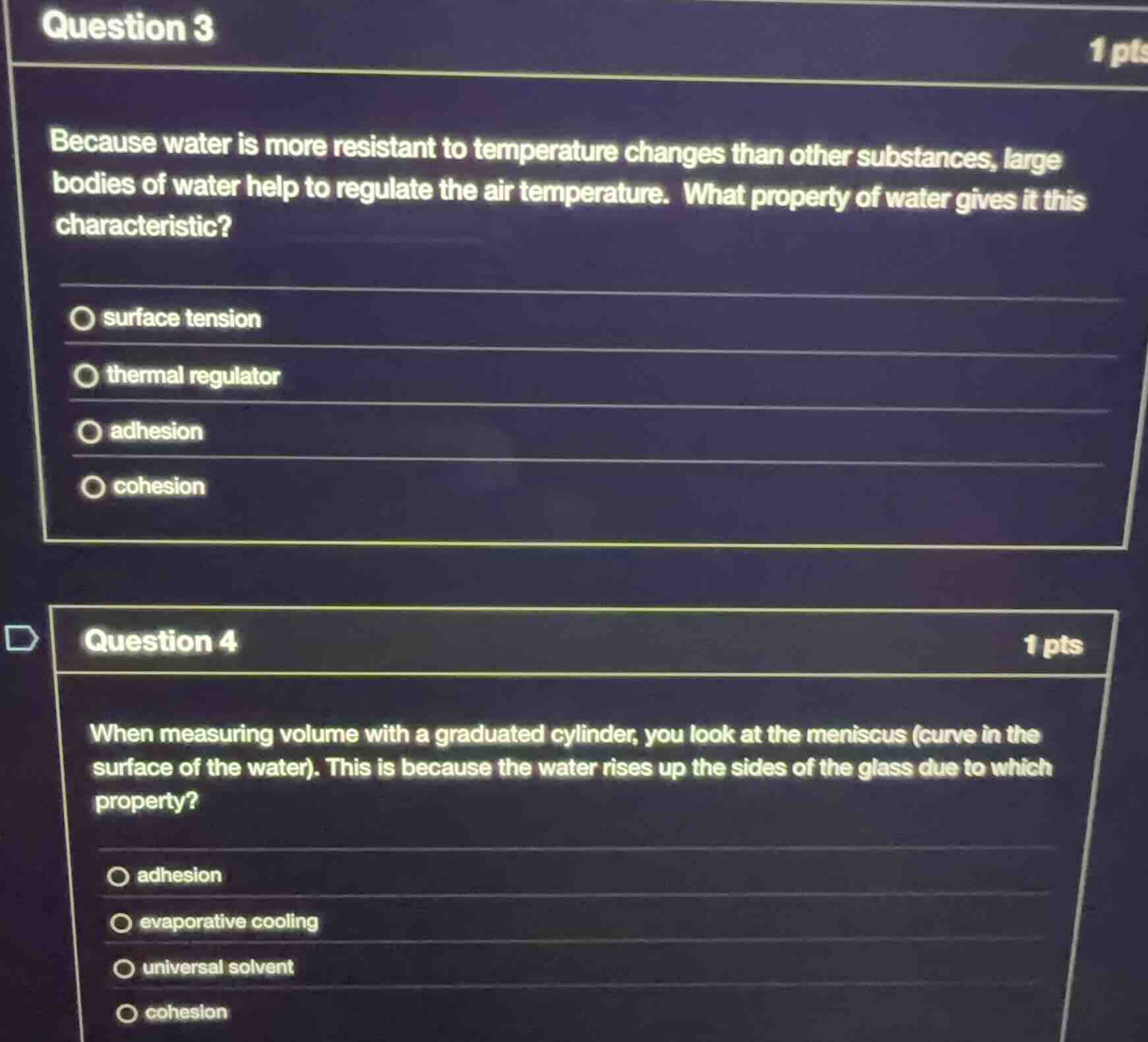
question 3 because water is more resistant to temperature changes than …

Question

question 3
because water is more resistant to temperature changes than other substances, large bodies of water help to regulate the air temperature. what property of water gives it this characteristic?
surface tension
thermal regulator
adhesion
cohesion

question 4
when measuring volume with a graduated cylinder, you look at the meniscus (curve in the surface of the water). this is because the water rises up the sides of the glass due to which property?
adhesion
evaporative cooling
universal solvent
cohesion

Explanation:

Response

<pre_analysis>
{
"quality": "clear",
"question_count": 2,
"skills_matched": [
"direct_cot",
"multiple_choice_formatter",
"explain_then_answer",
"tutor",
"mastery_adaptive_brevity"
],
"needs_drawing": false,
"concepts_used": [
"Hydrogen Bonding"
],
"new_concepts": [
"Specific Heat Capacity",
"Adhesion and Cohesion"
],
"current_concepts": [
"Hydrogen Bonding",
"Specific Heat Capacity",
"Adhesion and Cohesion"
]
}
</pre_analysis>

<reasoning>

Analyze Question 3

Using the Hydrogen Bonding knowledge point
Water's high resistance to temperature changes is due to its high specific heat capacity, which is a direct result of Hydrogen Bonding. In the given options, "thermal regulator" is the term that describes this functional characteristic of water regulating temperature.

Analyze Question 4

The rising of water up the sides of a glass graduated cylinder to form a meniscus is caused by the attraction between water molecules and the glass molecules. This attraction between different substances is known as adhesion.
</reasoning>

<answer>

Question 3

<mcq-option>surface tension</mcq-option>
<mcq-correct>thermal regulator</mcq-correct>
<mcq-option>adhesion</mcq-option>
<mcq-option>cohesion</mcq-option>

Question 4

<mcq-correct>adhesion</mcq-correct>
<mcq-option>evaporative cooling</mcq-option>
<mcq-option>universal solvent</mcq-option>
<mcq-option>cohesion</mcq-option>
</answer>

<post_analysis>
{
"subject": "Natural Science",
"question_type": "Multiple Choice",
"knowledge_point": [
"Natural Science",
"Biology",
"Properties of Water"
]
}
</post_analysis>

Answer:

<pre_analysis>
{
"quality": "clear",
"question_count": 2,
"skills_matched": [
"direct_cot",
"multiple_choice_formatter",
"explain_then_answer",
"tutor",
"mastery_adaptive_brevity"
],
"needs_drawing": false,
"concepts_used": [
"Hydrogen Bonding"
],
"new_concepts": [
"Specific Heat Capacity",
"Adhesion and Cohesion"
],
"current_concepts": [
"Hydrogen Bonding",
"Specific Heat Capacity",
"Adhesion and Cohesion"
]
}
</pre_analysis>

<reasoning>

Analyze Question 3

Using the Hydrogen Bonding knowledge point
Water's high resistance to temperature changes is due to its high specific heat capacity, which is a direct result of Hydrogen Bonding. In the given options, "thermal regulator" is the term that describes this functional characteristic of water regulating temperature.

Analyze Question 4

The rising of water up the sides of a glass graduated cylinder to form a meniscus is caused by the attraction between water molecules and the glass molecules. This attraction between different substances is known as adhesion.
</reasoning>

<answer>

Question 3

<mcq-option>surface tension</mcq-option>
<mcq-correct>thermal regulator</mcq-correct>
<mcq-option>adhesion</mcq-option>
<mcq-option>cohesion</mcq-option>

Question 4

<mcq-correct>adhesion</mcq-correct>
<mcq-option>evaporative cooling</mcq-option>
<mcq-option>universal solvent</mcq-option>
<mcq-option>cohesion</mcq-option>
</answer>

<post_analysis>
{
"subject": "Natural Science",
"question_type": "Multiple Choice",
"knowledge_point": [
"Natural Science",
"Biology",
"Properties of Water"
]
}
</post_analysis>