QUESTION IMAGE
Question
question 24 of 26
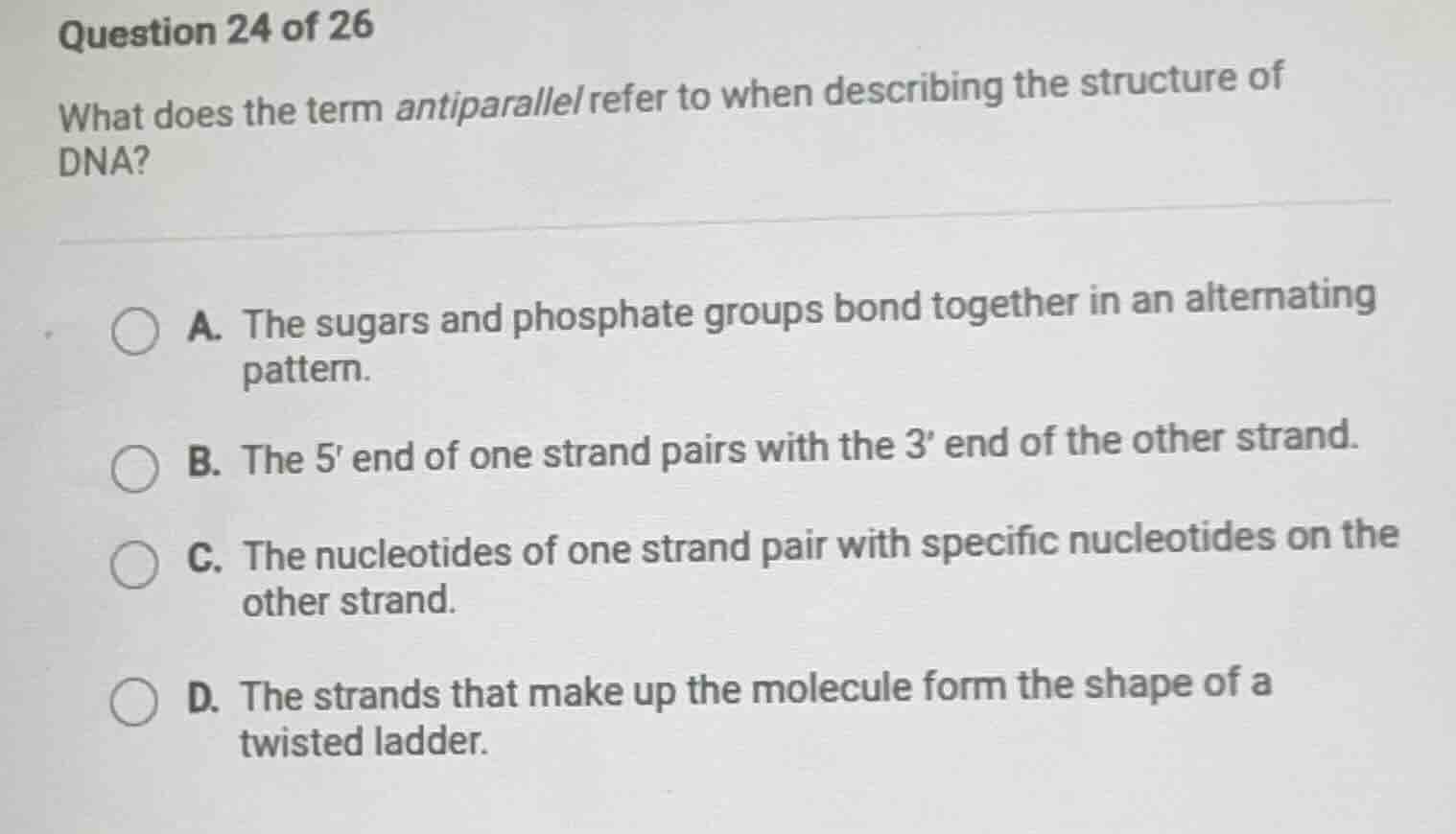
what does the term antiparallel refer to when describing the structure of dna?
a. the sugars and phosphate groups bond together in an alternating pattern.
b. the 5 end of one strand pairs with the 3 end of the other strand.
c. the nucleotides of one strand pair with specific nucleotides on the other strand.
d. the strands that make up the molecule form the shape of a twisted ladder.
<pre_analysis>
{
"quality": "clear",
"question_count": 1,
"skills_matched": [
"direct_cot",
"multiple_choice_formatter",
"explain_then_answer",
"quick"
],
"needs_drawing": false,
"concepts_used": [
"DNA Structure"
],
"new_concepts": [],
"current_concepts": [
"DNA Structure"
]
}
</pre_analysis>
<reasoning>
Define antiparallel in DNA
The term "antiparallel" in DNA structure means that the two strands of the double helix run parallel to each other but in opposite directions. One strand runs in the \(5'\) to \(3'\) direction, while the complementary strand runs in the \(3'\) to \(5'\) direction.
Analyze the given options
- A describes the sugar-phosphate backbone structure, not the relative directionality of the two strands.
- B correctly states that the \(5'\) end of one strand aligns and pairs with the \(3'\) end of the complementary strand, reflecting their opposite orientations.
- C describes complementary base pairing, not the antiparallel orientation.
- D describes the double helix shape, not the antiparallel nature of the strands.
</reasoning>
<answer>
<mcq-option>(A) The sugars and phosphate groups bond together in an alternating pattern.</mcq-option>
<mcq-correct>(B) The 5' end of one strand pairs with the 3' end of the other strand.</mcq-correct>
<mcq-option>(C) The nucleotides of one strand pair with specific nucleotides on the other strand.</mcq-option>
<mcq-option>(D) The strands that make up the molecule form the shape of a twisted ladder.</mcq-option>
</answer>
<post_analysis>
{
"subject": "Natural Science",
"question_type": "Multiple Choice",
"knowledge_point": [
"Natural Science",
"Biology",
"DNA Structure"
]
}
</post_analysis>
Snap & solve any problem in the app
Get step-by-step solutions on Sovi AI
Photo-based solutions with guided steps
Explore more problems and detailed explanations
<pre_analysis>
{
"quality": "clear",
"question_count": 1,
"skills_matched": [
"direct_cot",
"multiple_choice_formatter",
"explain_then_answer",
"quick"
],
"needs_drawing": false,
"concepts_used": [
"DNA Structure"
],
"new_concepts": [],
"current_concepts": [
"DNA Structure"
]
}
</pre_analysis>
<reasoning>
Define antiparallel in DNA
The term "antiparallel" in DNA structure means that the two strands of the double helix run parallel to each other but in opposite directions. One strand runs in the \(5'\) to \(3'\) direction, while the complementary strand runs in the \(3'\) to \(5'\) direction.
Analyze the given options
- A describes the sugar-phosphate backbone structure, not the relative directionality of the two strands.
- B correctly states that the \(5'\) end of one strand aligns and pairs with the \(3'\) end of the complementary strand, reflecting their opposite orientations.
- C describes complementary base pairing, not the antiparallel orientation.
- D describes the double helix shape, not the antiparallel nature of the strands.
</reasoning>
<answer>
<mcq-option>(A) The sugars and phosphate groups bond together in an alternating pattern.</mcq-option>
<mcq-correct>(B) The 5' end of one strand pairs with the 3' end of the other strand.</mcq-correct>
<mcq-option>(C) The nucleotides of one strand pair with specific nucleotides on the other strand.</mcq-option>
<mcq-option>(D) The strands that make up the molecule form the shape of a twisted ladder.</mcq-option>
</answer>
<post_analysis>
{
"subject": "Natural Science",
"question_type": "Multiple Choice",
"knowledge_point": [
"Natural Science",
"Biology",
"DNA Structure"
]
}
</post_analysis>