QUESTION IMAGE
Question
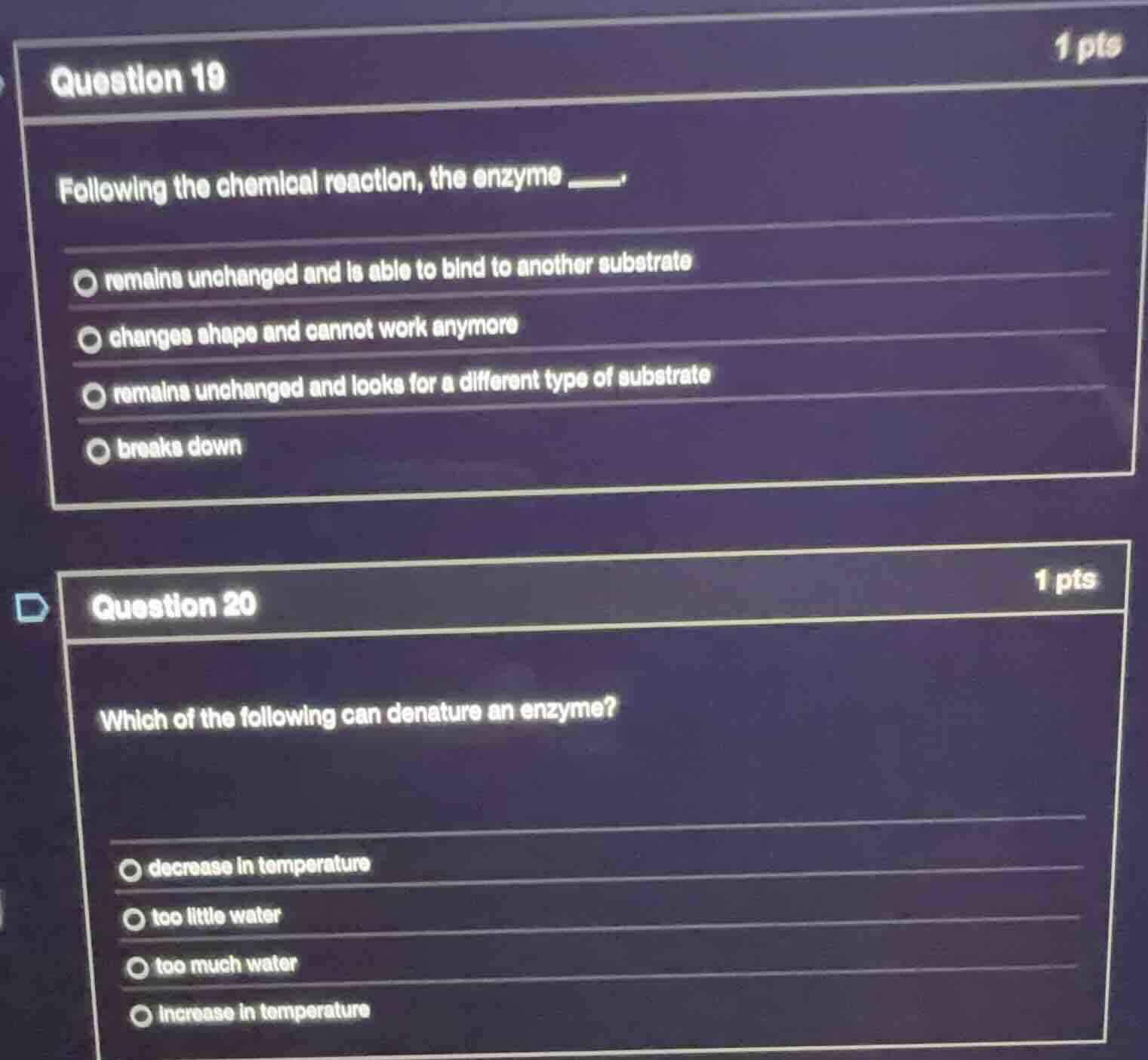
question 19
following the chemical reaction, the enzyme __.
- remains unchanged and is able to bind to another substrate
- changes shape and cannot work anymore
- remains unchanged and looks for a different type of substrate
- breaks down
question 20
which of the following can denature an enzyme?
- decrease in temperature
- too little water
- too much water
- increase in temperature
<pre_analysis>
{
"quality": "clear",
"question_count": 2,
"skills_matched": [
"direct_cot",
"multiple_choice_formatter",
"explain_then_answer",
"tutor"
],
"needs_drawing": false,
"concepts_used": [
"Protein Functions"
],
"new_concepts": [
"Enzyme Catalysis",
"Enzyme Denaturation"
],
"current_concepts": [
"Protein Functions",
"Enzyme Catalysis",
"Enzyme Denaturation"
]
}
</pre_analysis>
<reasoning>
Analyze the properties of enzymes in chemical reactions
Enzymes are biological catalysts that speed up chemical reactions without being consumed or permanently altered in the process. This relates to their role in Protein Functions, where they facilitate metabolic reactions. Because they remain unchanged after a reaction, they are free to bind to another substrate molecule and repeat the process. Therefore, for Question 19, the correct option is that the enzyme remains unchanged and is able to bind to another substrate.
Analyze factors causing enzyme denaturation
Denaturation refers to the unfolding or structural alteration of a protein, which destroys its catalytic activity. Enzymes have an optimal temperature range. While low temperatures generally slow down molecular movement and decrease reaction rates without destroying the enzyme's structure, high temperatures provide excess thermal energy that disrupts the weak chemical bonds (such as hydrogen bonds) holding the enzyme's three-dimensional shape together. This structural disruption denatures the enzyme. Therefore, for Question 20, an increase in temperature can denature an enzyme.
</reasoning>
<answer>
Question 19
<mcq-correct>remains unchanged and is able to bind to another substrate</mcq-correct>
<mcq-option>changes shape and cannot work anymore</mcq-option>
<mcq-option>remains unchanged and looks for a different type of substrate</mcq-option>
<mcq-option>breaks down</mcq-option>
Question 20
<mcq-option>decrease in temperature</mcq-option>
<mcq-option>too little water</mcq-option>
<mcq-option>too much water</mcq-option>
<mcq-correct>increase in temperature</mcq-correct>
</answer>
<post_analysis>
{
"subject": "Natural Science",
"question_type": "Multiple Choice",
"knowledge_point": [
"Natural Science",
"Biology",
"Enzymes"
]
}
</post_analysis>
Snap & solve any problem in the app
Get step-by-step solutions on Sovi AI
Photo-based solutions with guided steps
Explore more problems and detailed explanations
<pre_analysis>
{
"quality": "clear",
"question_count": 2,
"skills_matched": [
"direct_cot",
"multiple_choice_formatter",
"explain_then_answer",
"tutor"
],
"needs_drawing": false,
"concepts_used": [
"Protein Functions"
],
"new_concepts": [
"Enzyme Catalysis",
"Enzyme Denaturation"
],
"current_concepts": [
"Protein Functions",
"Enzyme Catalysis",
"Enzyme Denaturation"
]
}
</pre_analysis>
<reasoning>
Analyze the properties of enzymes in chemical reactions
Enzymes are biological catalysts that speed up chemical reactions without being consumed or permanently altered in the process. This relates to their role in Protein Functions, where they facilitate metabolic reactions. Because they remain unchanged after a reaction, they are free to bind to another substrate molecule and repeat the process. Therefore, for Question 19, the correct option is that the enzyme remains unchanged and is able to bind to another substrate.
Analyze factors causing enzyme denaturation
Denaturation refers to the unfolding or structural alteration of a protein, which destroys its catalytic activity. Enzymes have an optimal temperature range. While low temperatures generally slow down molecular movement and decrease reaction rates without destroying the enzyme's structure, high temperatures provide excess thermal energy that disrupts the weak chemical bonds (such as hydrogen bonds) holding the enzyme's three-dimensional shape together. This structural disruption denatures the enzyme. Therefore, for Question 20, an increase in temperature can denature an enzyme.
</reasoning>
<answer>
Question 19
<mcq-correct>remains unchanged and is able to bind to another substrate</mcq-correct>
<mcq-option>changes shape and cannot work anymore</mcq-option>
<mcq-option>remains unchanged and looks for a different type of substrate</mcq-option>
<mcq-option>breaks down</mcq-option>
Question 20
<mcq-option>decrease in temperature</mcq-option>
<mcq-option>too little water</mcq-option>
<mcq-option>too much water</mcq-option>
<mcq-correct>increase in temperature</mcq-correct>
</answer>
<post_analysis>
{
"subject": "Natural Science",
"question_type": "Multiple Choice",
"knowledge_point": [
"Natural Science",
"Biology",
"Enzymes"
]
}
</post_analysis>