QUESTION IMAGE
Question
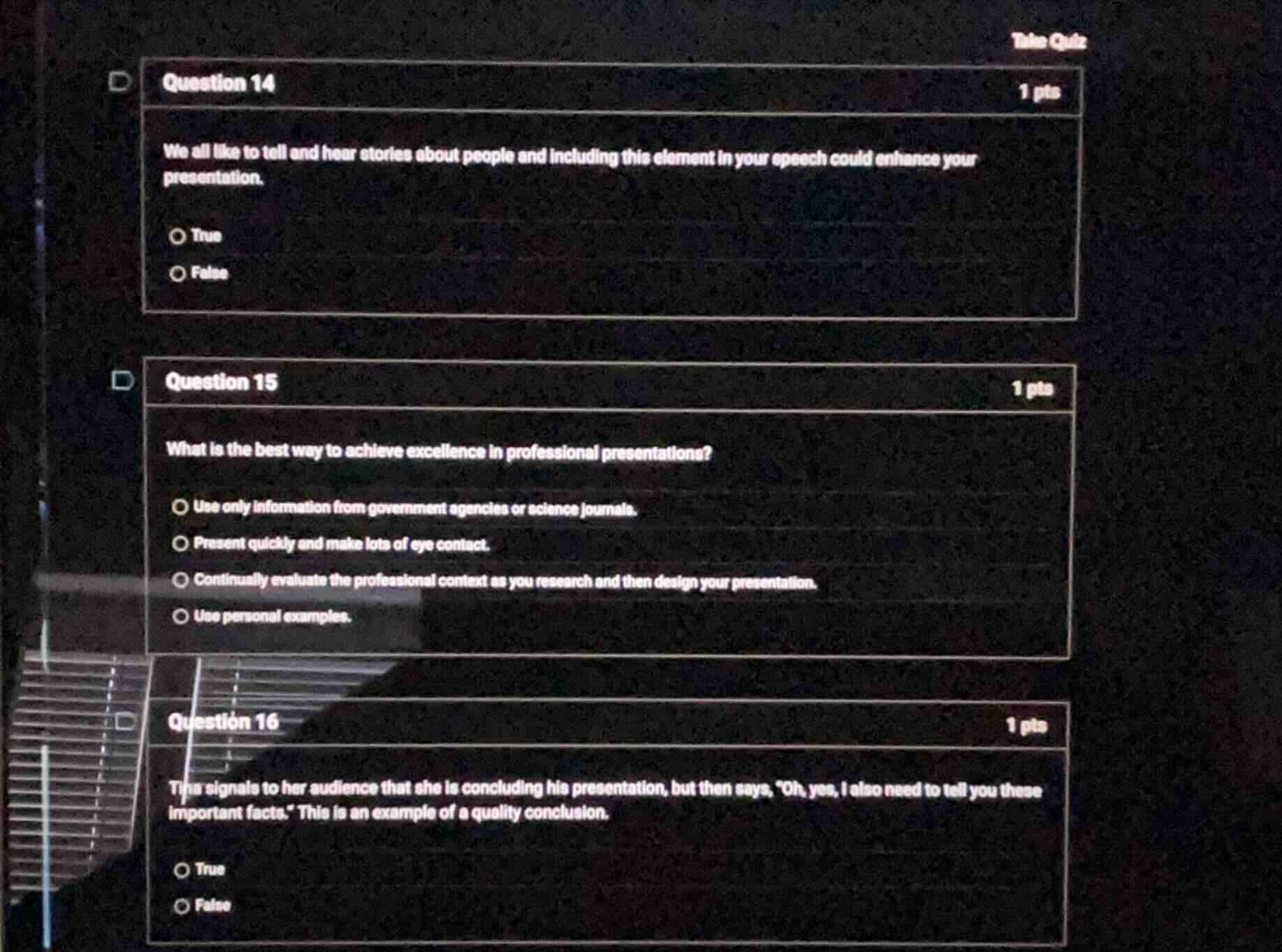
question 14
we all like to tell and hear stories about people and including this element in your speech could enhance your presentation.
true
false
question 15
what is the best way to achieve excellence in professional presentations?
use only information from government agencies or science journals.
present quickly and make lots of eye contact.
continually evaluate the professional context as you research and then design your presentation.
use personal examples.
question 16
tina signals to her audience that she is concluding his presentation, but then says, \oh, yes, i also need to tell you these important facts.\ this is an example of a quality conclusion.
true
false
<pre_analysis>
{
"quality": "clear",
"question_count": 3,
"skills_matched": [
"direct_cot",
"multiple_choice_formatter",
"explain_then_answer",
"tutor"
],
"needs_drawing": false,
"concepts_used": [
"Presentation Objectives",
"Speech Organization"
],
"new_concepts": [
"Professional Presentation Design",
"Effective Speech Conclusions"
],
"current_concepts": [
"Presentation Objectives",
"Speech Organization",
"Professional Presentation Design",
"Effective Speech Conclusions"
]
}
</pre_analysis>
<reasoning>
Analyze storytelling in presentations
Using the Presentation Objectives knowledge point, we evaluate Question 14. Human beings are naturally drawn to narratives. Incorporating stories (narrative elements) about people helps build a connection with the audience, makes complex information relatable, and increases engagement. Therefore, including this element in a speech enhances the presentation.
Determine professional presentation excellence
Using the Presentation Objectives knowledge point, we evaluate Question 15. Achieving excellence in professional presentations requires a holistic approach. While eye contact, personal examples, and credible sources are useful, the most comprehensive strategy is to continually evaluate the professional context (the audience, setting, and purpose) throughout the research and design phases to ensure the message is tailored and effective.
Evaluate speech conclusion quality
Using the Speech Organization knowledge point, we evaluate Question 16. A quality conclusion should smoothly wrap up the presentation, reinforce the main ideas, and provide closure. Signaling a conclusion but then introducing new "important facts" disrupts the structure, confuses the audience, and diminishes the impact of the speech. Thus, this is an example of a poor, rather than quality, conclusion.
</reasoning>
<answer>
Question 14
<mcq-correct>True</mcq-correct>
<mcq-option>False</mcq-option>
Question 15
<mcq-option>Use only information from government agencies or science journals.</mcq-option>
<mcq-option>Present quickly and make lots of eye contact.</mcq-option>
<mcq-correct>Continually evaluate the professional context as you research and then design your presentation.</mcq-correct>
<mcq-option>Use personal examples.</mcq-option>
Question 16
<mcq-option>True</mcq-option>
<mcq-correct>False</mcq-correct>
</answer>
<post_analysis>
{
"subject": "Social Science",
"question_type": "Multiple Choice",
"knowledge_point": [
"Social Science",
"Communication Studies",
"Public Speaking and Presentation Skills"
]
}
</post_analysis>
Snap & solve any problem in the app
Get step-by-step solutions on Sovi AI
Photo-based solutions with guided steps
Explore more problems and detailed explanations
<pre_analysis>
{
"quality": "clear",
"question_count": 3,
"skills_matched": [
"direct_cot",
"multiple_choice_formatter",
"explain_then_answer",
"tutor"
],
"needs_drawing": false,
"concepts_used": [
"Presentation Objectives",
"Speech Organization"
],
"new_concepts": [
"Professional Presentation Design",
"Effective Speech Conclusions"
],
"current_concepts": [
"Presentation Objectives",
"Speech Organization",
"Professional Presentation Design",
"Effective Speech Conclusions"
]
}
</pre_analysis>
<reasoning>
Analyze storytelling in presentations
Using the Presentation Objectives knowledge point, we evaluate Question 14. Human beings are naturally drawn to narratives. Incorporating stories (narrative elements) about people helps build a connection with the audience, makes complex information relatable, and increases engagement. Therefore, including this element in a speech enhances the presentation.
Determine professional presentation excellence
Using the Presentation Objectives knowledge point, we evaluate Question 15. Achieving excellence in professional presentations requires a holistic approach. While eye contact, personal examples, and credible sources are useful, the most comprehensive strategy is to continually evaluate the professional context (the audience, setting, and purpose) throughout the research and design phases to ensure the message is tailored and effective.
Evaluate speech conclusion quality
Using the Speech Organization knowledge point, we evaluate Question 16. A quality conclusion should smoothly wrap up the presentation, reinforce the main ideas, and provide closure. Signaling a conclusion but then introducing new "important facts" disrupts the structure, confuses the audience, and diminishes the impact of the speech. Thus, this is an example of a poor, rather than quality, conclusion.
</reasoning>
<answer>
Question 14
<mcq-correct>True</mcq-correct>
<mcq-option>False</mcq-option>
Question 15
<mcq-option>Use only information from government agencies or science journals.</mcq-option>
<mcq-option>Present quickly and make lots of eye contact.</mcq-option>
<mcq-correct>Continually evaluate the professional context as you research and then design your presentation.</mcq-correct>
<mcq-option>Use personal examples.</mcq-option>
Question 16
<mcq-option>True</mcq-option>
<mcq-correct>False</mcq-correct>
</answer>
<post_analysis>
{
"subject": "Social Science",
"question_type": "Multiple Choice",
"knowledge_point": [
"Social Science",
"Communication Studies",
"Public Speaking and Presentation Skills"
]
}
</post_analysis>