QUESTION IMAGE
Question
question 2 of 10
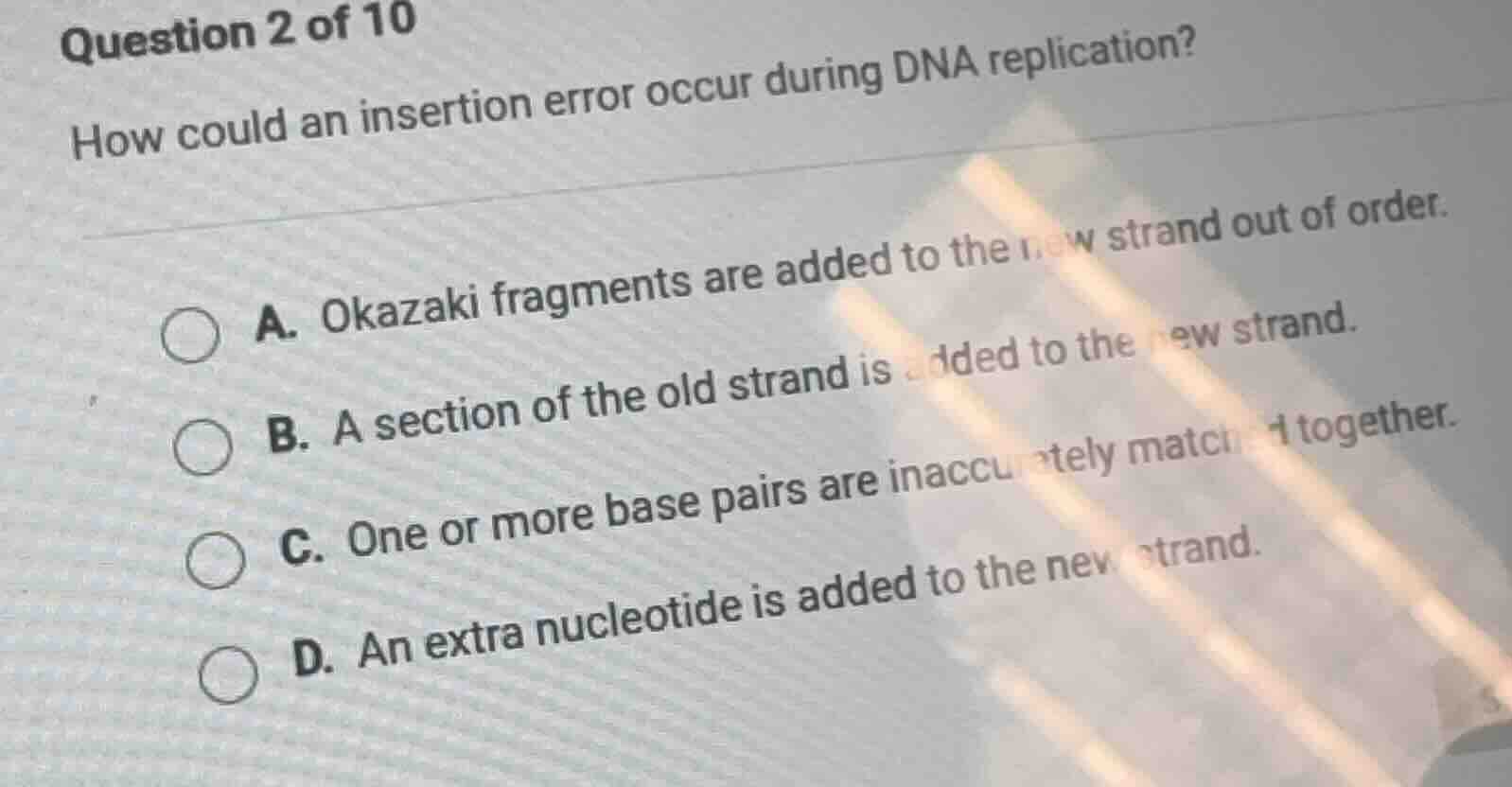
how could an insertion error occur during dna replication?
a. okazaki fragments are added to the new strand out of order.
b. a section of the old strand is added to the new strand.
c. one or more base pairs are inaccurately matched together.
d. an extra nucleotide is added to the new strand.
<pre_analysis>
{
"quality": "clear",
"question_count": 1,
"skills_matched": [
"direct_cot",
"multiple_choice_formatter",
"explain_then_answer",
"tutor"
],
"needs_drawing": false,
"concepts_used": [
"DNA Replication Errors",
"Gene Mutations"
],
"new_concepts": [
"Insertion Mutation"
],
"current_concepts": [
"DNA Replication Errors",
"Gene Mutations",
"Insertion Mutation"
]
}
</pre_analysis>
<reasoning>
Define insertion error
An insertion error during DNA replication is a type of mutation where one or more extra nucleotides are mistakenly added into the newly synthesized DNA strand. This is a core concept in Gene Mutations and DNA Replication Errors.
Analyze option A
Option A states that Okazaki fragments are added to the new strand out of order. Okazaki fragments are normal intermediates on the lagging strand during replication, and their incorrect joining does not define a simple nucleotide insertion error.
Analyze option B
Option B states that a section of the old strand is added to the new strand. The old (template) strand is used as a guide for base pairing, but physical pieces of the old strand are not directly incorporated into the newly synthesized strand.
Analyze option C
Option C states that one or more base pairs are inaccurately matched together. This describes a substitution mutation (mismatch error), not an insertion.
Analyze option D
Option D states that an extra nucleotide is added to the new strand. This directly matches the definition of an insertion mutation, where DNA polymerase adds one or more extra bases during synthesis.
</reasoning>
<answer>
<mcq-option>(A) Okazaki fragments are added to the new strand out of order.</mcq-option>
<mcq-option>(B) A section of the old strand is added to the new strand.</mcq-option>
<mcq-option>(C) One or more base pairs are inaccurately matched together.</mcq-option>
<mcq-correct>(D) An extra nucleotide is added to the new strand.</mcq-correct>
</answer>
<post_analysis>
{
"subject": "Natural Science",
"question_type": "Multiple Choice",
"knowledge_point": [
"Natural Science",
"Biology",
"DNA Replication and Mutations"
]
}
</post_analysis>
Snap & solve any problem in the app
Get step-by-step solutions on Sovi AI
Photo-based solutions with guided steps
Explore more problems and detailed explanations
<pre_analysis>
{
"quality": "clear",
"question_count": 1,
"skills_matched": [
"direct_cot",
"multiple_choice_formatter",
"explain_then_answer",
"tutor"
],
"needs_drawing": false,
"concepts_used": [
"DNA Replication Errors",
"Gene Mutations"
],
"new_concepts": [
"Insertion Mutation"
],
"current_concepts": [
"DNA Replication Errors",
"Gene Mutations",
"Insertion Mutation"
]
}
</pre_analysis>
<reasoning>
Define insertion error
An insertion error during DNA replication is a type of mutation where one or more extra nucleotides are mistakenly added into the newly synthesized DNA strand. This is a core concept in Gene Mutations and DNA Replication Errors.
Analyze option A
Option A states that Okazaki fragments are added to the new strand out of order. Okazaki fragments are normal intermediates on the lagging strand during replication, and their incorrect joining does not define a simple nucleotide insertion error.
Analyze option B
Option B states that a section of the old strand is added to the new strand. The old (template) strand is used as a guide for base pairing, but physical pieces of the old strand are not directly incorporated into the newly synthesized strand.
Analyze option C
Option C states that one or more base pairs are inaccurately matched together. This describes a substitution mutation (mismatch error), not an insertion.
Analyze option D
Option D states that an extra nucleotide is added to the new strand. This directly matches the definition of an insertion mutation, where DNA polymerase adds one or more extra bases during synthesis.
</reasoning>
<answer>
<mcq-option>(A) Okazaki fragments are added to the new strand out of order.</mcq-option>
<mcq-option>(B) A section of the old strand is added to the new strand.</mcq-option>
<mcq-option>(C) One or more base pairs are inaccurately matched together.</mcq-option>
<mcq-correct>(D) An extra nucleotide is added to the new strand.</mcq-correct>
</answer>
<post_analysis>
{
"subject": "Natural Science",
"question_type": "Multiple Choice",
"knowledge_point": [
"Natural Science",
"Biology",
"DNA Replication and Mutations"
]
}
</post_analysis>