QUESTION IMAGE
Question
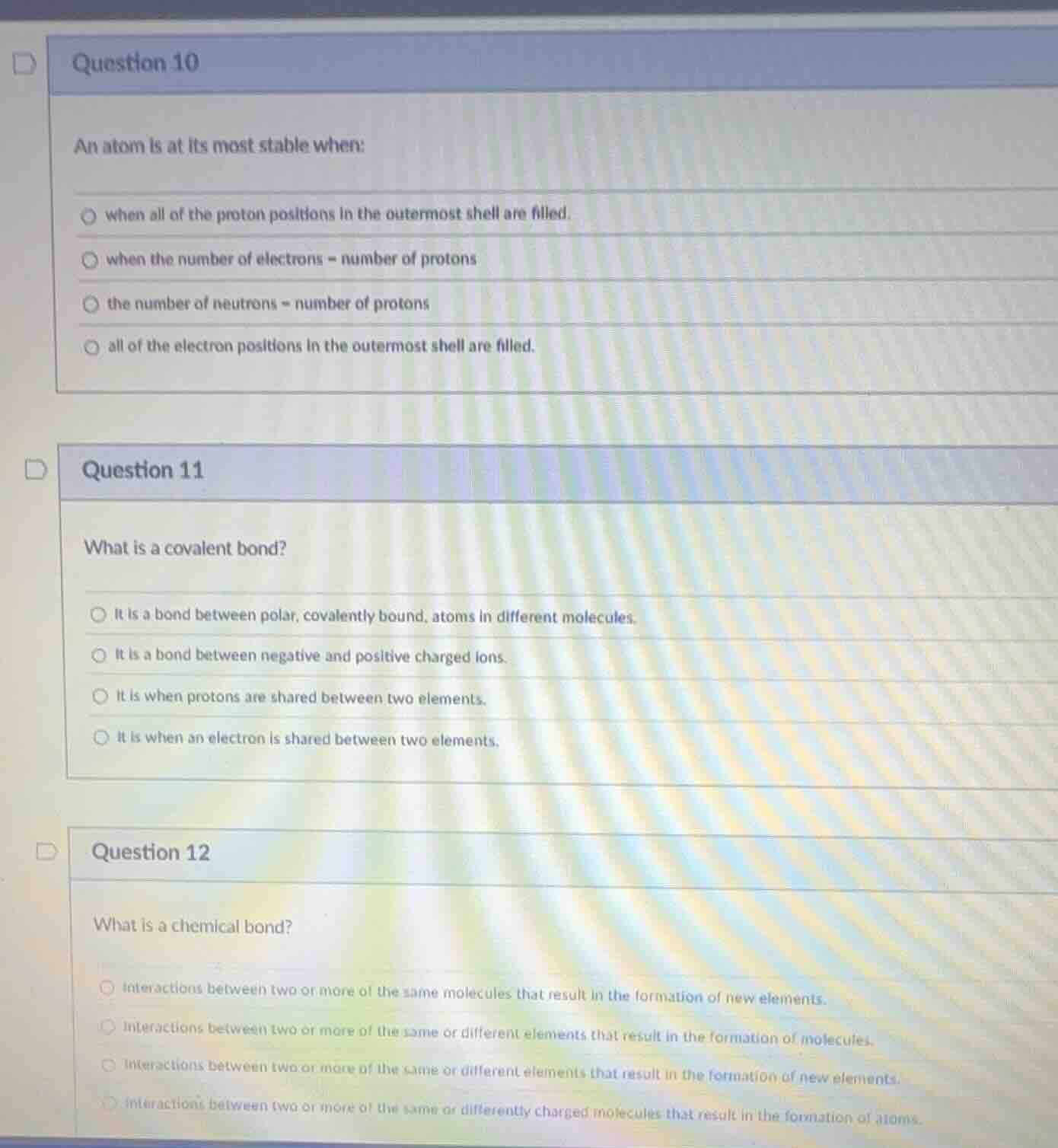
question 10
an atom is at its most stable when:
- when all of the proton positions in the outermost shell are filled.
- when the number of electrons = number of protons
- the number of neutrons = number of protons
- all of the electron positions in the outermost shell are filled.
question 11
what is a covalent bond?
- it is a bond between polar, covalently bound, atoms in different molecules.
- it is a bond between negative and positive charged ions.
- it is when protons are shared between two elements.
- it is when an electron is shared between two elements.
question 12
what is a chemical bond?
- interactions between two or more of the same molecules that result in the formation of new elements.
- interactions between two or more of the same or different elements that result in the formation of molecules.
- interactions between two or more of the same or different elements that result in the formation of new elements.
- interactions between two or more of the same or differently charged molecules that result in the formation of atoms.
Analyze atomic stability
An atom achieves maximum chemical stability when its outermost electron shell (valence shell) is completely filled with electrons, satisfying the octet rule for most main-group elements. Protons reside in the nucleus, not in shells, and equal numbers of protons and electrons represent a neutral atom, not necessarily a stable valence configuration.
Define covalent bonding
A covalent bond is a chemical bond formed when two atoms share one or more pairs of electrons. This sharing allows each atom to attain a stable, filled outer electron shell. It does not involve sharing protons, nor is it primarily an electrostatic attraction between fully charged ions (which describes ionic bonding).
Define chemical bonding
A chemical bond refers to the attractive forces and interactions between two or more of the same or different atoms/elements that hold them together, resulting in the formation of molecules or compounds. Chemical reactions and bonding do not create new elements (which is a nuclear process).

Snap & solve any problem in the app
Get step-by-step solutions on Sovi AI
Photo-based solutions with guided steps
Explore more problems and detailed explanations
Question 10
- when all of the proton positions in the outermost shell are filled.
- when the number of electrons = number of protons
- the number of neutrons = number of protons
- all of the electron positions in the outermost shell are filled. (Correct answer)
Question 11
- It is a bond between polar, covalently bound, atoms in different molecules.
- It is a bond between negative and positive charged ions.
- It is when protons are shared between two elements.
- It is when an electron is shared between two elements. (Correct answer)
Question 12
- Interactions between two or more of the same molecules that result in the formation of new elements.
- Interactions between two or more of the same or different elements that result in the formation of molecules. (Correct answer)
- Interactions between two or more of the same or different elements that result in the formation of new elements.
- Interactions between two or more of the same or differently charged molecules that result in the formation of atoms.