Sovi.AI - AI Math Tutor

Scan to solve math questions

QUESTION IMAGE

navigate to map.half-earthproject.org, click on \explore data\, click o…

Question

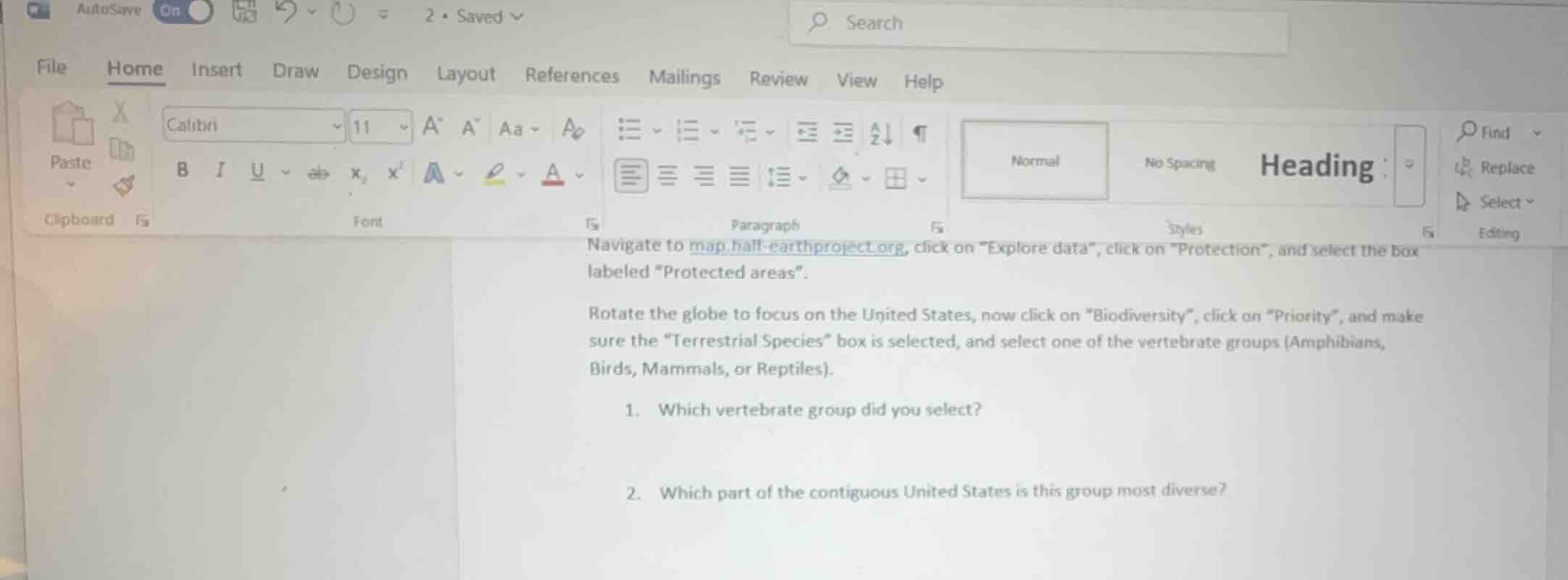
navigate to map.half-earthproject.org, click on \explore data\, click on \protection\, and select the box labeled \protected areas\.

rotate the globe to focus on the united states, now click on \biodiversity\, click on \priority\, and make sure the \terrestrial species\ box is selected, and select one of the vertebrate groups (amphibians, birds, mammals, or reptiles).

  1. which vertebrate group did you select?
  1. which part of the contiguous united states is this group most diverse?

Explanation:

Response

<pre_analysis>
{
"quality": "clear",
"question_count": 2,
"skills_matched": [
"direct_cot",
"explain_then_answer",
"tutor"
],
"needs_drawing": false,
"concepts_used": [
"Half-Earth Project",
"Biodiversity Mapping"
],
"new_concepts": [],
"current_concepts": [
"Half-Earth Project",
"Biodiversity Mapping",
"Vertebrate Diversity"
]
}
</pre_analysis>

<reasoning>

Select a vertebrate group

The prompt asks to navigate to the Half-Earth Project map, select "Biodiversity", then "Priority", ensure "Terrestrial Species" is selected, and choose one of the vertebrate groups: Amphibians, Birds, Mammals, or Reptiles.

Using the Half-Earth Project knowledge point, let us select Amphibians as our representative vertebrate group to analyze.

Analyze geographic diversity

Using the Biodiversity Mapping knowledge point, we evaluate the spatial distribution of the selected group (Amphibians) across the contiguous United States.

Amphibians require moist environments for breeding and survival. Consequently, their highest species richness and diversity in the contiguous United States are heavily concentrated in the humid, warm regions of the Southeast (such as the Appalachian region, the Gulf Coast, and Florida).
</reasoning>

<answer>

Question 1

Amphibians

Question 2

The southeastern United States (particularly the Southeast region and the southern Appalachian Mountains)
</answer>

<post_analysis>
{
"subject": "Natural Science",
"question_type": "Multi-part",
"knowledge_point": [
"Natural Science",
"Others",
"Biodiversity Mapping"
]
}
</post_analysis>

Answer:

<pre_analysis>
{
"quality": "clear",
"question_count": 2,
"skills_matched": [
"direct_cot",
"explain_then_answer",
"tutor"
],
"needs_drawing": false,
"concepts_used": [
"Half-Earth Project",
"Biodiversity Mapping"
],
"new_concepts": [],
"current_concepts": [
"Half-Earth Project",
"Biodiversity Mapping",
"Vertebrate Diversity"
]
}
</pre_analysis>

<reasoning>

Select a vertebrate group

The prompt asks to navigate to the Half-Earth Project map, select "Biodiversity", then "Priority", ensure "Terrestrial Species" is selected, and choose one of the vertebrate groups: Amphibians, Birds, Mammals, or Reptiles.

Using the Half-Earth Project knowledge point, let us select Amphibians as our representative vertebrate group to analyze.

Analyze geographic diversity

Using the Biodiversity Mapping knowledge point, we evaluate the spatial distribution of the selected group (Amphibians) across the contiguous United States.

Amphibians require moist environments for breeding and survival. Consequently, their highest species richness and diversity in the contiguous United States are heavily concentrated in the humid, warm regions of the Southeast (such as the Appalachian region, the Gulf Coast, and Florida).
</reasoning>

<answer>

Question 1

Amphibians

Question 2

The southeastern United States (particularly the Southeast region and the southern Appalachian Mountains)
</answer>

<post_analysis>
{
"subject": "Natural Science",
"question_type": "Multi-part",
"knowledge_point": [
"Natural Science",
"Others",
"Biodiversity Mapping"
]
}
</post_analysis>