QUESTION IMAGE
Question
multiple choice question
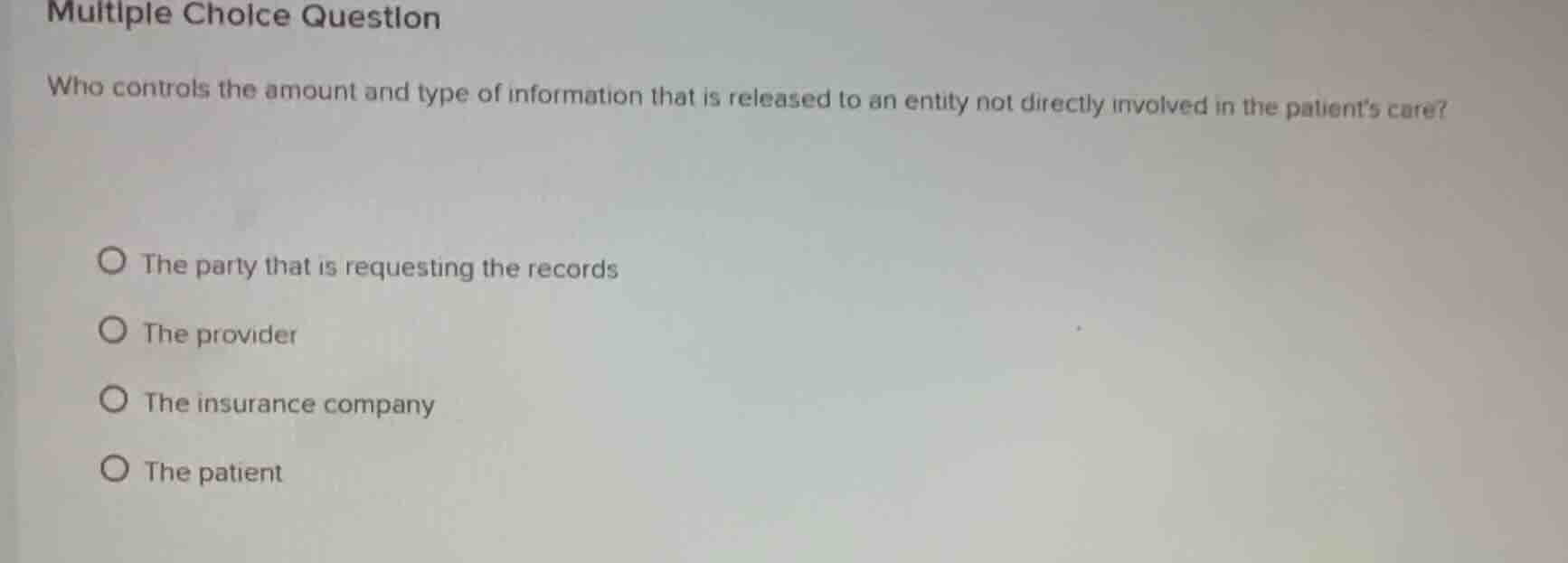
who controls the amount and type of information that is released to an entity not directly involved in the patients care?
- the party that is requesting the records
- the provider
- the insurance company
- the patient
<pre_analysis>
{
"quality": "clear",
"question_count": 1,
"skills_matched": [
"direct_cot",
"multiple_choice_formatter",
"explain_then_answer",
"tutor",
"mastery_adaptive_brevity"
],
"needs_drawing": false,
"concepts_used": [
"Patient Privacy Regulations"
],
"new_concepts": [],
"current_concepts": [
"Patient Privacy Regulations",
"Medical Record Ownership"
]
}
</pre_analysis>
<reasoning>
Identify the core legal and ethical principle
Using the Patient Privacy Regulations knowledge point
Under federal privacy regulations, specifically the Health Insurance Portability and Accountability Act (HIPAA), a patient maintains the ultimate authority over their protected health information (PHI).
Determine control over third-party disclosures
When disclosing medical records to an outside entity not directly involved in treatment, payment, or healthcare operations (such as an employer, attorney, or third party), the disclosure requires a signed authorization. The individual who specifies exactly what information can be shared, to whom, and for what purpose is the patient.
Evaluate the given options
- The party requesting the records: They can ask for information, but they do not control what is legally permitted to be released.
- The provider: While the provider owns the physical or electronic medical record, they only act as the custodian and cannot release PHI to non-treatment entities without patient authorization.
- The insurance company: They only have access to information necessary for payment and operations, not general control over external releases.
- The patient: The patient holds the legal right to authorize and limit the scope of disclosures to third parties.
</reasoning>
<answer>
<mcq-option>The party that is requesting the records</mcq-option>
<mcq-option>The provider</mcq-option>
<mcq-option>The insurance company</mcq-option>
<mcq-correct>The patient</mcq-correct>
</answer>
<post_analysis>
{
"subject": "Business",
"question_type": "Multiple Choice",
"knowledge_point": [
"Business",
"Healthcare Administration",
"Patient Privacy Regulations"
]
}
</post_analysis>
Snap & solve any problem in the app
Get step-by-step solutions on Sovi AI
Photo-based solutions with guided steps
Explore more problems and detailed explanations
<pre_analysis>
{
"quality": "clear",
"question_count": 1,
"skills_matched": [
"direct_cot",
"multiple_choice_formatter",
"explain_then_answer",
"tutor",
"mastery_adaptive_brevity"
],
"needs_drawing": false,
"concepts_used": [
"Patient Privacy Regulations"
],
"new_concepts": [],
"current_concepts": [
"Patient Privacy Regulations",
"Medical Record Ownership"
]
}
</pre_analysis>
<reasoning>
Identify the core legal and ethical principle
Using the Patient Privacy Regulations knowledge point
Under federal privacy regulations, specifically the Health Insurance Portability and Accountability Act (HIPAA), a patient maintains the ultimate authority over their protected health information (PHI).
Determine control over third-party disclosures
When disclosing medical records to an outside entity not directly involved in treatment, payment, or healthcare operations (such as an employer, attorney, or third party), the disclosure requires a signed authorization. The individual who specifies exactly what information can be shared, to whom, and for what purpose is the patient.
Evaluate the given options
- The party requesting the records: They can ask for information, but they do not control what is legally permitted to be released.
- The provider: While the provider owns the physical or electronic medical record, they only act as the custodian and cannot release PHI to non-treatment entities without patient authorization.
- The insurance company: They only have access to information necessary for payment and operations, not general control over external releases.
- The patient: The patient holds the legal right to authorize and limit the scope of disclosures to third parties.
</reasoning>
<answer>
<mcq-option>The party that is requesting the records</mcq-option>
<mcq-option>The provider</mcq-option>
<mcq-option>The insurance company</mcq-option>
<mcq-correct>The patient</mcq-correct>
</answer>
<post_analysis>
{
"subject": "Business",
"question_type": "Multiple Choice",
"knowledge_point": [
"Business",
"Healthcare Administration",
"Patient Privacy Regulations"
]
}
</post_analysis>