Sovi.AI - AI Math Tutor

Scan to solve math questions

QUESTION IMAGE

multiple choice question who controls the amount and type of informatio…

Question

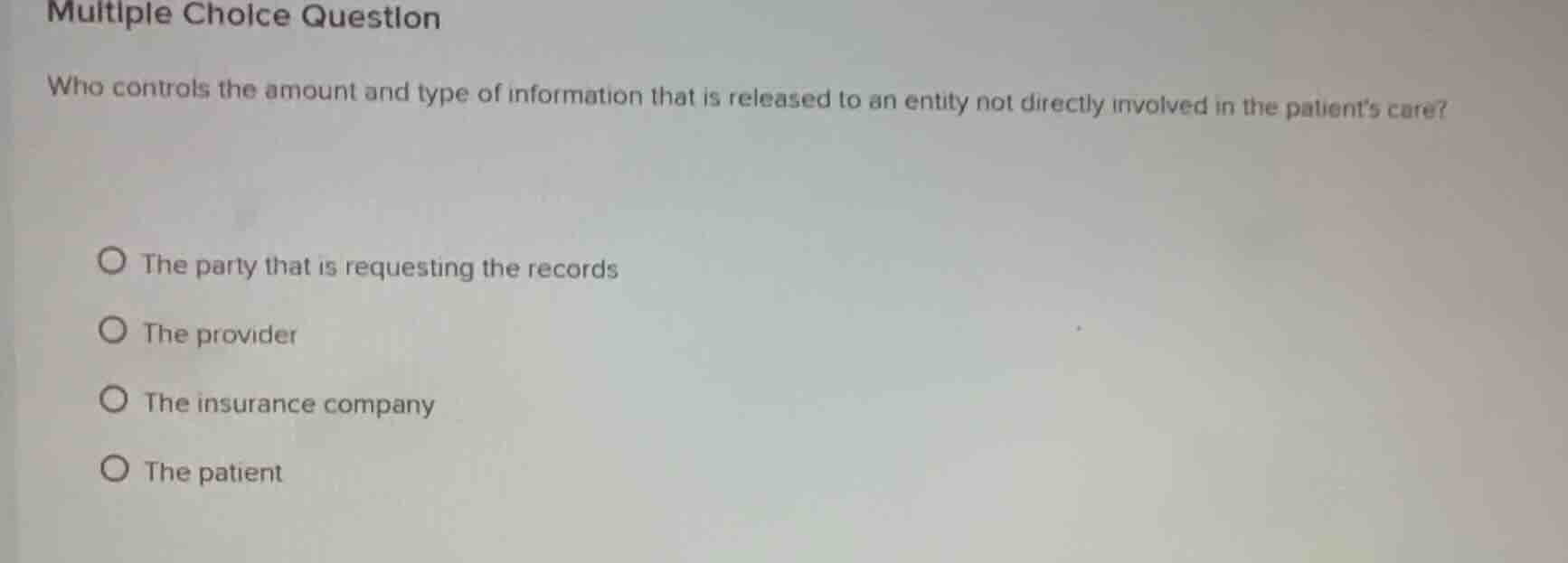
multiple choice question

who controls the amount and type of information that is released to an entity not directly involved in the patients care?

  • the party that is requesting the records
  • the provider
  • the insurance company
  • the patient

Explanation:

Response

<pre_analysis>
{
"quality": "clear",
"question_count": 1,
"skills_matched": [
"direct_cot",
"multiple_choice_formatter",
"explain_then_answer",
"tutor",
"mastery_adaptive_brevity"
],
"needs_drawing": false,
"concepts_used": [
"Patient Privacy Regulations"
],
"new_concepts": [],
"current_concepts": [
"Patient Privacy Regulations",
"Medical Record Ownership"
]
}
</pre_analysis>

<reasoning>

Identify the core legal and ethical principle

Using the Patient Privacy Regulations knowledge point

Under federal privacy regulations, specifically the Health Insurance Portability and Accountability Act (HIPAA), a patient maintains the ultimate authority over their protected health information (PHI).

Determine control over third-party disclosures

When disclosing medical records to an outside entity not directly involved in treatment, payment, or healthcare operations (such as an employer, attorney, or third party), the disclosure requires a signed authorization. The individual who specifies exactly what information can be shared, to whom, and for what purpose is the patient.

Evaluate the given options

  • The party requesting the records: They can ask for information, but they do not control what is legally permitted to be released.
  • The provider: While the provider owns the physical or electronic medical record, they only act as the custodian and cannot release PHI to non-treatment entities without patient authorization.
  • The insurance company: They only have access to information necessary for payment and operations, not general control over external releases.
  • The patient: The patient holds the legal right to authorize and limit the scope of disclosures to third parties.

</reasoning>

<answer>
<mcq-option>The party that is requesting the records</mcq-option>
<mcq-option>The provider</mcq-option>
<mcq-option>The insurance company</mcq-option>
<mcq-correct>The patient</mcq-correct>
</answer>

<post_analysis>
{
"subject": "Business",
"question_type": "Multiple Choice",
"knowledge_point": [
"Business",
"Healthcare Administration",
"Patient Privacy Regulations"
]
}
</post_analysis>

Answer:

<pre_analysis>
{
"quality": "clear",
"question_count": 1,
"skills_matched": [
"direct_cot",
"multiple_choice_formatter",
"explain_then_answer",
"tutor",
"mastery_adaptive_brevity"
],
"needs_drawing": false,
"concepts_used": [
"Patient Privacy Regulations"
],
"new_concepts": [],
"current_concepts": [
"Patient Privacy Regulations",
"Medical Record Ownership"
]
}
</pre_analysis>

<reasoning>

Identify the core legal and ethical principle

Using the Patient Privacy Regulations knowledge point

Under federal privacy regulations, specifically the Health Insurance Portability and Accountability Act (HIPAA), a patient maintains the ultimate authority over their protected health information (PHI).

Determine control over third-party disclosures

When disclosing medical records to an outside entity not directly involved in treatment, payment, or healthcare operations (such as an employer, attorney, or third party), the disclosure requires a signed authorization. The individual who specifies exactly what information can be shared, to whom, and for what purpose is the patient.

Evaluate the given options

  • The party requesting the records: They can ask for information, but they do not control what is legally permitted to be released.
  • The provider: While the provider owns the physical or electronic medical record, they only act as the custodian and cannot release PHI to non-treatment entities without patient authorization.
  • The insurance company: They only have access to information necessary for payment and operations, not general control over external releases.
  • The patient: The patient holds the legal right to authorize and limit the scope of disclosures to third parties.

</reasoning>

<answer>
<mcq-option>The party that is requesting the records</mcq-option>
<mcq-option>The provider</mcq-option>
<mcq-option>The insurance company</mcq-option>
<mcq-correct>The patient</mcq-correct>
</answer>

<post_analysis>
{
"subject": "Business",
"question_type": "Multiple Choice",
"knowledge_point": [
"Business",
"Healthcare Administration",
"Patient Privacy Regulations"
]
}
</post_analysis>