QUESTION IMAGE
Question
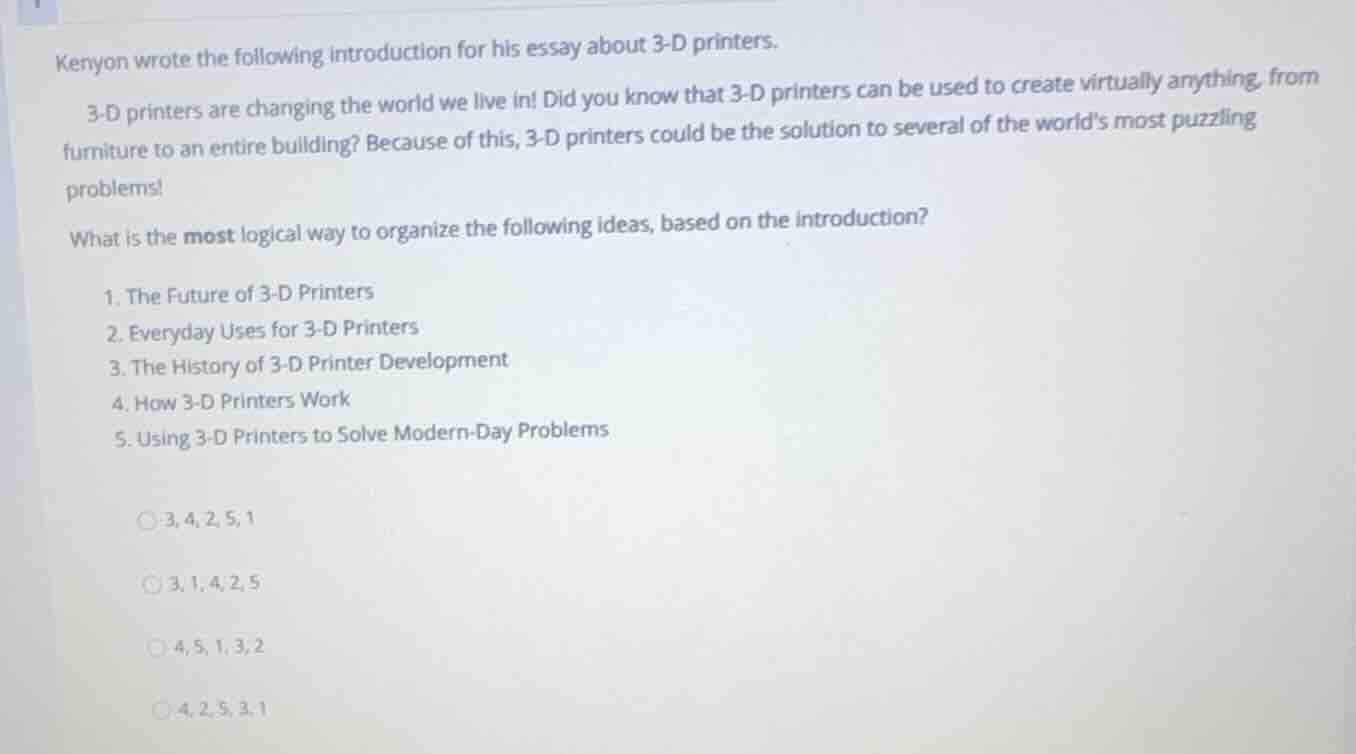
kenyon wrote the following introduction for his essay about 3-d printers.
3-d printers are changing the world we live in! did you know that 3-d printers can be used to create virtually anything, from furniture to an entire building? because of this, 3-d printers could be the solution to several of the worlds most puzzling problems!
what is the most logical way to organize the following ideas, based on the introduction?
- the future of 3-d printers
- everyday uses for 3-d printers
- the history of 3-d printer development
- how 3-d printers work
- using 3-d printers to solve modern-day problems
3, 4, 2, 5, 1
3, 1, 4, 2, 5
4, 5, 1, 3, 2
4, 2, 5, 3, 1
<pre_analysis>
{
"quality": "clear",
"question_count": 1,
"skills_matched": [
"direct_cot",
"multiple_choice_formatter",
"explain_then_answer",
"tutor"
],
"needs_drawing": false,
"concepts_used": [
"Textual Analysis"
],
"new_concepts": [
"Essay Organization",
"Logical Flow"
],
"current_concepts": [
"Textual Analysis",
"Essay Organization",
"Logical Flow"
]
}
</pre_analysis>
<reasoning>
Analyze the introduction text
The introduction introduces 3-D printers, mentions they can create "virtually anything, from furniture to an entire building," and concludes with: "Because of this, 3-D printers could be the solution to several of the world's most puzzling problems!" This thesis statement sets up a focus on solving problems.
Evaluate logical progression
A standard informative or argumentative essay structure should move from foundational background to specific details, and then to the core thesis application and future outlook:
- Background/Foundations: First, explain the history (3) and how they work (4) to establish basic understanding.
- Applications: Next, discuss everyday uses (2) to connect with the reader.
- Thesis Focus: Then, address using them to solve modern-day problems (5), which directly supports the thesis statement in the introduction.
- Conclusion/Outlook: Finally, look toward the future of 3-D printers (1).
Match with options
Using Textual Analysis, we evaluate the sequence \(3, 4, 2, 5, 1\):
- 3: The History of 3-D Printer Development (Logical starting point)
- 4: How 3-D Printers Work (Explains the mechanism after history)
- 2: Everyday Uses for 3-D Printers (Moves to common applications)
- 5: Using 3-D Printers to Solve Modern-Day Problems (Directly addresses the main thesis hook)
- 1: The Future of 3-D Printers (Forward-looking conclusion)
This matches the first option: \(3, 4, 2, 5, 1\).
</reasoning>
<answer>
<mcq-correct>(A) 3, 4, 2, 5, 1</mcq-correct>
<mcq-option>(B) 3, 1, 4, 2, 5</mcq-option>
<mcq-option>(C) 4, 5, 1, 3, 2</mcq-option>
<mcq-option>(D) 4, 2, 5, 3, 1</mcq-option>
</answer>
<post_analysis>
{
"subject": "Others",
"question_type": "Multiple Choice",
"knowledge_point": [
"Others",
"English Language Arts",
"Essay Structure and Organization"
]
}
</post_analysis>
Snap & solve any problem in the app
Get step-by-step solutions on Sovi AI
Photo-based solutions with guided steps
Explore more problems and detailed explanations
<pre_analysis>
{
"quality": "clear",
"question_count": 1,
"skills_matched": [
"direct_cot",
"multiple_choice_formatter",
"explain_then_answer",
"tutor"
],
"needs_drawing": false,
"concepts_used": [
"Textual Analysis"
],
"new_concepts": [
"Essay Organization",
"Logical Flow"
],
"current_concepts": [
"Textual Analysis",
"Essay Organization",
"Logical Flow"
]
}
</pre_analysis>
<reasoning>
Analyze the introduction text
The introduction introduces 3-D printers, mentions they can create "virtually anything, from furniture to an entire building," and concludes with: "Because of this, 3-D printers could be the solution to several of the world's most puzzling problems!" This thesis statement sets up a focus on solving problems.
Evaluate logical progression
A standard informative or argumentative essay structure should move from foundational background to specific details, and then to the core thesis application and future outlook:
- Background/Foundations: First, explain the history (3) and how they work (4) to establish basic understanding.
- Applications: Next, discuss everyday uses (2) to connect with the reader.
- Thesis Focus: Then, address using them to solve modern-day problems (5), which directly supports the thesis statement in the introduction.
- Conclusion/Outlook: Finally, look toward the future of 3-D printers (1).
Match with options
Using Textual Analysis, we evaluate the sequence \(3, 4, 2, 5, 1\):
- 3: The History of 3-D Printer Development (Logical starting point)
- 4: How 3-D Printers Work (Explains the mechanism after history)
- 2: Everyday Uses for 3-D Printers (Moves to common applications)
- 5: Using 3-D Printers to Solve Modern-Day Problems (Directly addresses the main thesis hook)
- 1: The Future of 3-D Printers (Forward-looking conclusion)
This matches the first option: \(3, 4, 2, 5, 1\).
</reasoning>
<answer>
<mcq-correct>(A) 3, 4, 2, 5, 1</mcq-correct>
<mcq-option>(B) 3, 1, 4, 2, 5</mcq-option>
<mcq-option>(C) 4, 5, 1, 3, 2</mcq-option>
<mcq-option>(D) 4, 2, 5, 3, 1</mcq-option>
</answer>
<post_analysis>
{
"subject": "Others",
"question_type": "Multiple Choice",
"knowledge_point": [
"Others",
"English Language Arts",
"Essay Structure and Organization"
]
}
</post_analysis>