Sovi.AI - AI Math Tutor

Scan to solve math questions

QUESTION IMAGE

kenyon wrote the following introduction for his essay about 3-d printer…

Question

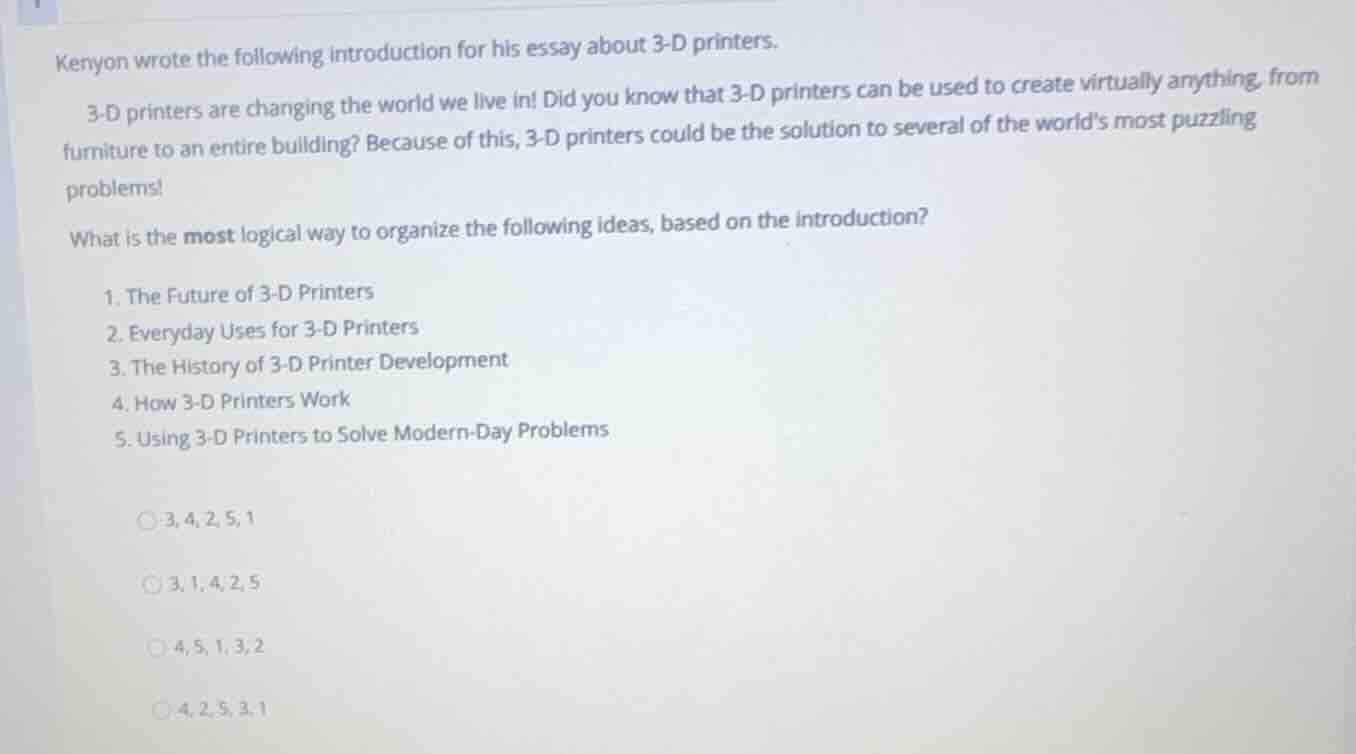
kenyon wrote the following introduction for his essay about 3-d printers.

3-d printers are changing the world we live in! did you know that 3-d printers can be used to create virtually anything, from furniture to an entire building? because of this, 3-d printers could be the solution to several of the worlds most puzzling problems!

what is the most logical way to organize the following ideas, based on the introduction?

  1. the future of 3-d printers
  2. everyday uses for 3-d printers
  3. the history of 3-d printer development
  4. how 3-d printers work
  5. using 3-d printers to solve modern-day problems

3, 4, 2, 5, 1
3, 1, 4, 2, 5
4, 5, 1, 3, 2
4, 2, 5, 3, 1

Explanation:

Response

<pre_analysis>
{
"quality": "clear",
"question_count": 1,
"skills_matched": [
"direct_cot",
"multiple_choice_formatter",
"explain_then_answer",
"tutor"
],
"needs_drawing": false,
"concepts_used": [
"Textual Analysis"
],
"new_concepts": [
"Essay Organization",
"Logical Flow"
],
"current_concepts": [
"Textual Analysis",
"Essay Organization",
"Logical Flow"
]
}
</pre_analysis>

<reasoning>

Analyze the introduction text

The introduction introduces 3-D printers, mentions they can create "virtually anything, from furniture to an entire building," and concludes with: "Because of this, 3-D printers could be the solution to several of the world's most puzzling problems!" This thesis statement sets up a focus on solving problems.

Evaluate logical progression

A standard informative or argumentative essay structure should move from foundational background to specific details, and then to the core thesis application and future outlook:

  • Background/Foundations: First, explain the history (3) and how they work (4) to establish basic understanding.
  • Applications: Next, discuss everyday uses (2) to connect with the reader.
  • Thesis Focus: Then, address using them to solve modern-day problems (5), which directly supports the thesis statement in the introduction.
  • Conclusion/Outlook: Finally, look toward the future of 3-D printers (1).

Match with options

Using Textual Analysis, we evaluate the sequence \(3, 4, 2, 5, 1\):

  • 3: The History of 3-D Printer Development (Logical starting point)
  • 4: How 3-D Printers Work (Explains the mechanism after history)
  • 2: Everyday Uses for 3-D Printers (Moves to common applications)
  • 5: Using 3-D Printers to Solve Modern-Day Problems (Directly addresses the main thesis hook)
  • 1: The Future of 3-D Printers (Forward-looking conclusion)

This matches the first option: \(3, 4, 2, 5, 1\).
</reasoning>

<answer>
<mcq-correct>(A) 3, 4, 2, 5, 1</mcq-correct>
<mcq-option>(B) 3, 1, 4, 2, 5</mcq-option>
<mcq-option>(C) 4, 5, 1, 3, 2</mcq-option>
<mcq-option>(D) 4, 2, 5, 3, 1</mcq-option>
</answer>

<post_analysis>
{
"subject": "Others",
"question_type": "Multiple Choice",
"knowledge_point": [
"Others",
"English Language Arts",
"Essay Structure and Organization"
]
}
</post_analysis>

Answer:

<pre_analysis>
{
"quality": "clear",
"question_count": 1,
"skills_matched": [
"direct_cot",
"multiple_choice_formatter",
"explain_then_answer",
"tutor"
],
"needs_drawing": false,
"concepts_used": [
"Textual Analysis"
],
"new_concepts": [
"Essay Organization",
"Logical Flow"
],
"current_concepts": [
"Textual Analysis",
"Essay Organization",
"Logical Flow"
]
}
</pre_analysis>

<reasoning>

Analyze the introduction text

The introduction introduces 3-D printers, mentions they can create "virtually anything, from furniture to an entire building," and concludes with: "Because of this, 3-D printers could be the solution to several of the world's most puzzling problems!" This thesis statement sets up a focus on solving problems.

Evaluate logical progression

A standard informative or argumentative essay structure should move from foundational background to specific details, and then to the core thesis application and future outlook:

  • Background/Foundations: First, explain the history (3) and how they work (4) to establish basic understanding.
  • Applications: Next, discuss everyday uses (2) to connect with the reader.
  • Thesis Focus: Then, address using them to solve modern-day problems (5), which directly supports the thesis statement in the introduction.
  • Conclusion/Outlook: Finally, look toward the future of 3-D printers (1).

Match with options

Using Textual Analysis, we evaluate the sequence \(3, 4, 2, 5, 1\):

  • 3: The History of 3-D Printer Development (Logical starting point)
  • 4: How 3-D Printers Work (Explains the mechanism after history)
  • 2: Everyday Uses for 3-D Printers (Moves to common applications)
  • 5: Using 3-D Printers to Solve Modern-Day Problems (Directly addresses the main thesis hook)
  • 1: The Future of 3-D Printers (Forward-looking conclusion)

This matches the first option: \(3, 4, 2, 5, 1\).
</reasoning>

<answer>
<mcq-correct>(A) 3, 4, 2, 5, 1</mcq-correct>
<mcq-option>(B) 3, 1, 4, 2, 5</mcq-option>
<mcq-option>(C) 4, 5, 1, 3, 2</mcq-option>
<mcq-option>(D) 4, 2, 5, 3, 1</mcq-option>
</answer>

<post_analysis>
{
"subject": "Others",
"question_type": "Multiple Choice",
"knowledge_point": [
"Others",
"English Language Arts",
"Essay Structure and Organization"
]
}
</post_analysis>