QUESTION IMAGE
Question
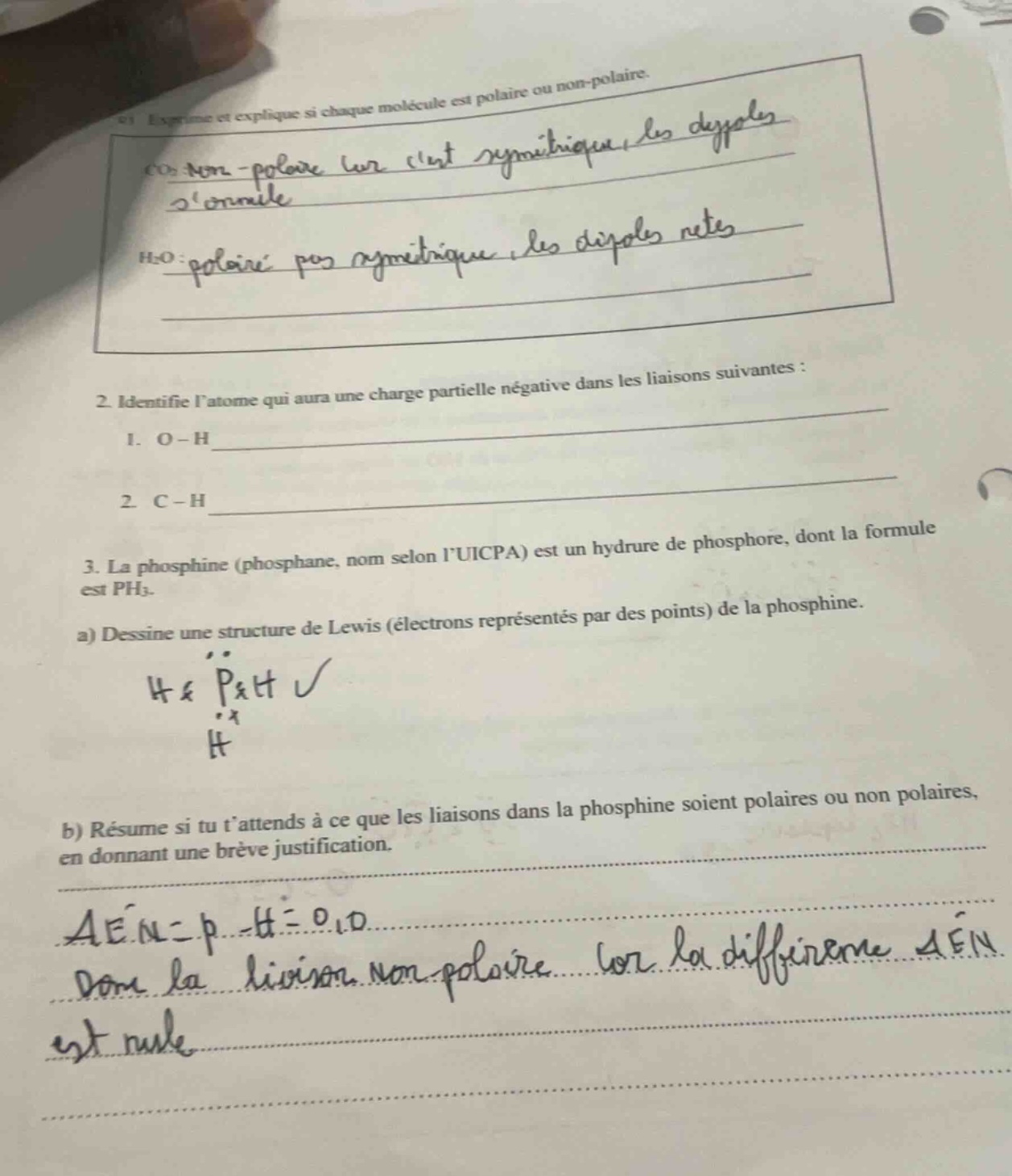
- identifie latome qui aura une charge partielle négative dans les liaisons suivantes :
- \\(\text{o}-\text{h}\\)
- \\(\text{c}-\text{h}\\)
- la phosphine (phosphane, nom selon luicpa) est un hydrure de phosphore, dont la formule est \\(\text{ph}_3\\).
a) dessine une structure de lewis (électrons représentés par des points) de la phosphine.
b) résume si tu tattends à ce que les liaisons dans la phosphine soient polaires ou non polaires, en donnant une brève justification.
<pre_analysis>
{
"quality": "clear",
"question_count": 4,
"skills_matched": [
"step_cot",
"explain_then_answer",
"tutor"
],
"needs_drawing": false,
"concepts_used": [],
"new_concepts": [
"Electronegativity",
"Chemical Bond Polarity",
"Lewis Structures"
],
"current_concepts": [
"Electronegativity",
"Chemical Bond Polarity",
"Lewis Structures",
"Molecular Geometry"
]
}
</pre_analysis>
<reasoning>
Identify electronegativity values
To determine partial charges and bond polarity, we compare the electronegativity values of the atoms involved.
- Oxygen (\(\text{O}\)): \(3.44\)
- Hydrogen (\(\text{H}\)): \(2.20\)
- Carbon (\(\text{C}\)): \(2.55\)
- Phosphorus (\(\text{P}\)): \(2.19\)
Determine partial charges for Question 2
The atom with the higher electronegativity attracts the shared electrons more strongly, acquiring a partial negative charge (\(\delta^-\)).
- For the \(\text{O}-\text{H}\) bond: Oxygen (\(3.44\)) is more electronegative than Hydrogen (\(2.20\)), so Oxygen carries the partial negative charge.
- For the \(\text{C}-\text{H}\) bond: Carbon (\(2.55\)) is more electronegative than Hydrogen (\(2.20\)), so Carbon carries the partial negative charge.
Analyze Lewis structure for Question 3a
Phosphorus (\(\text{P}\)) is in Group 15 and has 5 valence electrons. Each Hydrogen (\(\text{H}\)) has 1 valence electron.
- The central \(\text{P}\) atom forms 3 single covalent bonds with the 3 \(\text{H}\) atoms.
- This leaves one lone pair of electrons on the \(\text{P}\) atom, completing its octet.
Evaluate bond polarity for Question 3b
We calculate the electronegativity difference (\(\Delta\text{EN}\)) between Phosphorus and Hydrogen:
\[
\Delta\text{EN} = |\text{EN}_{\text{P}} - \text{EN}_{\text{H}}| = |2.19 - 2.20| = 0.01
\]
A difference of \(0.01\) is extremely close to \(0\). Bonds with \(\Delta\text{EN} < 0.4\) are considered non-polar covalent. Therefore, the \(\text{P}-\text{H}\) bonds in phosphine are non-polar.
</reasoning>
<answer>
Question 2
- \(\text{O}-\text{H}\): Oxygen (\(\text{O}\))
- \(\text{C}-\text{H}\): Carbon (\(\text{C}\))
Question 3
a) The Lewis structure of phosphine (\(\text{PH}_3\)) consists of a central Phosphorus (\(\text{P}\)) atom bonded to three Hydrogen (\(\text{H}\)) atoms via single covalent bonds, with one lone pair of electrons remaining on the Phosphorus atom:
\[
\]
b) The bonds in phosphine (\(\text{PH}_3\)) are expected to be non-polar.
Justification: The electronegativity of Phosphorus (\(2.19\)) and Hydrogen (\(2.20\)) are nearly identical. The electronegativity difference is extremely small (\(\Delta\text{EN} = 0.01\)), which is well below the threshold of \(0.4\) required for a bond to be considered polar.
</answer>
<post_analysis>
{
"subject": "Natural Science",
"question_type": "Multi-part",
"knowledge_point": [
"Natural Science",
"Chemistry",
"Chemical Bonding and Molecular Structure"
]
}
</post_analysis>
Snap & solve any problem in the app
Get step-by-step solutions on Sovi AI
Photo-based solutions with guided steps
Explore more problems and detailed explanations
<pre_analysis>
{
"quality": "clear",
"question_count": 4,
"skills_matched": [
"step_cot",
"explain_then_answer",
"tutor"
],
"needs_drawing": false,
"concepts_used": [],
"new_concepts": [
"Electronegativity",
"Chemical Bond Polarity",
"Lewis Structures"
],
"current_concepts": [
"Electronegativity",
"Chemical Bond Polarity",
"Lewis Structures",
"Molecular Geometry"
]
}
</pre_analysis>
<reasoning>
Identify electronegativity values
To determine partial charges and bond polarity, we compare the electronegativity values of the atoms involved.
- Oxygen (\(\text{O}\)): \(3.44\)
- Hydrogen (\(\text{H}\)): \(2.20\)
- Carbon (\(\text{C}\)): \(2.55\)
- Phosphorus (\(\text{P}\)): \(2.19\)
Determine partial charges for Question 2
The atom with the higher electronegativity attracts the shared electrons more strongly, acquiring a partial negative charge (\(\delta^-\)).
- For the \(\text{O}-\text{H}\) bond: Oxygen (\(3.44\)) is more electronegative than Hydrogen (\(2.20\)), so Oxygen carries the partial negative charge.
- For the \(\text{C}-\text{H}\) bond: Carbon (\(2.55\)) is more electronegative than Hydrogen (\(2.20\)), so Carbon carries the partial negative charge.
Analyze Lewis structure for Question 3a
Phosphorus (\(\text{P}\)) is in Group 15 and has 5 valence electrons. Each Hydrogen (\(\text{H}\)) has 1 valence electron.
- The central \(\text{P}\) atom forms 3 single covalent bonds with the 3 \(\text{H}\) atoms.
- This leaves one lone pair of electrons on the \(\text{P}\) atom, completing its octet.
Evaluate bond polarity for Question 3b
We calculate the electronegativity difference (\(\Delta\text{EN}\)) between Phosphorus and Hydrogen:
\[
\Delta\text{EN} = |\text{EN}_{\text{P}} - \text{EN}_{\text{H}}| = |2.19 - 2.20| = 0.01
\]
A difference of \(0.01\) is extremely close to \(0\). Bonds with \(\Delta\text{EN} < 0.4\) are considered non-polar covalent. Therefore, the \(\text{P}-\text{H}\) bonds in phosphine are non-polar.
</reasoning>
<answer>
Question 2
- \(\text{O}-\text{H}\): Oxygen (\(\text{O}\))
- \(\text{C}-\text{H}\): Carbon (\(\text{C}\))
Question 3
a) The Lewis structure of phosphine (\(\text{PH}_3\)) consists of a central Phosphorus (\(\text{P}\)) atom bonded to three Hydrogen (\(\text{H}\)) atoms via single covalent bonds, with one lone pair of electrons remaining on the Phosphorus atom:
\[
\]
b) The bonds in phosphine (\(\text{PH}_3\)) are expected to be non-polar.
Justification: The electronegativity of Phosphorus (\(2.19\)) and Hydrogen (\(2.20\)) are nearly identical. The electronegativity difference is extremely small (\(\Delta\text{EN} = 0.01\)), which is well below the threshold of \(0.4\) required for a bond to be considered polar.
</answer>
<post_analysis>
{
"subject": "Natural Science",
"question_type": "Multi-part",
"knowledge_point": [
"Natural Science",
"Chemistry",
"Chemical Bonding and Molecular Structure"
]
}
</post_analysis>