Sovi.AI - AI Math Tutor

Scan to solve math questions

QUESTION IMAGE

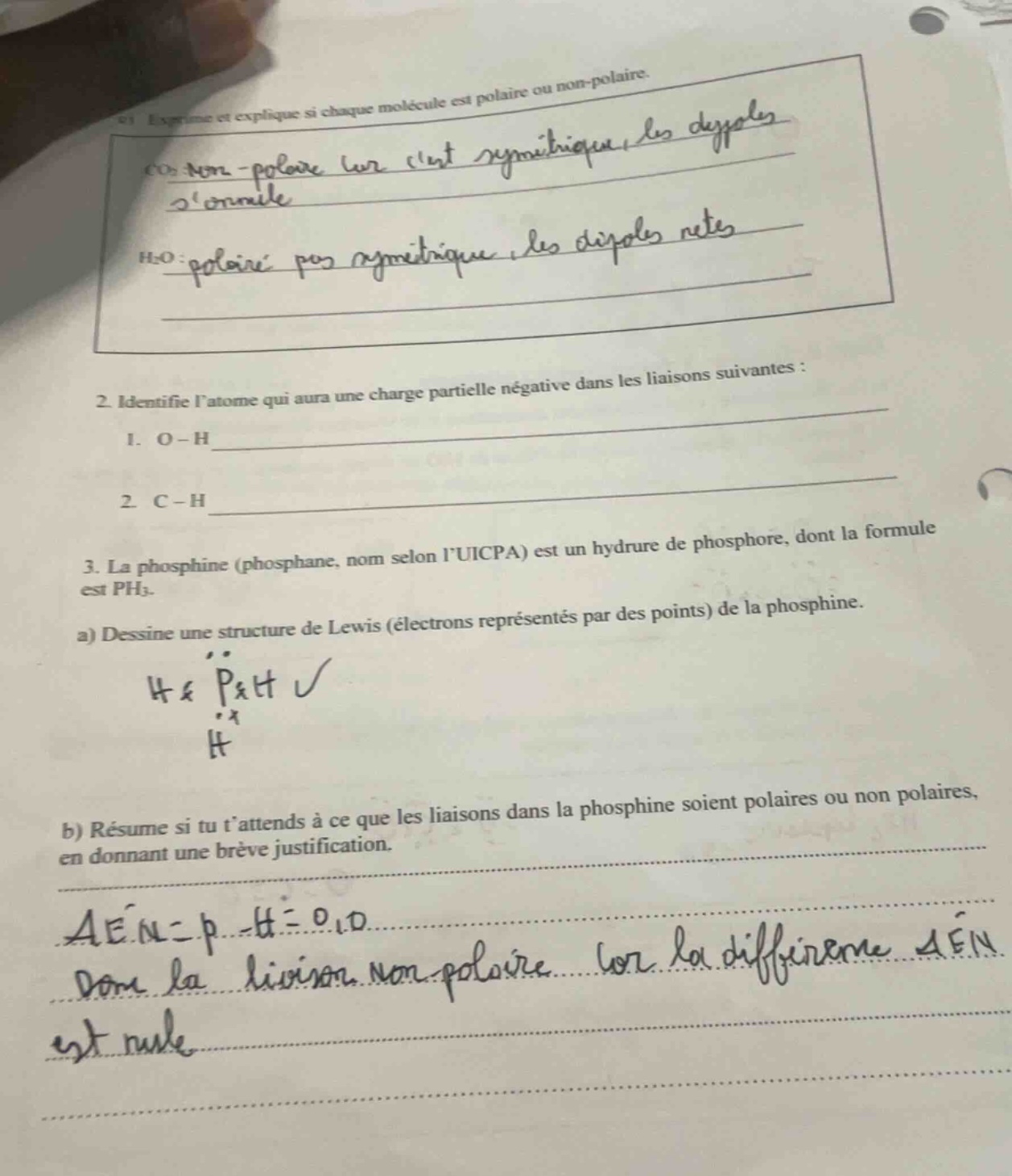
2. identifie latome qui aura une charge partielle négative dans les lia…

Question

  1. identifie latome qui aura une charge partielle négative dans les liaisons suivantes :
  2. \\(\text{o}-\text{h}\\)
  3. \\(\text{c}-\text{h}\\)
  1. la phosphine (phosphane, nom selon luicpa) est un hydrure de phosphore, dont la formule est \\(\text{ph}_3\\).

a) dessine une structure de lewis (électrons représentés par des points) de la phosphine.
b) résume si tu tattends à ce que les liaisons dans la phosphine soient polaires ou non polaires, en donnant une brève justification.

Explanation:

Response

<pre_analysis>
{
"quality": "clear",
"question_count": 4,
"skills_matched": [
"step_cot",
"explain_then_answer",
"tutor"
],
"needs_drawing": false,
"concepts_used": [],
"new_concepts": [
"Electronegativity",
"Chemical Bond Polarity",
"Lewis Structures"
],
"current_concepts": [
"Electronegativity",
"Chemical Bond Polarity",
"Lewis Structures",
"Molecular Geometry"
]
}
</pre_analysis>

<reasoning>

Identify electronegativity values

To determine partial charges and bond polarity, we compare the electronegativity values of the atoms involved.

  • Oxygen (\(\text{O}\)): \(3.44\)
  • Hydrogen (\(\text{H}\)): \(2.20\)
  • Carbon (\(\text{C}\)): \(2.55\)
  • Phosphorus (\(\text{P}\)): \(2.19\)

Determine partial charges for Question 2

The atom with the higher electronegativity attracts the shared electrons more strongly, acquiring a partial negative charge (\(\delta^-\)).

  • For the \(\text{O}-\text{H}\) bond: Oxygen (\(3.44\)) is more electronegative than Hydrogen (\(2.20\)), so Oxygen carries the partial negative charge.
  • For the \(\text{C}-\text{H}\) bond: Carbon (\(2.55\)) is more electronegative than Hydrogen (\(2.20\)), so Carbon carries the partial negative charge.

Analyze Lewis structure for Question 3a

Phosphorus (\(\text{P}\)) is in Group 15 and has 5 valence electrons. Each Hydrogen (\(\text{H}\)) has 1 valence electron.

  • The central \(\text{P}\) atom forms 3 single covalent bonds with the 3 \(\text{H}\) atoms.
  • This leaves one lone pair of electrons on the \(\text{P}\) atom, completing its octet.

Evaluate bond polarity for Question 3b

We calculate the electronegativity difference (\(\Delta\text{EN}\)) between Phosphorus and Hydrogen:
\[
\Delta\text{EN} = |\text{EN}_{\text{P}} - \text{EN}_{\text{H}}| = |2.19 - 2.20| = 0.01
\]
A difference of \(0.01\) is extremely close to \(0\). Bonds with \(\Delta\text{EN} < 0.4\) are considered non-polar covalent. Therefore, the \(\text{P}-\text{H}\) bonds in phosphine are non-polar.
</reasoning>

<answer>

Question 2

  1. \(\text{O}-\text{H}\): Oxygen (\(\text{O}\))
  2. \(\text{C}-\text{H}\): Carbon (\(\text{C}\))

Question 3

a) The Lewis structure of phosphine (\(\text{PH}_3\)) consists of a central Phosphorus (\(\text{P}\)) atom bonded to three Hydrogen (\(\text{H}\)) atoms via single covalent bonds, with one lone pair of electrons remaining on the Phosphorus atom:
\[

$$\begin{array}{ccc} & \ddot{\text{P}} & \\ \text{H} & \cdot\ \cdot & \text{H} \\ & \text{H} & \end{array}$$

\]

b) The bonds in phosphine (\(\text{PH}_3\)) are expected to be non-polar.

Justification: The electronegativity of Phosphorus (\(2.19\)) and Hydrogen (\(2.20\)) are nearly identical. The electronegativity difference is extremely small (\(\Delta\text{EN} = 0.01\)), which is well below the threshold of \(0.4\) required for a bond to be considered polar.
</answer>

<post_analysis>
{
"subject": "Natural Science",
"question_type": "Multi-part",
"knowledge_point": [
"Natural Science",
"Chemistry",
"Chemical Bonding and Molecular Structure"
]
}
</post_analysis>

Answer:

<pre_analysis>
{
"quality": "clear",
"question_count": 4,
"skills_matched": [
"step_cot",
"explain_then_answer",
"tutor"
],
"needs_drawing": false,
"concepts_used": [],
"new_concepts": [
"Electronegativity",
"Chemical Bond Polarity",
"Lewis Structures"
],
"current_concepts": [
"Electronegativity",
"Chemical Bond Polarity",
"Lewis Structures",
"Molecular Geometry"
]
}
</pre_analysis>

<reasoning>

Identify electronegativity values

To determine partial charges and bond polarity, we compare the electronegativity values of the atoms involved.

  • Oxygen (\(\text{O}\)): \(3.44\)
  • Hydrogen (\(\text{H}\)): \(2.20\)
  • Carbon (\(\text{C}\)): \(2.55\)
  • Phosphorus (\(\text{P}\)): \(2.19\)

Determine partial charges for Question 2

The atom with the higher electronegativity attracts the shared electrons more strongly, acquiring a partial negative charge (\(\delta^-\)).

  • For the \(\text{O}-\text{H}\) bond: Oxygen (\(3.44\)) is more electronegative than Hydrogen (\(2.20\)), so Oxygen carries the partial negative charge.
  • For the \(\text{C}-\text{H}\) bond: Carbon (\(2.55\)) is more electronegative than Hydrogen (\(2.20\)), so Carbon carries the partial negative charge.

Analyze Lewis structure for Question 3a

Phosphorus (\(\text{P}\)) is in Group 15 and has 5 valence electrons. Each Hydrogen (\(\text{H}\)) has 1 valence electron.

  • The central \(\text{P}\) atom forms 3 single covalent bonds with the 3 \(\text{H}\) atoms.
  • This leaves one lone pair of electrons on the \(\text{P}\) atom, completing its octet.

Evaluate bond polarity for Question 3b

We calculate the electronegativity difference (\(\Delta\text{EN}\)) between Phosphorus and Hydrogen:
\[
\Delta\text{EN} = |\text{EN}_{\text{P}} - \text{EN}_{\text{H}}| = |2.19 - 2.20| = 0.01
\]
A difference of \(0.01\) is extremely close to \(0\). Bonds with \(\Delta\text{EN} < 0.4\) are considered non-polar covalent. Therefore, the \(\text{P}-\text{H}\) bonds in phosphine are non-polar.
</reasoning>

<answer>

Question 2

  1. \(\text{O}-\text{H}\): Oxygen (\(\text{O}\))
  2. \(\text{C}-\text{H}\): Carbon (\(\text{C}\))

Question 3

a) The Lewis structure of phosphine (\(\text{PH}_3\)) consists of a central Phosphorus (\(\text{P}\)) atom bonded to three Hydrogen (\(\text{H}\)) atoms via single covalent bonds, with one lone pair of electrons remaining on the Phosphorus atom:
\[

$$\begin{array}{ccc} & \ddot{\text{P}} & \\ \text{H} & \cdot\ \cdot & \text{H} \\ & \text{H} & \end{array}$$

\]

b) The bonds in phosphine (\(\text{PH}_3\)) are expected to be non-polar.

Justification: The electronegativity of Phosphorus (\(2.19\)) and Hydrogen (\(2.20\)) are nearly identical. The electronegativity difference is extremely small (\(\Delta\text{EN} = 0.01\)), which is well below the threshold of \(0.4\) required for a bond to be considered polar.
</answer>

<post_analysis>
{
"subject": "Natural Science",
"question_type": "Multi-part",
"knowledge_point": [
"Natural Science",
"Chemistry",
"Chemical Bonding and Molecular Structure"
]
}
</post_analysis>