QUESTION IMAGE
Question
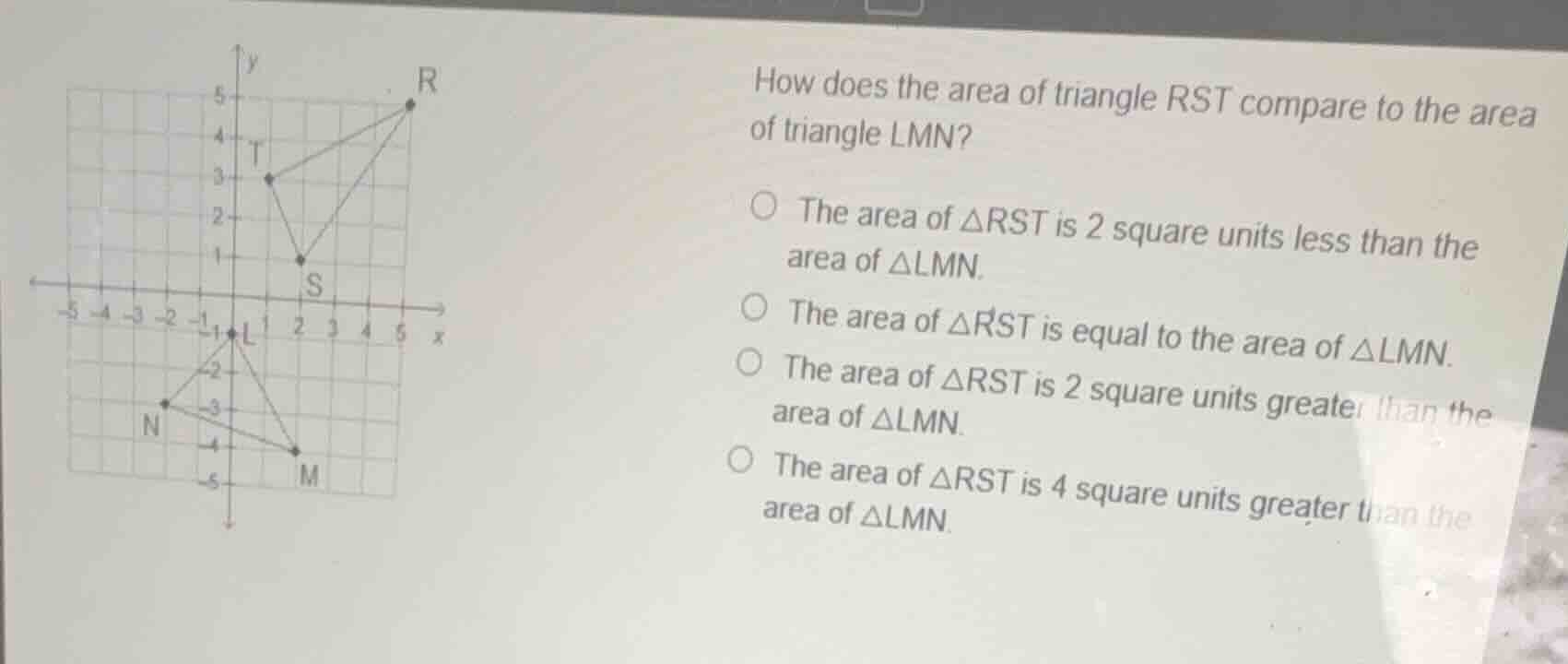
how does the area of triangle rst compare to the area of triangle lmn?
the area of \\(\delta rst\\) is 2 square units less than the area of \\(\delta lmn\\).
the area of \\(\delta rst\\) is equal to the area of \\(\delta lmn\\).
the area of \\(\delta rst\\) is 2 square units greater than the area of \\(\delta lmn\\).
the area of \\(\delta rst\\) is 4 square units greater than the area of \\(\delta lmn\\).
Identify coordinates of the vertices
Calculate the area of triangle RST
Calculate the area of triangle LMN
Compare the areas
Since the options do not contain \(1.5\), we recalculate using bounding boxes (Green's theorem / subtraction method) to verify coordinates:
For \(\Delta RST\):
Bounding box: \(x \in [1, 5]\), \(y \in [1, 5]\). Area of box = \(4 \times 4 = 16\).
Subtract three outer right triangles:
- Top-right: \(\frac{1}{2} \times (5-1) \times (5-3) = \frac{1}{2} \times 4 \times 2 = 4\) (using horizontal from T to x=5, but R is at (5,5), T is at (1,3). The right triangle has vertices (1,3), (5,3), (5,5). Area = \(\frac{1}{2} \times 4 \times 2 = 4\)).
- Bottom-right: Vertices (2,1), (5,1), (5,5). Area = \(\frac{1}{2} \times 3 \times 4 = 6\).
- Left: Vertices (1,1), (2,1), (1,3). Area = \(\frac{1}{2} \times 1 \times 2 = 1\).
- Remaining rectangle at bottom-left: \(1 \times 1\) square from \(x \in [1,2]\), \(y \in [1,2]\) minus the triangle?
Let's use standard box subtraction:
Box vertices: \((1,1), (5,1), (5,5), (1,5)\).
- Triangle 1 (under RT): Vertices \((1,3), (1,5), (5,5)\). Area = \(\frac{1}{2} \times 4 \times 2 = 4\).
- Triangle 2 (under RS): Vertices \((5,5), (5,1), (2,1)\). Area = \(\frac{1}{2} \times 3 \times 4 = 6\).
- Triangle 3 (under ST): Vertices \((2,1), (1,1), (1,3)\). Area = \(\frac{1}{2} \times 1 \times 2 = 1\).
Total area of \(\Delta RST = 16 - (4 + 6 + 1) = 5\).
For \(\Delta LMN\):
Let's re-verify coordinates from the grid:
\(L\) is at \((0, -1)\).
\(M\) is at \((2, -4)\).
\(N\) is at \((-2, -3)\) (Looking closely at the grid, \(N\) is at \(x = -2\), not \(-3\)).
Let's recalculate with \(N(-2, -3)\):
Thus, \(\text{Area}(\Delta RST) = \text{Area}(\Delta LMN) = 5\).

Snap & solve any problem in the app
Get step-by-step solutions on Sovi AI
Photo-based solutions with guided steps
Explore more problems and detailed explanations
- The area of \(\Delta RST\) is 2 square units less than the area of \(\Delta LMN\).
- The area of \(\Delta RST\) is equal to the area of \(\Delta LMN\). (Correct answer)
- The area of \(\Delta RST\) is 2 square units greater than the area of \(\Delta LMN\).
- The area of \(\Delta RST\) is 4 square units greater than the area of \(\Delta LMN\).