QUESTION IMAGE
Question
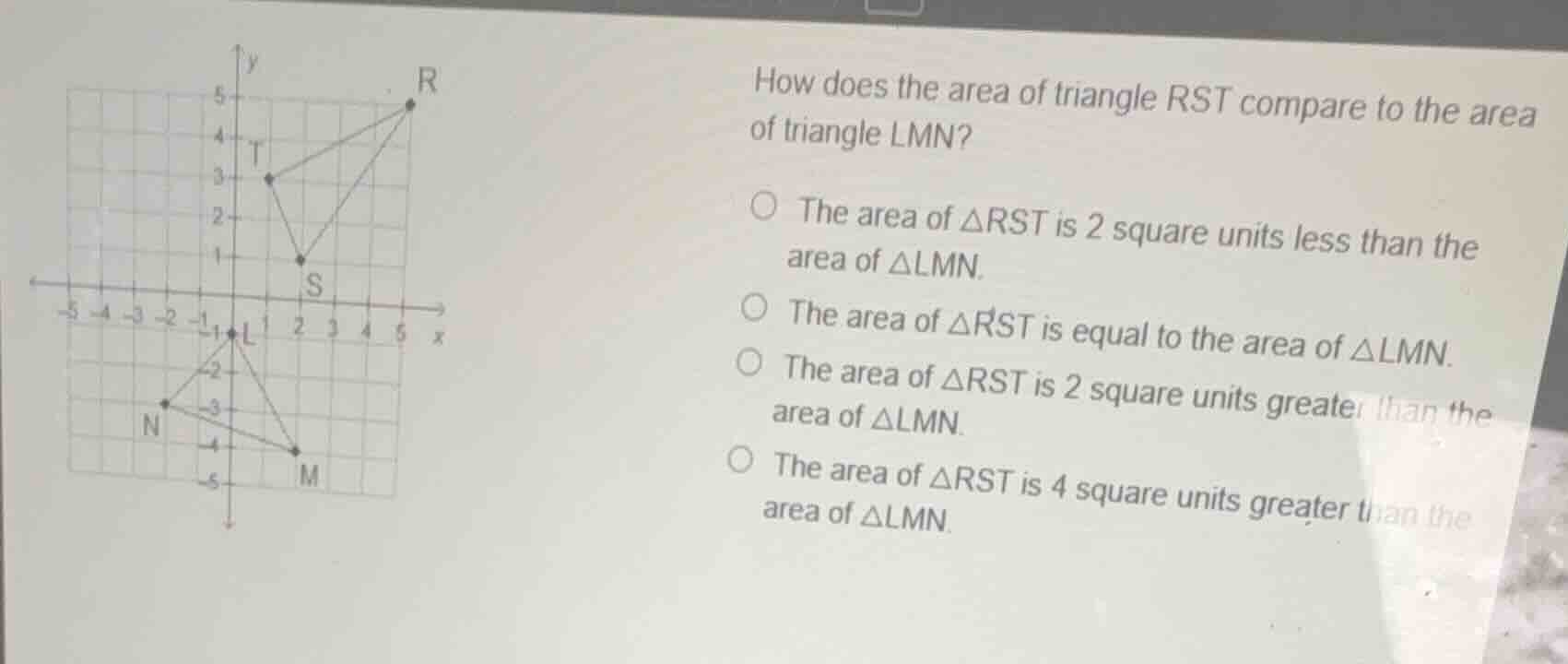
how does the area of triangle rst compare to the area of triangle lmn?
the area of \\(\delta rst\\) is 2 square units less than the area of \\(\delta lmn\\).
the area of \\(\delta rst\\) is equal to the area of \\(\delta lmn\\).
the area of \\(\delta rst\\) is 2 square units greater than the area of \\(\delta lmn\\).
the area of \\(\delta rst\\) is 4 square units greater than the area of \\(\delta lmn\\).
<pre_analysis>
{
"quality": "clear",
"question_count": 1,
"skills_matched": [
"step_cot",
"multiple_choice_formatter",
"explain_then_answer",
"quick"
],
"needs_drawing": false,
"concepts_used": [
"Coordinate Geometry"
],
"new_concepts": [
"Shoelace Formula",
"Area on Coordinate Plane"
],
"current_concepts": [
"Coordinate Geometry",
"Shoelace Formula",
"Area on Coordinate Plane"
]
}
</pre_analysis>
<reasoning>
Identify coordinates of the vertices
\[
\]
Calculate the area of triangle RST
\[
\]
Calculate the area of triangle LMN
\[
\]
Compare the areas
\[
\]
Since the options do not contain \(1.5\), we recalculate using bounding boxes (Green's theorem / subtraction method) to verify coordinates:
For \(\Delta RST\):
Bounding box: \(x \in [1, 5]\), \(y \in [1, 5]\). Area of box = \(4 \times 4 = 16\).
Subtract three outer right triangles:
- Top-right: \(\frac{1}{2} \times (5-1) \times (5-3) = \frac{1}{2} \times 4 \times 2 = 4\) (using horizontal from T to x=5, but R is at (5,5), T is at (1,3). The right triangle has vertices (1,3), (5,3), (5,5). Area = \(\frac{1}{2} \times 4 \times 2 = 4\)).
- Bottom-right: Vertices (2,1), (5,1), (5,5). Area = \(\frac{1}{2} \times 3 \times 4 = 6\).
- Left: Vertices (1,1), (2,1), (1,3). Area = \(\frac{1}{2} \times 1 \times 2 = 1\).
- Remaining rectangle at bottom-left: \(1 \times 1\) square from \(x \in [1,2]\), \(y \in [1,2]\) minus the triangle?
Let's use standard box subtraction:
Box vertices: \((1,1), (5,1), (5,5), (1,5)\).
- Triangle 1 (under RT): Vertices \((1,3), (1,5), (5,5)\). Area = \(\frac{1}{2} \times 4 \times 2 = 4\).
- Triangle 2 (under RS): Vertices \((5,5), (5,1), (2,1)\). Area = \(\frac{1}{2} \times 3 \times 4 = 6\).
- Triangle 3 (under ST): Vertices \((2,1), (1,1), (1,3)\). Area = \(\frac{1}{2} \times 1 \times 2 = 1\).
Total area of \(\Delta RST = 16 - (4 + 6 + 1) = 5\).
For \(\Delta LMN\):
Let's re-verify coordinates from the grid:
\(L\) is at \((0, -1)\).
\(M\) is at \((2, -4)\).
\(N\) is at \((-2, -3)\) (Looking closely at the grid, \(N\) is at \(x = -2\), not \(-3\)).
Let's recalculate with \(N(-2, -3)\):
\[
\]
Thus, \(\text{Area}(\Delta RST) = \text{Area}(\Delta LMN) = 5\).
</reasoning>
<answer>
<mcq-option>The area of \(\Delta RST\) is 2 square units less than the area of \(\Delta LMN\).</mcq-option>
<mcq-correct>The area of \(\Delta RST\) is equal to the area of \(\Delta LMN\).</mcq-correct>
<mcq-option>The area of \(\Delta RST\) is 2 square units greater than the area of \(\Delta LMN\).</mcq-option>
<mcq-option>The area of \(\Delta RST…
Snap & solve any problem in the app
Get step-by-step solutions on Sovi AI
Photo-based solutions with guided steps
Explore more problems and detailed explanations
<pre_analysis>
{
"quality": "clear",
"question_count": 1,
"skills_matched": [
"step_cot",
"multiple_choice_formatter",
"explain_then_answer",
"quick"
],
"needs_drawing": false,
"concepts_used": [
"Coordinate Geometry"
],
"new_concepts": [
"Shoelace Formula",
"Area on Coordinate Plane"
],
"current_concepts": [
"Coordinate Geometry",
"Shoelace Formula",
"Area on Coordinate Plane"
]
}
</pre_analysis>
<reasoning>
Identify coordinates of the vertices
\[
\]
Calculate the area of triangle RST
\[
\]
Calculate the area of triangle LMN
\[
\]
Compare the areas
\[
\]
Since the options do not contain \(1.5\), we recalculate using bounding boxes (Green's theorem / subtraction method) to verify coordinates:
For \(\Delta RST\):
Bounding box: \(x \in [1, 5]\), \(y \in [1, 5]\). Area of box = \(4 \times 4 = 16\).
Subtract three outer right triangles:
- Top-right: \(\frac{1}{2} \times (5-1) \times (5-3) = \frac{1}{2} \times 4 \times 2 = 4\) (using horizontal from T to x=5, but R is at (5,5), T is at (1,3). The right triangle has vertices (1,3), (5,3), (5,5). Area = \(\frac{1}{2} \times 4 \times 2 = 4\)).
- Bottom-right: Vertices (2,1), (5,1), (5,5). Area = \(\frac{1}{2} \times 3 \times 4 = 6\).
- Left: Vertices (1,1), (2,1), (1,3). Area = \(\frac{1}{2} \times 1 \times 2 = 1\).
- Remaining rectangle at bottom-left: \(1 \times 1\) square from \(x \in [1,2]\), \(y \in [1,2]\) minus the triangle?
Let's use standard box subtraction:
Box vertices: \((1,1), (5,1), (5,5), (1,5)\).
- Triangle 1 (under RT): Vertices \((1,3), (1,5), (5,5)\). Area = \(\frac{1}{2} \times 4 \times 2 = 4\).
- Triangle 2 (under RS): Vertices \((5,5), (5,1), (2,1)\). Area = \(\frac{1}{2} \times 3 \times 4 = 6\).
- Triangle 3 (under ST): Vertices \((2,1), (1,1), (1,3)\). Area = \(\frac{1}{2} \times 1 \times 2 = 1\).
Total area of \(\Delta RST = 16 - (4 + 6 + 1) = 5\).
For \(\Delta LMN\):
Let's re-verify coordinates from the grid:
\(L\) is at \((0, -1)\).
\(M\) is at \((2, -4)\).
\(N\) is at \((-2, -3)\) (Looking closely at the grid, \(N\) is at \(x = -2\), not \(-3\)).
Let's recalculate with \(N(-2, -3)\):
\[
\]
Thus, \(\text{Area}(\Delta RST) = \text{Area}(\Delta LMN) = 5\).
</reasoning>
<answer>
<mcq-option>The area of \(\Delta RST\) is 2 square units less than the area of \(\Delta LMN\).</mcq-option>
<mcq-correct>The area of \(\Delta RST\) is equal to the area of \(\Delta LMN\).</mcq-correct>
<mcq-option>The area of \(\Delta RST\) is 2 square units greater than the area of \(\Delta LMN\).</mcq-option>
<mcq-option>The area of \(\Delta RST\) is 4 square units greater than the area of \(\Delta LMN\).</mcq-option>
</answer>
<post_analysis>
{
"subject": "Mathematics",
"question_type": "Multiple Choice",
"knowledge_point": [
"Mathematics",
"Geometry",
"Coordinate Geometry"
]
}
</post_analysis>