QUESTION IMAGE
Question
base words
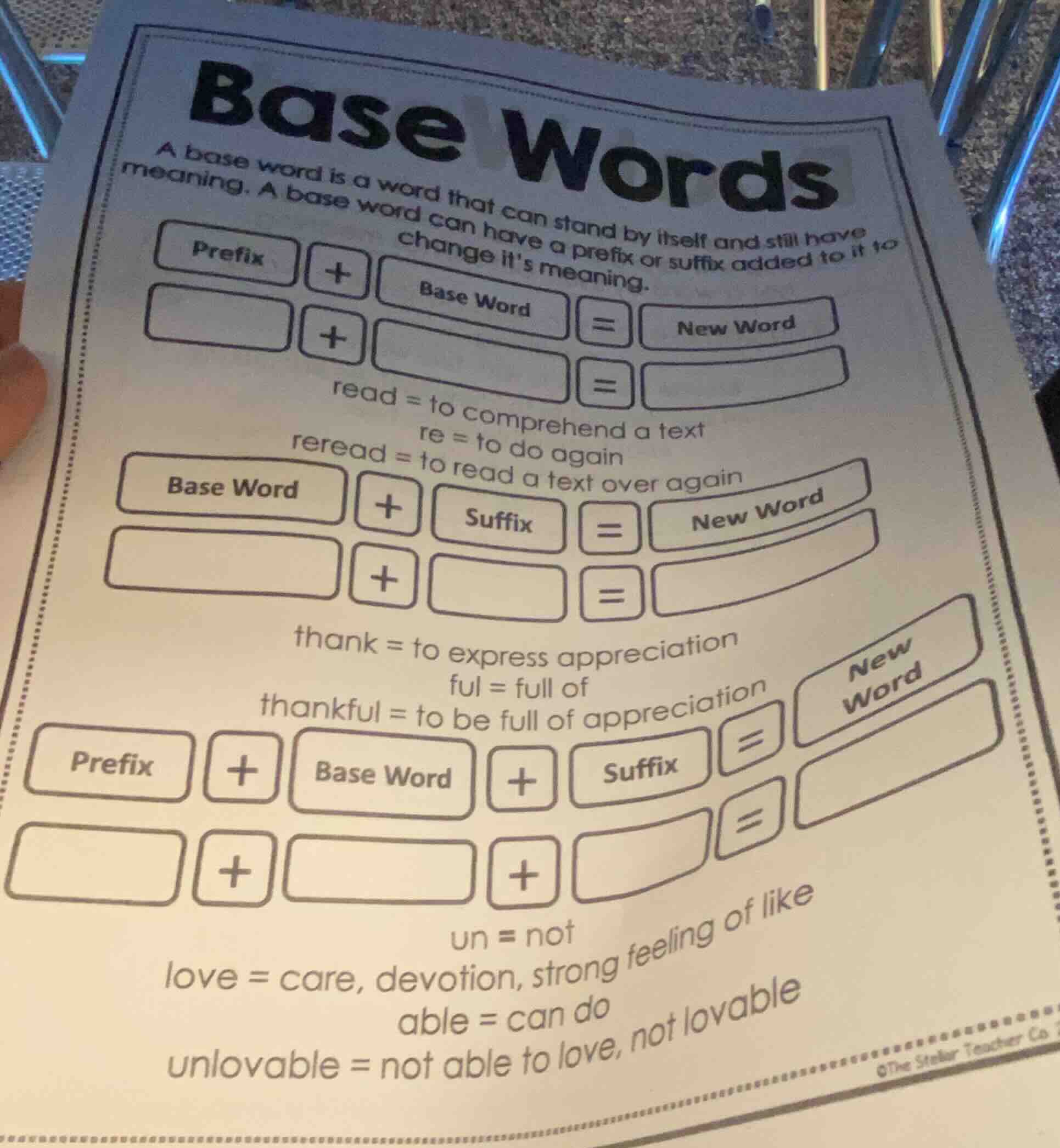
a base word is a word that can stand by itself and still have meaning. a base word can have a prefix or suffix added to it to change its meaning.
prefix + base word = new word
read = to comprehend a text
re = to do again
reread = to read a text over again
base word + suffix = new word
thank = to express appreciation
ful = full of
thankful = to be full of appreciation
prefix + base word + suffix = new word
un = not
love = care, devotion, strong feeling of like
able = can do
unlovable = not able to love, not lovable
<pre_analysis>
{
"quality": "clear",
"question_count": 3,
"skills_matched": [
"direct_cot",
"table_formatter",
"explain_then_answer",
"tutor"
],
"needs_drawing": false,
"concepts_used": [
"Word Analysis"
],
"new_concepts": [
"Prefixes and Suffixes",
"Base Words"
],
"current_concepts": [
"Word Analysis",
"Prefixes and Suffixes",
"Base Words"
]
}
</pre_analysis>
<reasoning>
Analyze the first word equation
The worksheet provides definitions and examples to fill in the blank boxes.
For the first section, the example shows:
- \( \text{read} = \text{to comprehend a text} \)
- \( \text{re} = \text{to do again} \)
- \( \text{reread} = \text{to read a text over again} \)
Using Word Analysis, we identify:
- Prefix: \( \text{re} \)
- Base Word: \( \text{read} \)
- New Word: \( \text{reread} \)
Analyze the second word equation
For the second section, the example shows:
- \( \text{thank} = \text{to express appreciation} \)
- \( \text{ful} = \text{full of} \)
- \( \text{thankful} = \text{to be full of appreciation} \)
Using Word Analysis, we identify:
- Base Word: \( \text{thank} \)
- Suffix: \( \text{ful} \)
- New Word: \( \text{thankful} \)
Analyze the third word equation
For the third section, the example shows:
- \( \text{un} = \text{not} \)
- \( \text{love} = \text{care, devotion, strong feeling of like} \)
- \( \text{able} = \text{can do} \)
- \( \text{unlovable} = \text{not able to love, not lovable} \)
Using Word Analysis, we identify:
- Prefix: \( \text{un} \)
- Base Word: \( \text{love} \)
- Suffix: \( \text{able} \)
- New Word: \( \text{unlovable} \)
</reasoning>
<answer>
| Section | Prefix | Base Word | Suffix | New Word |
|---|---|---|---|---|
| 2 (Base Word + Suffix) | — | thank | ful | thankful |
| 3 (Prefix + Base Word + Suffix) | un | love | able | unlovable |
</answer>
<post_analysis>
{
"subject": "Others",
"question_type": "Fill-in-the-blank",
"knowledge_point": [
"Others",
"English Language Arts",
"Morphology and Word Formation"
]
}
</post_analysis>
Snap & solve any problem in the app
Get step-by-step solutions on Sovi AI
Photo-based solutions with guided steps
Explore more problems and detailed explanations
<pre_analysis>
{
"quality": "clear",
"question_count": 3,
"skills_matched": [
"direct_cot",
"table_formatter",
"explain_then_answer",
"tutor"
],
"needs_drawing": false,
"concepts_used": [
"Word Analysis"
],
"new_concepts": [
"Prefixes and Suffixes",
"Base Words"
],
"current_concepts": [
"Word Analysis",
"Prefixes and Suffixes",
"Base Words"
]
}
</pre_analysis>
<reasoning>
Analyze the first word equation
The worksheet provides definitions and examples to fill in the blank boxes.
For the first section, the example shows:
- \( \text{read} = \text{to comprehend a text} \)
- \( \text{re} = \text{to do again} \)
- \( \text{reread} = \text{to read a text over again} \)
Using Word Analysis, we identify:
- Prefix: \( \text{re} \)
- Base Word: \( \text{read} \)
- New Word: \( \text{reread} \)
Analyze the second word equation
For the second section, the example shows:
- \( \text{thank} = \text{to express appreciation} \)
- \( \text{ful} = \text{full of} \)
- \( \text{thankful} = \text{to be full of appreciation} \)
Using Word Analysis, we identify:
- Base Word: \( \text{thank} \)
- Suffix: \( \text{ful} \)
- New Word: \( \text{thankful} \)
Analyze the third word equation
For the third section, the example shows:
- \( \text{un} = \text{not} \)
- \( \text{love} = \text{care, devotion, strong feeling of like} \)
- \( \text{able} = \text{can do} \)
- \( \text{unlovable} = \text{not able to love, not lovable} \)
Using Word Analysis, we identify:
- Prefix: \( \text{un} \)
- Base Word: \( \text{love} \)
- Suffix: \( \text{able} \)
- New Word: \( \text{unlovable} \)
</reasoning>
<answer>
| Section | Prefix | Base Word | Suffix | New Word |
|---|---|---|---|---|
| 2 (Base Word + Suffix) | — | thank | ful | thankful |
| 3 (Prefix + Base Word + Suffix) | un | love | able | unlovable |
</answer>
<post_analysis>
{
"subject": "Others",
"question_type": "Fill-in-the-blank",
"knowledge_point": [
"Others",
"English Language Arts",
"Morphology and Word Formation"
]
}
</post_analysis>