QUESTION IMAGE
Question
alkenes - intermediate
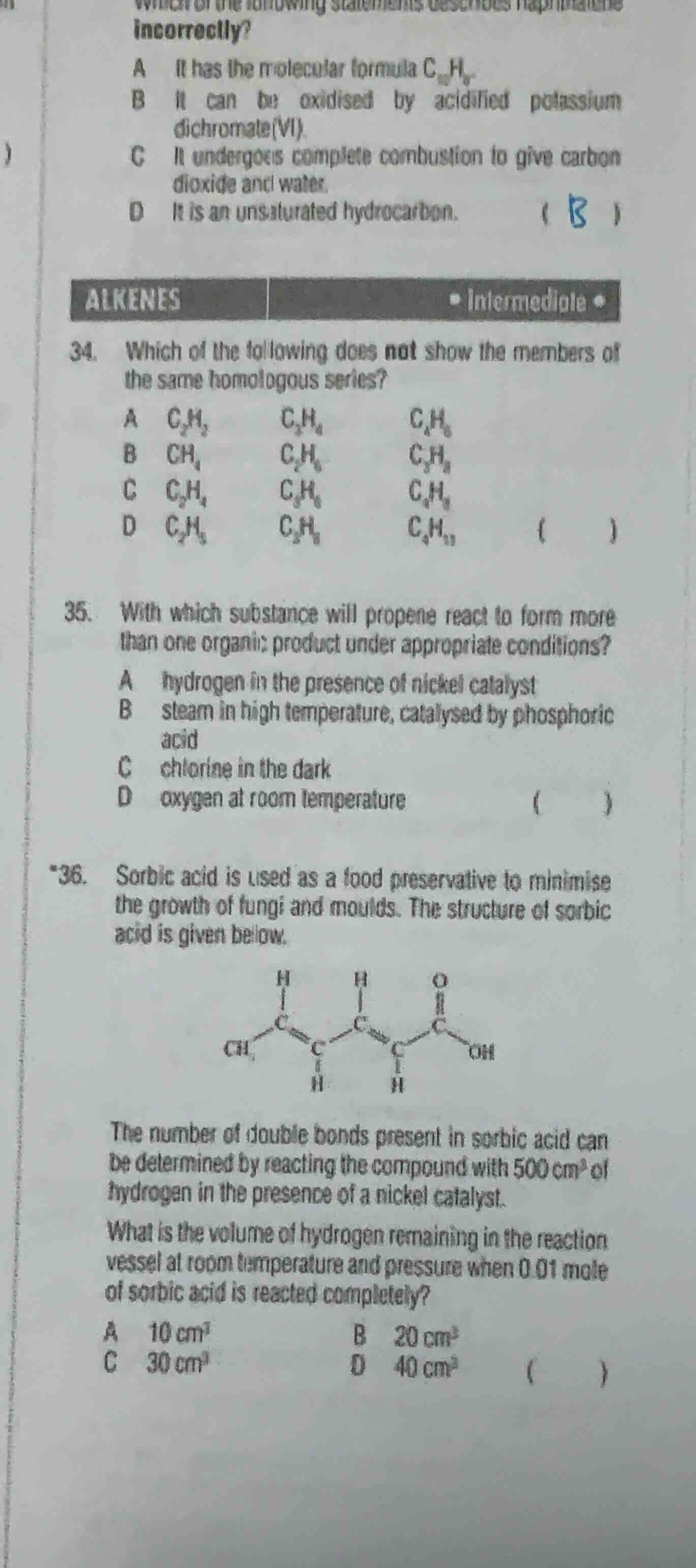
- which of the following does not show the members of the same homologous series?
a \\(c_2h_2\\), \\(c_3h_4\\), \\(c_4h_6\\)
b \\(ch_4\\), \\(c_2h_6\\), \\(c_3h_8\\)
c \\(c_2h_4\\), \\(c_3h_6\\), \\(c_4h_8\\)
d \\(c_2h_5\\), \\(c_3h_7\\), \\(c_4h_9\\)
- with which substance will propene react to form more than one organic product under appropriate conditions?
a hydrogen in the presence of nickel catalyst
b steam in high temperature, catalysed by phosphoric acid
c chlorine in the dark
d oxygen at room temperature
*36. sorbic acid is used as a food preservative to minimise the growth of fungi and moulds. the structure of sorbic acid is given below.
\\\text{ch}_3-\text{ch}=\text{ch}-\text{ch}=\text{ch}-\text{cooh}\\
the number of double bonds present in sorbic acid can be determined by reacting the compound with \\(500\text{ cm}^3\\) of hydrogen in the presence of a nickel catalyst.
what is the volume of hydrogen remaining in the reaction vessel at room temperature and pressure when \\(0.01\text{ mole}\\) of sorbic acid is reacted completely?
a \\(10\text{ cm}^3\\)
b \\(20\text{ cm}^3\\)
c \\(30\text{ cm}^3\\)
d \\(40\text{ cm}^3\\)
Analyze Question 34
Analyze Question 35
Analyze Question 36

Snap & solve any problem in the app
Get step-by-step solutions on Sovi AI
Photo-based solutions with guided steps
Explore more problems and detailed explanations
Question 34
- (A) \(\text{C}_2\text{H}_2\), \(\text{C}_3\text{H}_4\), \(\text{C}_4\text{H}_6\)
- (B) \(\text{CH}_4\), \(\text{C}_2\text{H}_6\), \(\text{C}_3\text{H}_8\)
- (C) \(\text{C}_2\text{H}_4\), \(\text{C}_3\text{H}_6\), \(\text{C}_4\text{H}_8\)
- (D) \(\text{C}_2\text{H}_5\), \(\text{C}_3\text{H}_7\), \(\text{C}_4\text{H}_{11}\) (Correct answer)
Question 35
- (A) hydrogen in the presence of nickel catalyst
- (B) steam in high temperature, catalysed by phosphoric acid (Correct answer)
- (C) chlorine in the dark
- (D) oxygen at room temperature
Question 36
- (A) \(10\text{ cm}^3\)
- (B) \(20\text{ cm}^3\) (Correct answer)
- (C) \(30\text{ cm}^3\)
- (D) \(40\text{ cm}^3\)