Sovi.AI - AI Math Tutor

Scan to solve math questions

QUESTION IMAGE

alkenes - intermediate 34. which of the following does not show the mem…

Question

alkenes - intermediate

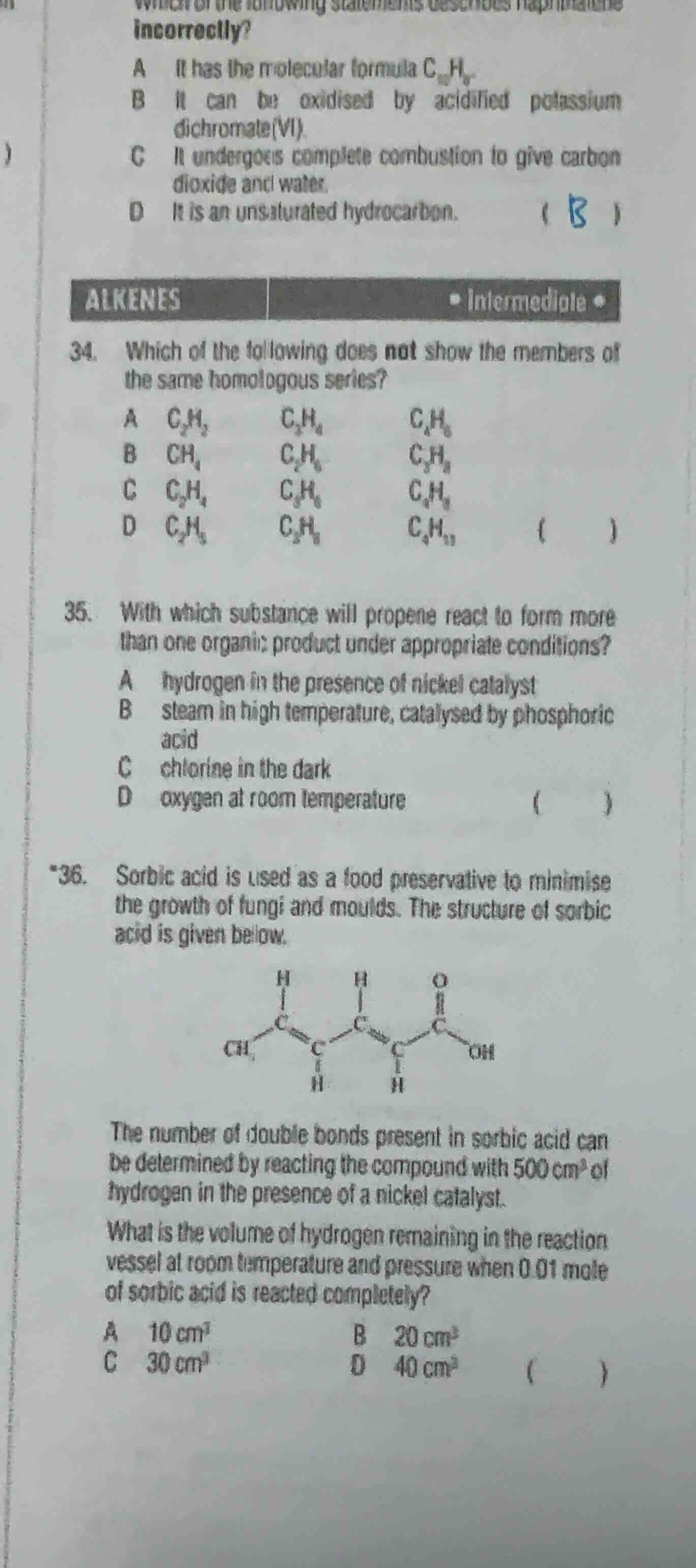
  1. which of the following does not show the members of the same homologous series?

a \\(c_2h_2\\), \\(c_3h_4\\), \\(c_4h_6\\)
b \\(ch_4\\), \\(c_2h_6\\), \\(c_3h_8\\)
c \\(c_2h_4\\), \\(c_3h_6\\), \\(c_4h_8\\)
d \\(c_2h_5\\), \\(c_3h_7\\), \\(c_4h_9\\)

  1. with which substance will propene react to form more than one organic product under appropriate conditions?

a hydrogen in the presence of nickel catalyst
b steam in high temperature, catalysed by phosphoric acid
c chlorine in the dark
d oxygen at room temperature

*36. sorbic acid is used as a food preservative to minimise the growth of fungi and moulds. the structure of sorbic acid is given below.

\\\text{ch}_3-\text{ch}=\text{ch}-\text{ch}=\text{ch}-\text{cooh}\\

the number of double bonds present in sorbic acid can be determined by reacting the compound with \\(500\text{ cm}^3\\) of hydrogen in the presence of a nickel catalyst.

what is the volume of hydrogen remaining in the reaction vessel at room temperature and pressure when \\(0.01\text{ mole}\\) of sorbic acid is reacted completely?
a \\(10\text{ cm}^3\\)
b \\(20\text{ cm}^3\\)
c \\(30\text{ cm}^3\\)
d \\(40\text{ cm}^3\\)

Explanation:

Response

<pre_analysis>
{
"quality": "clear",
"question_count": 3,
"skills_matched": [
"step_cot",
"multiple_choice_formatter",
"explain_then_answer",
"quick"
],
"needs_drawing": false,
"concepts_used": [
"Homologous Series",
"Alkene Reactions",
"Catalytic Hydration"
],
"new_concepts": [
"Stoichiometry of Hydrogenation",
"Molar Volume of Gas"
],
"current_concepts": [
"Homologous Series",
"Alkene Reactions",
"Catalytic Hydration",
"Stoichiometry of Hydrogenation",
"Molar Volume of Gas"
]
}
</pre_analysis>

<reasoning>

Analyze Question 34

\[

$$\begin{aligned} &\text{General formulas for homologous series:} \\ &\text{Alkanes: } \text{C}_n\text{H}_{2n+2} \\ &\text{Alkenes: } \text{C}_n\text{H}_{2n} \\ &\text{Alcohols: } \text{C}_n\text{H}_{2n+1}\text{OH} \\ &\text{Alkyl radicals: } \text{C}_n\text{H}_{2n+1} \\ \\ &\text{Option A: } \text{C}_2\text{H}_2, \text{C}_3\text{H}_4, \text{C}_4\text{H}_6 \implies \text{Alkynes } (\text{C}_n\text{H}_{2n-2}) \\ &\text{Option B: } \text{CH}_4, \text{C}_2\text{H}_6, \text{C}_3\text{H}_8 \implies \text{Alkanes } (\text{C}_n\text{H}_{2n+2}) \\ &\text{Option C: } \text{C}_2\text{H}_4, \text{C}_3\text{H}_6, \text{C}_4\text{H}_8 \implies \text{Alkenes } (\text{C}_n\text{H}_{2n}) \\ &\text{Option D: } \text{C}_2\text{H}_5, \text{C}_3\text{H}_7, \text{C}_4\text{H}_9 \implies \text{Alkyl groups } (\text{C}_n\text{H}_{2n+1}) \\ &\text{Wait, let's re-examine Option D in the image: } \text{C}_2\text{H}_5, \text{C}_3\text{H}_7, \text{C}_4\text{H}_{11} \\ &\text{For } n=4\text{, the alkyl group is } \text{C}_4\text{H}_9\text{. } \text{C}_4\text{H}_{11} \text{ is not a valid alkyl group or member of this series.} \end{aligned}$$

\]

Analyze Question 35

\[

$$\begin{aligned} &\text{Propene } (\text{CH}_3\text{-CH=CH}_2) \text{ is an unsymmetrical alkene.} \\ &\text{A: Reaction with } \text{H}_2/\text{Ni} \implies \text{propane (1 product).} \\ &\text{B: Reaction with } \text{H}_2\text{O(g)}/\text{H}_3\text{PO}_4 \implies \text{propan-1-ol and propan-2-ol (2 products due to unsymmetrical addition).} \\ &\text{C: Reaction with } \text{Cl}_2 \text{ in the dark} \implies \text{1,2-dichloropropane (1 product).} \\ &\text{D: Reaction with } \text{O}_2 \text{ at room temperature} \implies \text{No reaction.} \end{aligned}$$

\]

Analyze Question 36

\[

$$\begin{aligned} &\text{Sorbic acid structure contains two } \text{C=C} \text{ double bonds and one } \text{C=O} \text{ double bond (in carboxylic acid).} \\ &\text{Only the two } \text{C=C} \text{ double bonds undergo addition reaction with } \text{H}_2 \text{ in the presence of Ni catalyst.} \\ &\text{Mole ratio of sorbic acid to } \text{H}_2 \text{ reacted} = 1 : 2 \\ &\text{Moles of } \text{H}_2 \text{ reacted} = 2 \times 0.01\text{ mol} = 0.02\text{ mol} \\ &\text{Volume of } \text{H}_2 \text{ reacted at r.t.p.} = 0.02\text{ mol} \times 24000\text{ cm}^3/\text{mol} = 480\text{ cm}^3 \\ &\text{Volume of } \text{H}_2 \text{ remaining} = 500\text{ cm}^3 - 480\text{ cm}^3 = 20\text{ cm}^3 \end{aligned}$$

\]
</reasoning>

<answer>

Question 34

<mcq-option>(A) \(\text{C}_2\text{H}_2\), \(\text{C}_3\text{H}_4\), \(\text{C}_4\text{H}_6\)</mcq-option>
<mcq-option>(B) \(\text{CH}_4\), \(\text{C}_2\text{H}_6\), \(\text{C}_3\text{H}_8\)</mcq-option>
<mcq-option>(C) \(\text{C}_2\text{H}_4\), \(\text{C}_3\text{H}_6\), \(\text{C}_4\text{H}_8\)</mcq-option>
<mcq-correct>(D) \(\text{C}_2\text{H}_5\), \(\text{C}_3\text{H}_7\), \(\text{C}_4\text{H}_{11}\)</mcq-correct>

Question 35

<mcq-option>(A) hydrogen in the presen…

Answer:

<pre_analysis>
{
"quality": "clear",
"question_count": 3,
"skills_matched": [
"step_cot",
"multiple_choice_formatter",
"explain_then_answer",
"quick"
],
"needs_drawing": false,
"concepts_used": [
"Homologous Series",
"Alkene Reactions",
"Catalytic Hydration"
],
"new_concepts": [
"Stoichiometry of Hydrogenation",
"Molar Volume of Gas"
],
"current_concepts": [
"Homologous Series",
"Alkene Reactions",
"Catalytic Hydration",
"Stoichiometry of Hydrogenation",
"Molar Volume of Gas"
]
}
</pre_analysis>

<reasoning>

Analyze Question 34

\[

$$\begin{aligned} &\text{General formulas for homologous series:} \\ &\text{Alkanes: } \text{C}_n\text{H}_{2n+2} \\ &\text{Alkenes: } \text{C}_n\text{H}_{2n} \\ &\text{Alcohols: } \text{C}_n\text{H}_{2n+1}\text{OH} \\ &\text{Alkyl radicals: } \text{C}_n\text{H}_{2n+1} \\ \\ &\text{Option A: } \text{C}_2\text{H}_2, \text{C}_3\text{H}_4, \text{C}_4\text{H}_6 \implies \text{Alkynes } (\text{C}_n\text{H}_{2n-2}) \\ &\text{Option B: } \text{CH}_4, \text{C}_2\text{H}_6, \text{C}_3\text{H}_8 \implies \text{Alkanes } (\text{C}_n\text{H}_{2n+2}) \\ &\text{Option C: } \text{C}_2\text{H}_4, \text{C}_3\text{H}_6, \text{C}_4\text{H}_8 \implies \text{Alkenes } (\text{C}_n\text{H}_{2n}) \\ &\text{Option D: } \text{C}_2\text{H}_5, \text{C}_3\text{H}_7, \text{C}_4\text{H}_9 \implies \text{Alkyl groups } (\text{C}_n\text{H}_{2n+1}) \\ &\text{Wait, let's re-examine Option D in the image: } \text{C}_2\text{H}_5, \text{C}_3\text{H}_7, \text{C}_4\text{H}_{11} \\ &\text{For } n=4\text{, the alkyl group is } \text{C}_4\text{H}_9\text{. } \text{C}_4\text{H}_{11} \text{ is not a valid alkyl group or member of this series.} \end{aligned}$$

\]

Analyze Question 35

\[

$$\begin{aligned} &\text{Propene } (\text{CH}_3\text{-CH=CH}_2) \text{ is an unsymmetrical alkene.} \\ &\text{A: Reaction with } \text{H}_2/\text{Ni} \implies \text{propane (1 product).} \\ &\text{B: Reaction with } \text{H}_2\text{O(g)}/\text{H}_3\text{PO}_4 \implies \text{propan-1-ol and propan-2-ol (2 products due to unsymmetrical addition).} \\ &\text{C: Reaction with } \text{Cl}_2 \text{ in the dark} \implies \text{1,2-dichloropropane (1 product).} \\ &\text{D: Reaction with } \text{O}_2 \text{ at room temperature} \implies \text{No reaction.} \end{aligned}$$

\]

Analyze Question 36

\[

$$\begin{aligned} &\text{Sorbic acid structure contains two } \text{C=C} \text{ double bonds and one } \text{C=O} \text{ double bond (in carboxylic acid).} \\ &\text{Only the two } \text{C=C} \text{ double bonds undergo addition reaction with } \text{H}_2 \text{ in the presence of Ni catalyst.} \\ &\text{Mole ratio of sorbic acid to } \text{H}_2 \text{ reacted} = 1 : 2 \\ &\text{Moles of } \text{H}_2 \text{ reacted} = 2 \times 0.01\text{ mol} = 0.02\text{ mol} \\ &\text{Volume of } \text{H}_2 \text{ reacted at r.t.p.} = 0.02\text{ mol} \times 24000\text{ cm}^3/\text{mol} = 480\text{ cm}^3 \\ &\text{Volume of } \text{H}_2 \text{ remaining} = 500\text{ cm}^3 - 480\text{ cm}^3 = 20\text{ cm}^3 \end{aligned}$$

\]
</reasoning>

<answer>

Question 34

<mcq-option>(A) \(\text{C}_2\text{H}_2\), \(\text{C}_3\text{H}_4\), \(\text{C}_4\text{H}_6\)</mcq-option>
<mcq-option>(B) \(\text{CH}_4\), \(\text{C}_2\text{H}_6\), \(\text{C}_3\text{H}_8\)</mcq-option>
<mcq-option>(C) \(\text{C}_2\text{H}_4\), \(\text{C}_3\text{H}_6\), \(\text{C}_4\text{H}_8\)</mcq-option>
<mcq-correct>(D) \(\text{C}_2\text{H}_5\), \(\text{C}_3\text{H}_7\), \(\text{C}_4\text{H}_{11}\)</mcq-correct>

Question 35

<mcq-option>(A) hydrogen in the presence of nickel catalyst</mcq-option>
<mcq-correct>(B) steam in high temperature, catalysed by phosphoric acid</mcq-correct>
<mcq-option>(C) chlorine in the dark</mcq-option>
<mcq-option>(D) oxygen at room temperature</mcq-option>

Question 36

<mcq-option>(A) \(10\text{ cm}^3\)</mcq-option>
<mcq-correct>(B) \(20\text{ cm}^3\)</mcq-correct>
<mcq-option>(C) \(30\text{ cm}^3\)</mcq-option>
<mcq-option>(D) \(40\text{ cm}^3\)</mcq-option>
</answer>

<post_analysis>
{
"subject": "Natural Science",
"question_type": "Multiple Choice",
"knowledge_point": [
"Natural Science",
"Chemistry",
"Organic Chemistry"
]
}
</post_analysis>