QUESTION IMAGE
Question
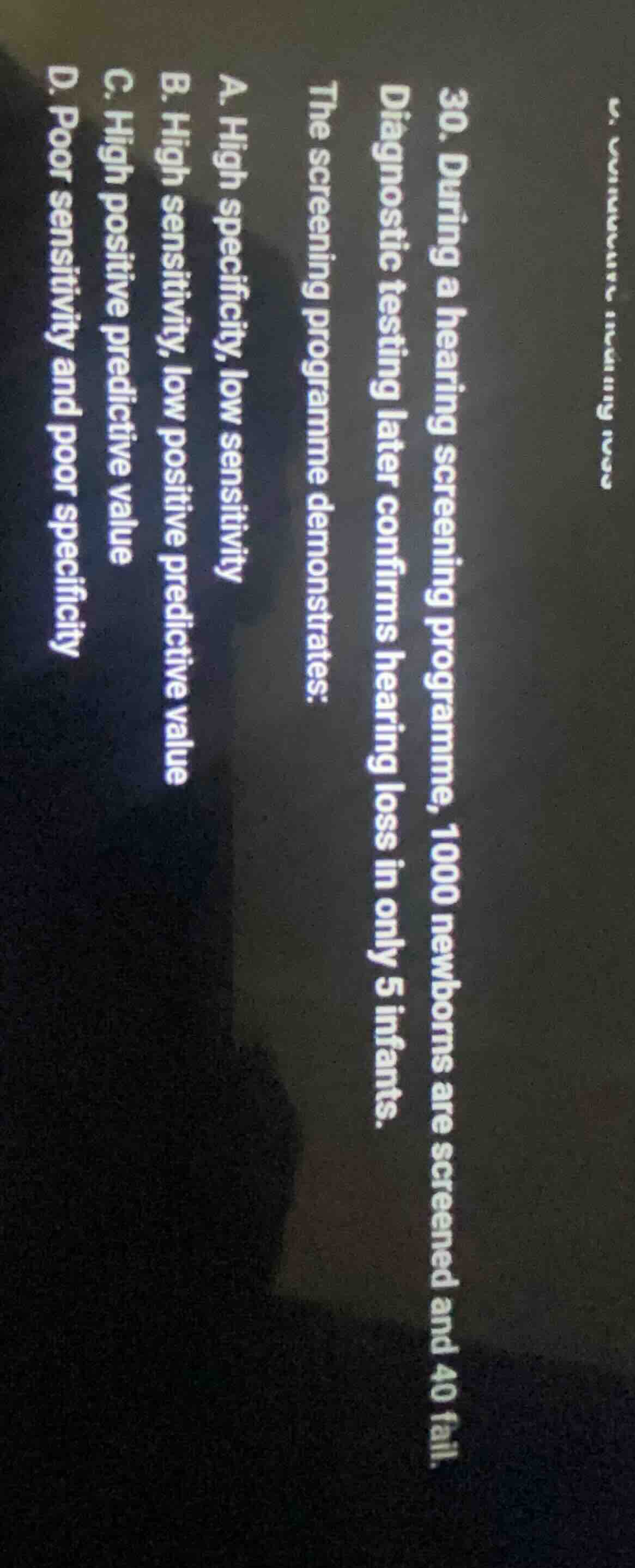
- during a hearing screening programme, 1000 newborns are screened and 40 fail. diagnostic testing later confirms hearing loss in only 5 infants.
the screening programme demonstrates:
a. high specificity, low sensitivity
b. high sensitivity, low positive predictive value
c. high positive predictive value
d. poor sensitivity and poor specificity
Define the given parameters
We identify the key values from the screening scenario:
- Total newborns screened: \(1000\)
- Number of newborns who fail the screening (test positive): \(40\)
- Number of newborns confirmed with hearing loss (true cases): \(5\)
Analyze the positive predictive value
The positive predictive value (PPV) is the probability that a subject has the condition given a positive test result:
Assuming all 5 confirmed cases were among the 40 who failed the screening (which is the standard assumption for a screening program where only those who fail are referred for diagnostic testing):
- \(\text{TP} = 5\)
- \(\text{Total Test Positives} = 40\)
- \(\text{PPV} = \frac{5}{40} = 12.5\%\)
A PPV of \(12.5\%\) is considered low because the vast majority of those who fail the screening (\(87.5\%\)) do not actually have the condition.
Analyze the sensitivity
Sensitivity is the probability that the test correctly identifies those with the condition:
Since diagnostic testing confirmed hearing loss in 5 infants, and assuming the screening successfully detected them:
- \(\text{TP} = 5\)
- \(\text{Total Diseased} = 5\)
- \(\text{Sensitivity} = \frac{5}{5} = 100\%\)
Even if there were undetected cases (false negatives), detecting all 5 confirmed cases indicates a high sensitivity. Screening programs are designed to have high sensitivity to avoid missing any affected individuals.
Match with the options
We evaluate the calculated metrics against the choices:
- High sensitivity: Correct, as it is designed to catch all true cases.
- Low positive predictive value: Correct, as only \(12.5\%\) of those who failed actually had the disease.
This matches option B.

Snap & solve any problem in the app
Get step-by-step solutions on Sovi AI
Photo-based solutions with guided steps
Explore more problems and detailed explanations
- (A) High specificity, low sensitivity
- (B) High sensitivity, low positive predictive value (Correct answer)
- (C) High positive predictive value
- (D) Poor sensitivity and poor specificity