Sovi.AI - AI Math Tutor

Scan to solve math questions

QUESTION IMAGE

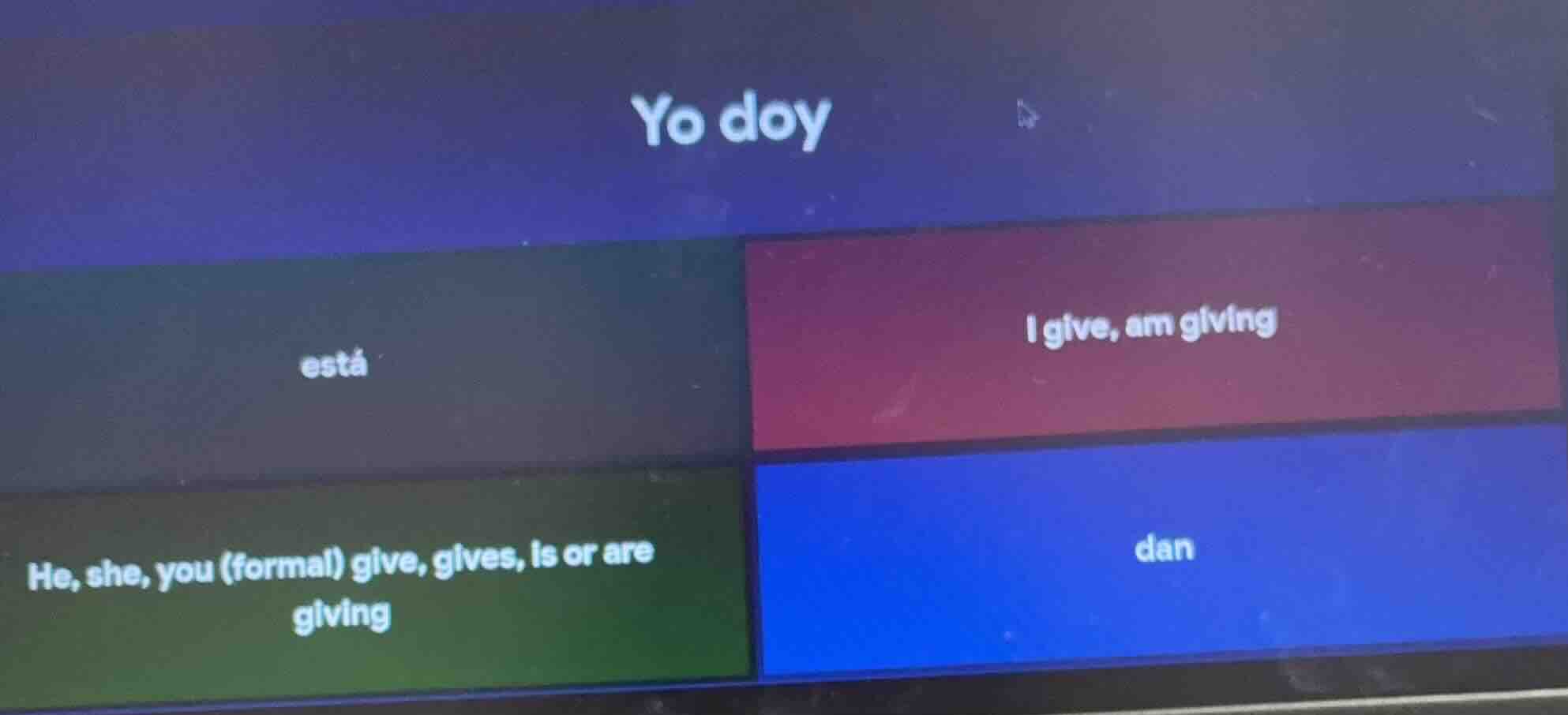
yo doy está i give, am giving he, she, you (formal) give, gives, is or …

Question

yo doy

está

i give, am giving

he, she, you (formal) give, gives, is or are giving

dan

Explanation:

Response

<pre_analysis>
{
"quality": "clear",
"question_count": 1,
"skills_matched": [
"direct_cot",
"multiple_choice_formatter",
"explain_then_answer",
"quick"
],
"needs_drawing": false,
"concepts_used": [
"Spanish Verb Translation",
"Spanish Irregular Verbs"
],
"new_concepts": [],
"current_concepts": [
"Spanish Verb Translation",
"Spanish Irregular Verbs",
"Spanish Present Tense"
]
}
</pre_analysis>

<reasoning>

Identify the subject and verb

The prompt displays the Spanish phrase "Yo doy". "Yo" is the first-person singular pronoun meaning "I". "Doy" is the first-person singular present tense conjugation of the irregular verb "dar", which means "to give".

Translate the phrase

"Yo doy" translates directly to English as "I give" or "I am giving" (present continuous).

Evaluate the options

  • "está": This is a conjugated form of the verb "estar" (to be), which is incorrect.
  • "I give, am giving": This is the correct translation of "Yo doy".
  • "He, she, you (formal) give, gives, is or are giving": This corresponds to third-person singular forms (e.g., "él/ella/usted da"), which is incorrect.
  • "dan": This is the third-person plural conjugation of "dar" (they/you all give), which is incorrect.

</reasoning>

<answer>
<mcq-option>(A) está</mcq-option>
<mcq-correct>(B) I give, am giving</mcq-correct>
<mcq-option>(C) He, she, you (formal) give, gives, is or are giving</mcq-option>
<mcq-option>(D) dan</mcq-option>
</answer>

<post_analysis>
{
"subject": "Others",
"question_type": "Multiple Choice",
"knowledge_point": [
"Others",
"Spanish",
"Spanish Verb Translation"
]
}
</post_analysis>

Answer:

<pre_analysis>
{
"quality": "clear",
"question_count": 1,
"skills_matched": [
"direct_cot",
"multiple_choice_formatter",
"explain_then_answer",
"quick"
],
"needs_drawing": false,
"concepts_used": [
"Spanish Verb Translation",
"Spanish Irregular Verbs"
],
"new_concepts": [],
"current_concepts": [
"Spanish Verb Translation",
"Spanish Irregular Verbs",
"Spanish Present Tense"
]
}
</pre_analysis>

<reasoning>

Identify the subject and verb

The prompt displays the Spanish phrase "Yo doy". "Yo" is the first-person singular pronoun meaning "I". "Doy" is the first-person singular present tense conjugation of the irregular verb "dar", which means "to give".

Translate the phrase

"Yo doy" translates directly to English as "I give" or "I am giving" (present continuous).

Evaluate the options

  • "está": This is a conjugated form of the verb "estar" (to be), which is incorrect.
  • "I give, am giving": This is the correct translation of "Yo doy".
  • "He, she, you (formal) give, gives, is or are giving": This corresponds to third-person singular forms (e.g., "él/ella/usted da"), which is incorrect.
  • "dan": This is the third-person plural conjugation of "dar" (they/you all give), which is incorrect.

</reasoning>

<answer>
<mcq-option>(A) está</mcq-option>
<mcq-correct>(B) I give, am giving</mcq-correct>
<mcq-option>(C) He, she, you (formal) give, gives, is or are giving</mcq-option>
<mcq-option>(D) dan</mcq-option>
</answer>

<post_analysis>
{
"subject": "Others",
"question_type": "Multiple Choice",
"knowledge_point": [
"Others",
"Spanish",
"Spanish Verb Translation"
]
}
</post_analysis>