QUESTION IMAGE
Question
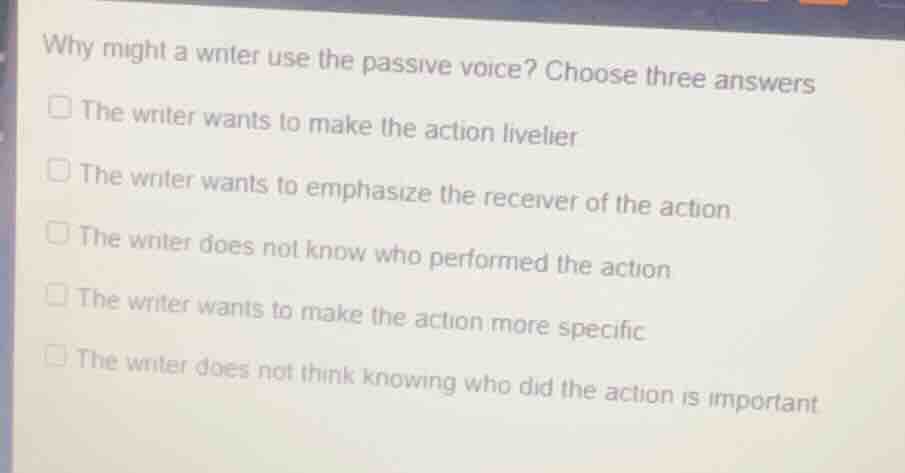
why might a writer use the passive voice? choose three answers
the writer wants to make the action livelier
the writer wants to emphasize the receiver of the action
the writer does not know who performed the action
the writer wants to make the action more specific
the writer does not think knowing who did the action is important
<pre_analysis>
{
"quality": "clear",
"question_count": 1,
"skills_matched": [
"direct_cot",
"multiple_choice_formatter",
"explain_then_answer",
"quick"
],
"needs_drawing": false,
"concepts_used": [],
"new_concepts": [
"Passive Voice Functions"
],
"current_concepts": [
"Passive Voice",
"Grammatical Voice",
"Passive Voice Functions"
]
}
</pre_analysis>
<reasoning>
Analyze the function of passive voice
The passive voice shifts the focus of a sentence from the performer of the action (the agent) to the recipient of the action. This grammatical structure is deliberately chosen by writers for specific rhetorical purposes.
Evaluate each option
- The writer wants to make the action livelier: Incorrect. Active voice is generally used to make writing more dynamic and lively.
- The writer wants to emphasize the receiver of the action: Correct. Passive voice naturally places the receiver of the action in the subject position, drawing the reader's attention to it.
- The writer does not know who performed the action: Correct. Passive voice is ideal when the actor is unknown (e.g., "The window was broken").
- The writer wants to make the action more specific: Incorrect. Passive voice often makes sentences less specific because the agent performing the action can be omitted.
- The writer does not think knowing who did the action is important: Correct. Passive voice allows the writer to omit the agent when their identity is irrelevant to the context (e.g., "The experimental results were published").
</reasoning>
<answer>
<mcq-option>The writer wants to make the action livelier</mcq-option>
<mcq-correct>The writer wants to emphasize the receiver of the action</mcq-correct>
<mcq-correct>The writer does not know who performed the action</mcq-correct>
<mcq-option>The writer wants to make the action more specific</mcq-option>
<mcq-correct>The writer does not think knowing who did the action is important</mcq-correct>
</answer>
<post_analysis>
{
"subject": "Others",
"question_type": "Multiple Choice",
"knowledge_point": [
"Others",
"Grammar and Mechanics",
"Passive Voice Functions"
]
}
</post_analysis>
Snap & solve any problem in the app
Get step-by-step solutions on Sovi AI
Photo-based solutions with guided steps
Explore more problems and detailed explanations
<pre_analysis>
{
"quality": "clear",
"question_count": 1,
"skills_matched": [
"direct_cot",
"multiple_choice_formatter",
"explain_then_answer",
"quick"
],
"needs_drawing": false,
"concepts_used": [],
"new_concepts": [
"Passive Voice Functions"
],
"current_concepts": [
"Passive Voice",
"Grammatical Voice",
"Passive Voice Functions"
]
}
</pre_analysis>
<reasoning>
Analyze the function of passive voice
The passive voice shifts the focus of a sentence from the performer of the action (the agent) to the recipient of the action. This grammatical structure is deliberately chosen by writers for specific rhetorical purposes.
Evaluate each option
- The writer wants to make the action livelier: Incorrect. Active voice is generally used to make writing more dynamic and lively.
- The writer wants to emphasize the receiver of the action: Correct. Passive voice naturally places the receiver of the action in the subject position, drawing the reader's attention to it.
- The writer does not know who performed the action: Correct. Passive voice is ideal when the actor is unknown (e.g., "The window was broken").
- The writer wants to make the action more specific: Incorrect. Passive voice often makes sentences less specific because the agent performing the action can be omitted.
- The writer does not think knowing who did the action is important: Correct. Passive voice allows the writer to omit the agent when their identity is irrelevant to the context (e.g., "The experimental results were published").
</reasoning>
<answer>
<mcq-option>The writer wants to make the action livelier</mcq-option>
<mcq-correct>The writer wants to emphasize the receiver of the action</mcq-correct>
<mcq-correct>The writer does not know who performed the action</mcq-correct>
<mcq-option>The writer wants to make the action more specific</mcq-option>
<mcq-correct>The writer does not think knowing who did the action is important</mcq-correct>
</answer>
<post_analysis>
{
"subject": "Others",
"question_type": "Multiple Choice",
"knowledge_point": [
"Others",
"Grammar and Mechanics",
"Passive Voice Functions"
]
}
</post_analysis>