Sovi.AI - AI Math Tutor

Scan to solve math questions

QUESTION IMAGE

which statements should be included in a summary of act 1, scene 1? che…

Question

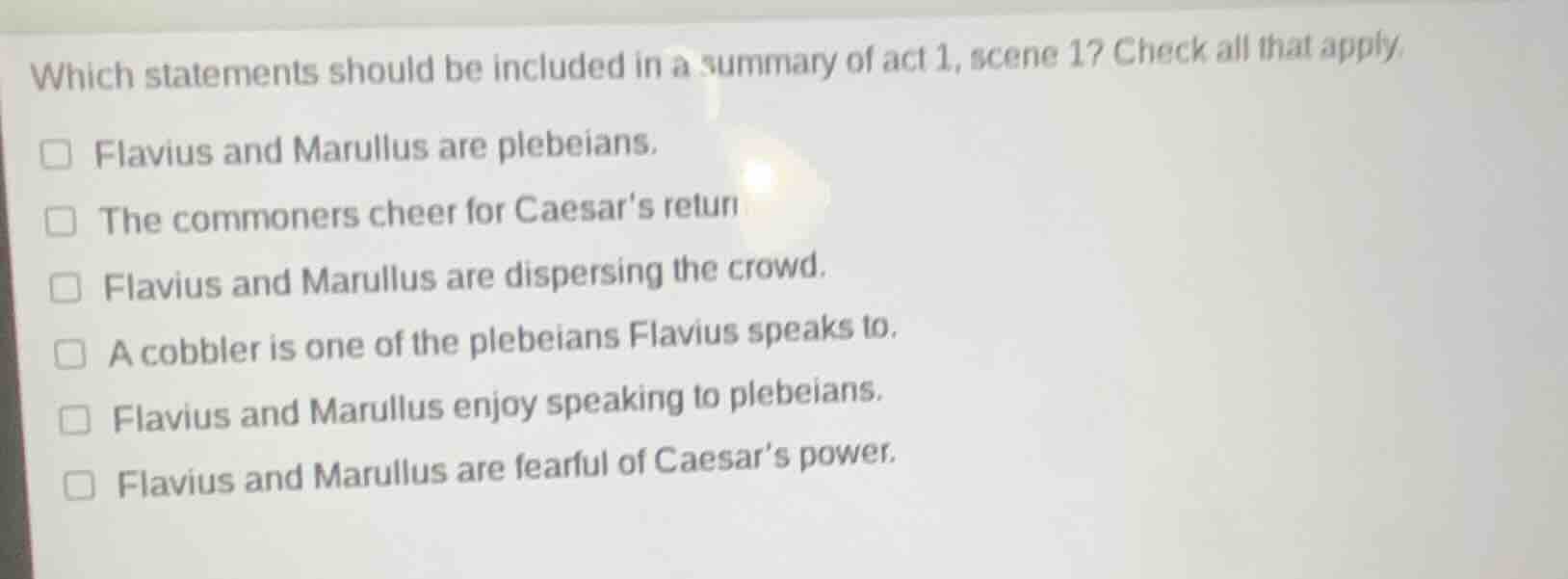
which statements should be included in a summary of act 1, scene 1? check all that apply.

flavius and marullus are plebeians.
the commoners cheer for caesars return.
flavius and marullus are dispersing the crowd.
a cobbler is one of the plebeians flavius speaks to.
flavius and marullus enjoy speaking to plebeians.
flavius and marullus are fearful of caesars power.

Explanation:

Response

<pre_analysis>
{
"quality": "clear",
"question_count": 1,
"skills_matched": [
"direct_cot",
"multiple_choice_formatter",
"explain_then_answer",
"tutor"
],
"needs_drawing": false,
"concepts_used": [
"Rhetorical Analysis"
],
"new_concepts": [
"Literary Summary",
"Drama Analysis"
],
"current_concepts": [
"Rhetorical Analysis",
"Literary Summary",
"Drama Analysis"
]
}
</pre_analysis>

<reasoning>

Analyze character roles and identities

We examine the first statement: "Flavius and Marullus are plebeians." In Shakespeare's Julius Caesar, Act 1, Scene 1, Flavius and Marullus are actually tribunes (high-ranking officials), not plebeians (commoners). Therefore, this statement is factually incorrect and should not be included in a summary.

Identify key plot actions

We analyze the actions of the crowd and the tribunes. The commoners have gathered in the streets to celebrate and cheer for Julius Caesar's triumphant return after defeating Pompey's sons. Flavius and Marullus are angry at this celebration and actively work to disperse the crowd, scolding them for their fickle loyalty. Thus, "The commoners cheer for Caesar's return" and "Flavius and Marullus are dispersing the crowd" are central plot points that belong in a summary.

Evaluate minor details versus summary-worthy events

We look at the interaction with the cobbler: "A cobbler is one of the plebeians Flavius speaks to." While this interaction occurs and provides comic relief/wordplay, a summary focuses on major plot developments rather than specific minor characters spoken to, making this detail less essential for a concise summary.

Assess character motivations and attitudes

We evaluate the final two statements regarding the tribunes' feelings. Flavius and Marullus do not enjoy speaking to the plebeians; they treat them with contempt and anger. However, their actions are driven by a deeper political anxiety: they are highly fearful of Caesar's growing power and popularity, worrying he will enslave Rome. Thus, "Flavius and Marullus are fearful of Caesar's power" is a key thematic motivator that belongs in a summary. We apply Rhetorical Analysis to understand how their speeches reveal this underlying fear of tyranny.
</reasoning>

<answer>
<mcq-option>Flavius and Marullus are plebeians.</mcq-option>
<mcq-correct>The commoners cheer for Caesar's return.</mcq-correct>
<mcq-correct>Flavius and Marullus are dispersing the crowd.</mcq-option>
<mcq-option>A cobbler is one of the plebeians Flavius speaks to.</mcq-option>
<mcq-option>Flavius and Marullus enjoy speaking to plebeians.</mcq-option>
<mcq-correct>Flavius and Marullus are fearful of Caesar's power.</mcq-correct>
</answer>

<post_analysis>
{
"subject": "Others",
"question_type": "Multiple Choice",
"knowledge_point": [
"Others",
"Literature",
"Drama Analysis"
]
}
</post_analysis>

Answer:

<pre_analysis>
{
"quality": "clear",
"question_count": 1,
"skills_matched": [
"direct_cot",
"multiple_choice_formatter",
"explain_then_answer",
"tutor"
],
"needs_drawing": false,
"concepts_used": [
"Rhetorical Analysis"
],
"new_concepts": [
"Literary Summary",
"Drama Analysis"
],
"current_concepts": [
"Rhetorical Analysis",
"Literary Summary",
"Drama Analysis"
]
}
</pre_analysis>

<reasoning>

Analyze character roles and identities

We examine the first statement: "Flavius and Marullus are plebeians." In Shakespeare's Julius Caesar, Act 1, Scene 1, Flavius and Marullus are actually tribunes (high-ranking officials), not plebeians (commoners). Therefore, this statement is factually incorrect and should not be included in a summary.

Identify key plot actions

We analyze the actions of the crowd and the tribunes. The commoners have gathered in the streets to celebrate and cheer for Julius Caesar's triumphant return after defeating Pompey's sons. Flavius and Marullus are angry at this celebration and actively work to disperse the crowd, scolding them for their fickle loyalty. Thus, "The commoners cheer for Caesar's return" and "Flavius and Marullus are dispersing the crowd" are central plot points that belong in a summary.

Evaluate minor details versus summary-worthy events

We look at the interaction with the cobbler: "A cobbler is one of the plebeians Flavius speaks to." While this interaction occurs and provides comic relief/wordplay, a summary focuses on major plot developments rather than specific minor characters spoken to, making this detail less essential for a concise summary.

Assess character motivations and attitudes

We evaluate the final two statements regarding the tribunes' feelings. Flavius and Marullus do not enjoy speaking to the plebeians; they treat them with contempt and anger. However, their actions are driven by a deeper political anxiety: they are highly fearful of Caesar's growing power and popularity, worrying he will enslave Rome. Thus, "Flavius and Marullus are fearful of Caesar's power" is a key thematic motivator that belongs in a summary. We apply Rhetorical Analysis to understand how their speeches reveal this underlying fear of tyranny.
</reasoning>

<answer>
<mcq-option>Flavius and Marullus are plebeians.</mcq-option>
<mcq-correct>The commoners cheer for Caesar's return.</mcq-correct>
<mcq-correct>Flavius and Marullus are dispersing the crowd.</mcq-option>
<mcq-option>A cobbler is one of the plebeians Flavius speaks to.</mcq-option>
<mcq-option>Flavius and Marullus enjoy speaking to plebeians.</mcq-option>
<mcq-correct>Flavius and Marullus are fearful of Caesar's power.</mcq-correct>
</answer>

<post_analysis>
{
"subject": "Others",
"question_type": "Multiple Choice",
"knowledge_point": [
"Others",
"Literature",
"Drama Analysis"
]
}
</post_analysis>