QUESTION IMAGE
Question
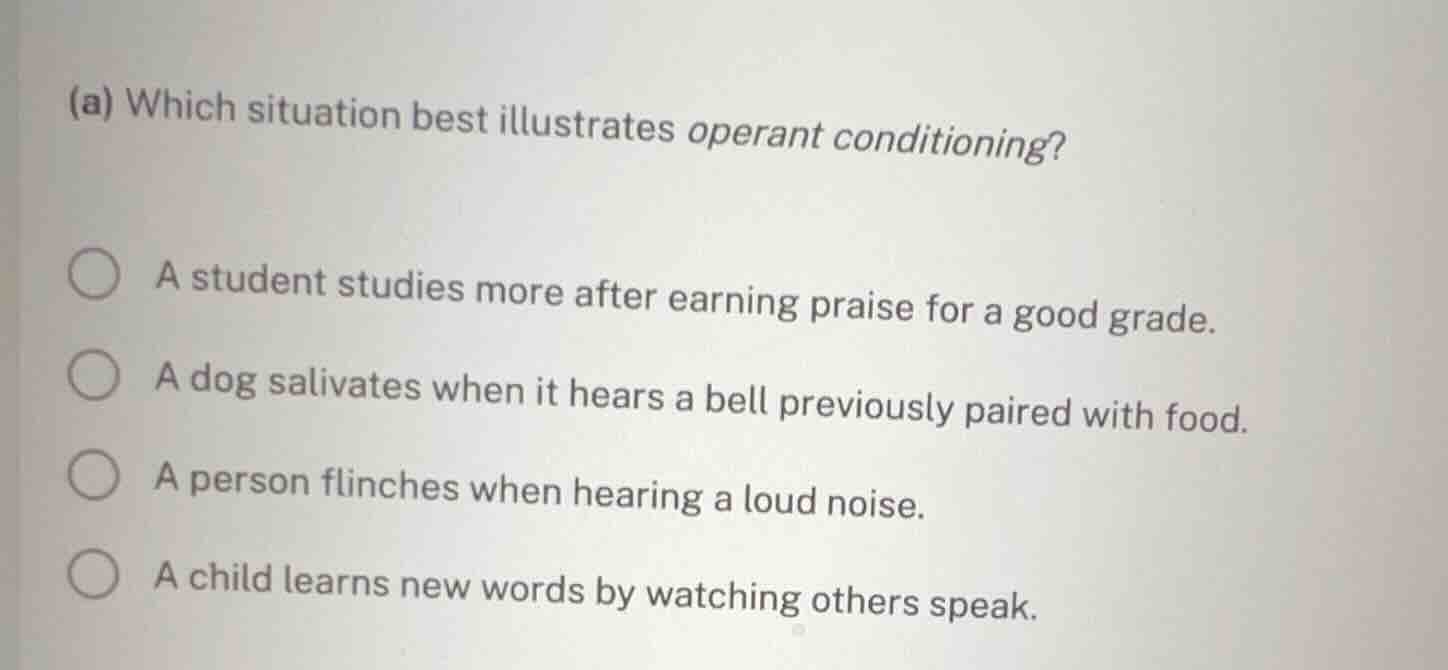
(a) which situation best illustrates operant conditioning?
a student studies more after earning praise for a good grade.
a dog salivates when it hears a bell previously paired with food.
a person flinches when hearing a loud noise.
a child learns new words by watching others speak.
Define operant conditioning
Using the Behavioral Conditioning knowledge point
Operant conditioning is a learning process where voluntary behaviors are modified by their consequences, such as reinforcement or punishment.
Analyze the first option
The student's voluntary behavior (studying more) increases because of a positive consequence (earning praise). This is a classic example of positive reinforcement within operant conditioning.
Analyze the second option
A dog salivating to a bell paired with food is an involuntary, reflex-like response triggered by an association between two stimuli. This represents classical conditioning.
Analyze the third option
Flinching at a loud noise is an unlearned, involuntary physiological reflex (an unconditioned response) rather than operant learning.
Analyze the fourth option
A child learning by watching others speak represents observational learning (modeling), which is a cognitive and social learning process rather than direct operant conditioning.

Snap & solve any problem in the app
Get step-by-step solutions on Sovi AI
Photo-based solutions with guided steps
Explore more problems and detailed explanations
- (A) A student studies more after earning praise for a good grade. (Correct answer)
- (B) A dog salivating when it hears a bell previously paired with food.
- (C) A person flinches when hearing a loud noise.
- (D) A child learns new words by watching others speak.