Sovi.AI - AI Math Tutor

Scan to solve math questions

QUESTION IMAGE

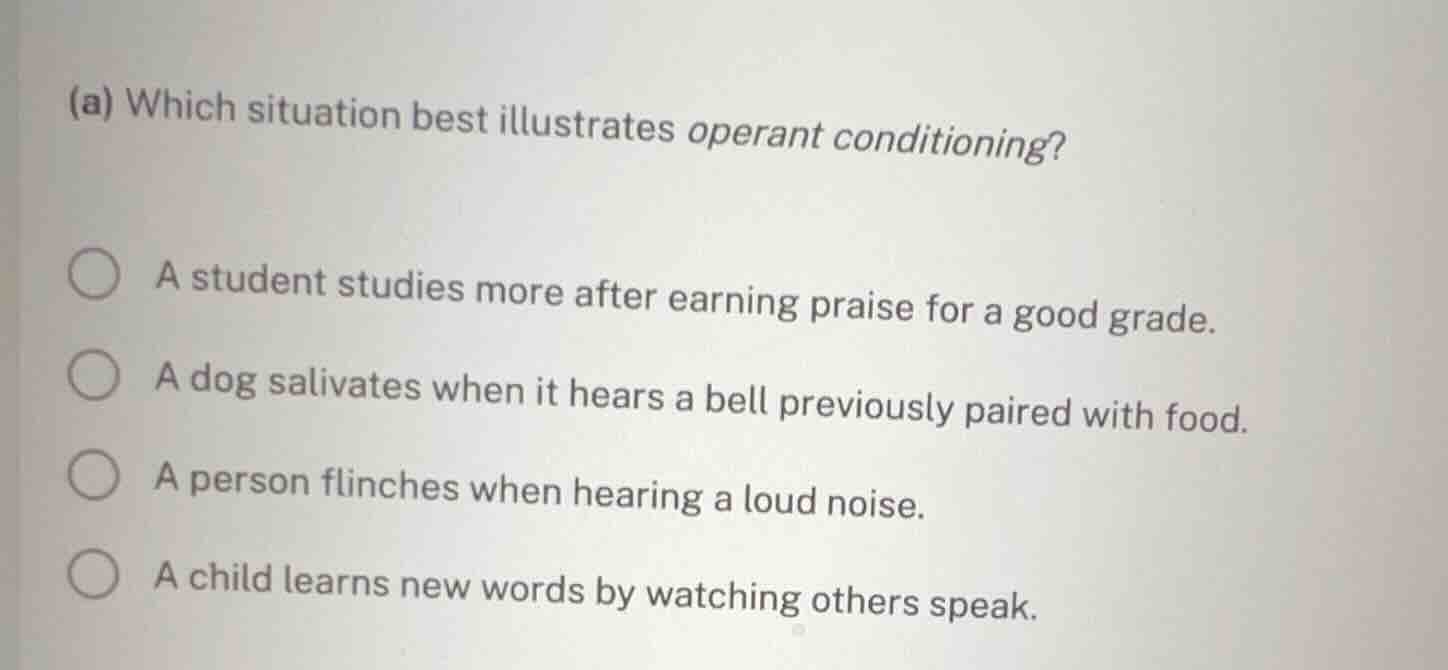
(a) which situation best illustrates operant conditioning? a student st…

Question

(a) which situation best illustrates operant conditioning?

a student studies more after earning praise for a good grade.
a dog salivates when it hears a bell previously paired with food.
a person flinches when hearing a loud noise.
a child learns new words by watching others speak.

Explanation:

Response

<pre_analysis>
{
"quality": "clear",
"question_count": 1,
"skills_matched": [
"direct_cot",
"multiple_choice_formatter",
"explain_then_answer",
"tutor",
"mastery_adaptive_brevity"
],
"needs_drawing": false,
"concepts_used": [
"Behavioral Conditioning"
],
"new_concepts": [
"Operant Conditioning",
"Classical Conditioning",
"Observational Learning"
],
"current_concepts": [
"Behavioral Conditioning",
"Operant Conditioning",
"Classical Conditioning",
"Observational Learning"
]
}
</pre_analysis>

<reasoning>

Define operant conditioning

Using the Behavioral Conditioning knowledge point
Operant conditioning is a learning process where voluntary behaviors are modified by their consequences, such as reinforcement or punishment.

Analyze the first option

The student's voluntary behavior (studying more) increases because of a positive consequence (earning praise). This is a classic example of positive reinforcement within operant conditioning.

Analyze the second option

A dog salivating to a bell paired with food is an involuntary, reflex-like response triggered by an association between two stimuli. This represents classical conditioning.

Analyze the third option

Flinching at a loud noise is an unlearned, involuntary physiological reflex (an unconditioned response) rather than operant learning.

Analyze the fourth option

A child learning by watching others speak represents observational learning (modeling), which is a cognitive and social learning process rather than direct operant conditioning.
</reasoning>

<answer>
<mcq-correct>(A) A student studies more after earning praise for a good grade.</mcq-correct>
<mcq-option>(B) A dog salivating when it hears a bell previously paired with food.</mcq-option>
<mcq-option>(C) A person flinches when hearing a loud noise.</mcq-option>
<mcq-option>(D) A child learns new words by watching others speak.</mcq-option>
</answer>

<post_analysis>
{
"subject": "Social Science",
"question_type": "Multiple Choice",
"knowledge_point": [
"Social Science",
"Psychology",
"Operant Conditioning"
]
}
</post_analysis>

Answer:

<pre_analysis>
{
"quality": "clear",
"question_count": 1,
"skills_matched": [
"direct_cot",
"multiple_choice_formatter",
"explain_then_answer",
"tutor",
"mastery_adaptive_brevity"
],
"needs_drawing": false,
"concepts_used": [
"Behavioral Conditioning"
],
"new_concepts": [
"Operant Conditioning",
"Classical Conditioning",
"Observational Learning"
],
"current_concepts": [
"Behavioral Conditioning",
"Operant Conditioning",
"Classical Conditioning",
"Observational Learning"
]
}
</pre_analysis>

<reasoning>

Define operant conditioning

Using the Behavioral Conditioning knowledge point
Operant conditioning is a learning process where voluntary behaviors are modified by their consequences, such as reinforcement or punishment.

Analyze the first option

The student's voluntary behavior (studying more) increases because of a positive consequence (earning praise). This is a classic example of positive reinforcement within operant conditioning.

Analyze the second option

A dog salivating to a bell paired with food is an involuntary, reflex-like response triggered by an association between two stimuli. This represents classical conditioning.

Analyze the third option

Flinching at a loud noise is an unlearned, involuntary physiological reflex (an unconditioned response) rather than operant learning.

Analyze the fourth option

A child learning by watching others speak represents observational learning (modeling), which is a cognitive and social learning process rather than direct operant conditioning.
</reasoning>

<answer>
<mcq-correct>(A) A student studies more after earning praise for a good grade.</mcq-correct>
<mcq-option>(B) A dog salivating when it hears a bell previously paired with food.</mcq-option>
<mcq-option>(C) A person flinches when hearing a loud noise.</mcq-option>
<mcq-option>(D) A child learns new words by watching others speak.</mcq-option>
</answer>

<post_analysis>
{
"subject": "Social Science",
"question_type": "Multiple Choice",
"knowledge_point": [
"Social Science",
"Psychology",
"Operant Conditioning"
]
}
</post_analysis>